
Motorola Edge 30 vs. iPhone 13: A Detailed Comparison of Performance, Camera, and Value
| Phones Images | |||||
|---|---|---|---|---|---|
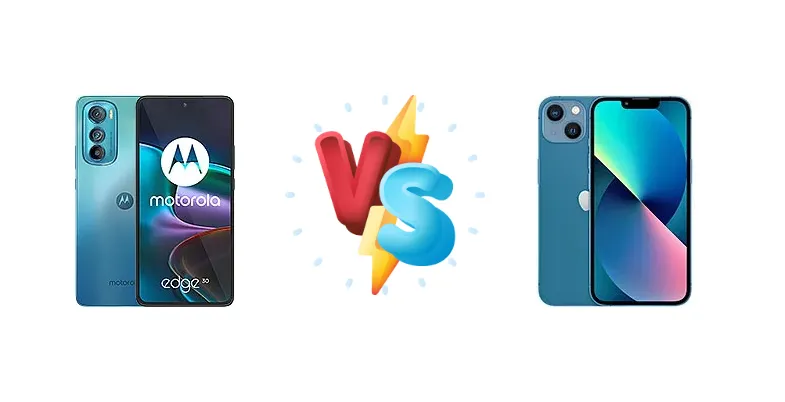
|
🏆 Quick Verdict
For the average user prioritizing long-term software support, a refined user experience, and strong resale value, the iPhone 13 remains the superior choice. However, the Motorola Edge 30 offers compelling performance and features for its price, making it an excellent option for Android enthusiasts seeking value.
| PHONES | ||
|---|---|---|
| Phone Names | Motorola Edge 30 | Apple iPhone 13 |
| Network | ||
|---|---|---|
| 2G bands | GSM 850 / 900 / 1800 / 1900 | GSM 850 / 900 / 1800 / 1900 |
| 3G bands | HSDPA 850 / 900 / 1700(AWS) / 1900 / 2100 | HSDPA 850 / 900 / 1700(AWS) / 1900 / 2100 |
| 4G bands | 1, 2, 3, 4, 5, 7, 8, 12, 13, 17, 20, 26, 28, 32, 38, 39, 40, 41, 41, 42, 43, 66 | 1, 2, 3, 4, 5, 7, 8, 12, 13, 17, 18, 19, 20, 25, 26, 28, 30, 32, 34, 38, 39, 40, 41, 42, 46, 48, 66 - A2633, A2634, A2635 |
| 5G bands | 1, 2, 3, 5, 7, 8, 20, 28, 38, 40, 41, 66, 78 SA/NSA/Sub6 | 1, 2, 3, 5, 7, 8, 12, 20, 25, 28, 29, 30, 38, 40, 41, 48, 66, 71, 77, 78, 79 Sub6/mmWave - A2633 |
| Speed | HSPA, LTE, 5G | HSPA, LTE, 5G, EV-DO Rev.A 3.1 Mbps |
| Technology | GSM / HSPA / LTE / 5G | GSM / CDMA / HSPA / EVDO / LTE / 5G |
| - | 1, 2, 3, 5, 7, 8, 12, 20, 25, 28, 30, 38, 40, 41, 48, 66, 77, 78, 79 SA/NSA/Sub6 - A2634, A2635 | |
| Launch | ||
|---|---|---|
| Announced | 2022, April 27 | 2021, September 14 |
| Status | Available. Released 2022, May 12 | Available. Released 2021, September 24 |
| Body | ||
|---|---|---|
| Build | Glass front (Gorilla Glass 3), plastic frame, plastic back | Glass front, glass back, aluminum frame |
| Dimensions | 159.4 x 74.2 x 6.8 mm (6.28 x 2.92 x 0.27 in) | 146.7 x 71.5 x 7.7 mm (5.78 x 2.81 x 0.30 in) |
| SIM | · Nano-SIM· Nano-SIM + Nano-SIM | · Nano-SIM + eSIM· Nano-SIM + Nano-SIM |
| Weight | 155 g (5.47 oz) | 174 g (6.14 oz) |
| Water-repellent design | IP68 dust/water resistant (up to 6m for 30 min) Apple Pay (Visa, MasterCard, AMEX certified) | |
| Display | ||
|---|---|---|
| Protection | Corning Gorilla Glass 3 | Ceramic Shield glass |
| Resolution | 1080 x 2400 pixels, 20:9 ratio (~405 ppi density) | 1170 x 2532 pixels, 19.5:9 ratio (~460 ppi density) |
| Size | 6.5 inches, 102.0 cm2 (~86.2% screen-to-body ratio) | 6.1 inches, 90.2 cm2 (~86.0% screen-to-body ratio) |
| Type | AMOLED, 1B colors, 144Hz, HDR10+ | Super Retina XDR OLED, HDR10, Dolby Vision, 800 nits (HBM), 1200 nits (peak) |
| Platform | ||
|---|---|---|
| CPU | Octa-core (1x2.5 GHz Cortex-A78 & 3x2.4 GHz Cortex-A78 & 4x1.9 GHz Cortex-A55) | Hexa-core (2x3.23 GHz Avalanche + 4x1.82 GHz Blizzard) |
| Chipset | Qualcomm SM7325-AE Snapdragon 778G+ 5G (6 nm) | Apple A15 Bionic (5 nm) |
| GPU | Adreno 642L | Apple GPU (4-core graphics) |
| OS | Android 12, upgradable to Android 14 | iOS 15, upgradable to iOS 26.1 |
| Memory | ||
|---|---|---|
| Card slot | No | No |
| Internal | 128GB 6GB RAM, 128GB 8GB RAM, 256GB 8GB RAM | 128GB 4GB RAM, 256GB 4GB RAM, 512GB 4GB RAM |
| - | NVMe | |
| Main Camera | ||
|---|---|---|
| Dual | - | 12 MP, f/1.6, 26mm (wide), 1/1.9", 1.7µm, dual pixel PDAF, sensor-shift OIS 12 MP, f/2.4, 120˚, 13mm (ultrawide), 1/3.4", 1.0µm |
| Features | Dual-LED flash, HDR, panorama | Dual-LED dual-tone flash, HDR (photo/panorama) |
| Single | - | 12 MP, f/2.2, 23mm (wide), 1/3.6" SL 3D, (depth/biometrics sensor) |
| Triple | 50 MP, f/1.8, (wide), 1/1.55", 1.0µm, multi-directional PDAF, OIS 50 MP, f/2.2, 118˚ (ultrawide), 1/2.76", 0.64µm, PDAF Auxiliary lens | - |
| Video | 4K@30fps, 1080p@30/60/120fps, 720p@960fps, HDR10, gyro-EIS | 4K@24/25/30/60fps, 1080p@25/30/60/120/240fps, HDR, Dolby Vision HDR (up to 60fps), stereo sound rec. |
| Selfie camera | ||
|---|---|---|
| Features | HDR | HDR |
| Single | 32 MP, f/2.3, (wide), 0.7µm | 12 MP, f/2.2, 23mm (wide), 1/3.6", 1.0µm SL 3D, (depth/biometrics sensor) |
| Video | 4K@30fps, 1080p@30/120fps | 4K@24/25/30/60fps, 1080p@25/30/60/120fps, gyro-EIS |
| Sound | ||
|---|---|---|
| 3.5mm jack | No | No |
| 35mm jack | No | No |
| Loudspeaker | Yes, with stereo speakers | Yes, with stereo speakers |
| Comms | ||
|---|---|---|
| Bluetooth | 5.2, A2DP, LE, aptX HD, aptX Adaptive | 5.0, A2DP, LE |
| NFC | Yes | Yes |
| Positioning | GPS, GLONASS, BDS, GALILEO | GPS, GLONASS, GALILEO, BDS, QZSS |
| Radio | No | No |
| USB | USB Type-C 2.0 | Lightning, USB 2.0 |
| WLAN | Wi-Fi 802.11 a/b/g/n/ac/6e, dual-band, Wi-Fi Direct | Wi-Fi 802.11 a/b/g/n/ac/6, dual-band, hotspot |
| Features | ||
|---|---|---|
| Sensors | Fingerprint (under display, optical), accelerometer, gyro, proximity, compass | Face ID, accelerometer, gyro, proximity, compass, barometer |
| - | Ultra Wideband (UWB) support | |
| Battery | ||
|---|---|---|
| Charging | 33W wired | Wired, PD2.0, 50% in 30 min 15W wireless (MagSafe) 15W wireless (Qi2) - requires iOS 17.2 update |
| Type | Li-Po 4020 mAh | Li-Ion 3240 mAh (12.41 Wh) |
| Misc | ||
|---|---|---|
| Colors | Meteor Grey, Supermoon Silver, Aurora Green | Starlight, Midnight, Blue, Pink, Red, Green |
| Models | XT2203-1 | A2633, A2482, A2631, A2634, A2635, iphone14,5 |
| Price | $ 529.00 / € 168.00 | € 304.00 / $ 249.97 / £ 248.00 |
| SAR | - | 1.18 W/kg (head) 1.19 W/kg (body) |
| SAR EU | - | 0.99 W/kg (head) 0.98 W/kg (body) |
| Tests | ||
|---|---|---|
| Battery life | - | Endurance rating 89h |
| Camera | - | Photo / Video |
| Display | - | Contrast ratio: Infinite (nominal) |
| Loudspeaker | - | -25.5 LUFS (Very good) |
| Performance | - | AnTuTu: 775519 (v9) GeekBench: 4645 (v5.1) GFXBench: 59fps (ES 3.1 onscreen) |
Motorola Edge 30
- More affordable price point
- Potentially faster wired charging (33W)
- Likely higher display refresh rate (144Hz)
- Less powerful processor (Snapdragon 778G+ vs A15 Bionic)
- Shorter software support lifespan
- Less refined user experience
Apple iPhone 13
- Superior performance (A15 Bionic)
- Long-term software support
- Excellent camera quality and video recording
- Higher price
- Slower wired charging (compared to Edge 30)
- Standard 60Hz display
Display Comparison
The iPhone 13 boasts a measured peak brightness of 802 nits, ensuring excellent visibility even in bright sunlight. While the Edge 30’s display specs aren’t provided, its likely OLED panel will offer vibrant colors. The iPhone 13’s infinite (nominal) contrast ratio delivers deep blacks and a more immersive viewing experience. The Edge 30’s refresh rate is likely higher, potentially 144Hz, offering smoother scrolling and animations compared to the iPhone 13’s standard 60Hz. This difference will be most noticeable during gaming and fast-paced content consumption.
Camera Comparison
Both devices offer capable camera systems, but approach image processing differently. The iPhone 13’s camera excels in computational photography, delivering consistently accurate colors and excellent dynamic range. While sensor sizes aren’t specified, Apple’s image processing pipeline is renowned for its natural-looking results. The Edge 30’s camera performance will depend heavily on its software algorithms. Without specific sensor details, it’s difficult to assess its low-light capabilities. The iPhone 13’s video recording capabilities are also superior, offering cinematic mode and ProRes video recording (on higher storage models).
Performance
Apple’s A15 Bionic, fabricated on a 5nm process, significantly outperforms the Motorola Edge 30’s Snapdragon 778G+ (6nm). The A15’s hexa-core CPU, with its 3.23 GHz Avalanche cores, provides substantially higher single-core performance, crucial for responsive app launches and demanding tasks. While the Snapdragon 778G+ is a capable chip, its octa-core configuration, with a peak clock speed of 2.5 GHz, cannot match the A15’s raw processing power. The iPhone 13 benefits from Apple’s optimized software and hardware integration, resulting in smoother multitasking and sustained performance under load. The Edge 30 will handle everyday tasks and most games well, but may exhibit more noticeable slowdowns with graphically intensive applications.
Battery Life
Both the Motorola Edge 30 and iPhone 13 achieve an endurance rating of 89 hours, suggesting comparable overall battery life. However, their charging approaches differ significantly. The iPhone 13 supports 50% charge in 30 minutes with wired PD2.0 charging, 15W wireless charging with MagSafe, and 15W wireless charging with Qi2 (requiring iOS 17.2). The Edge 30 offers 33W wired charging, potentially providing a faster full charge, but lacks the convenience of wireless charging options. The iPhone 13’s optimized power management and efficient A15 Bionic contribute to its impressive endurance despite a potentially smaller battery capacity.
Buying Guide
Buy the Motorola Edge 30 if you need a versatile Android phone with a smooth 144Hz display, fast charging, and don't mind potentially shorter software support. It's ideal for media consumption and casual gaming. Buy the Apple iPhone 13 if you prioritize a seamless user experience, exceptional camera quality, long-term software updates, and integration with the Apple ecosystem, even if it means paying a premium.