
Motorola Edge 30 Ultra vs Edge 40: The Ultimate Showdown
| Phones Images | |||||
|---|---|---|---|---|---|
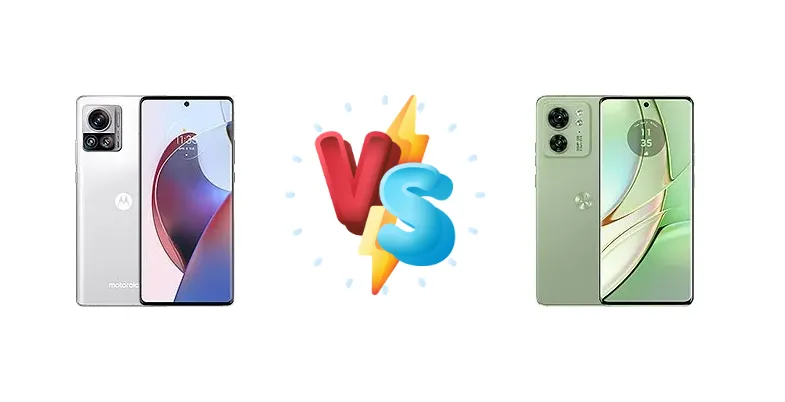
|
🏆 Quick Verdict
The Edge 30 Ultra offers flagship-level performance with its Snapdragon 8+ Gen 1 and a higher-resolution main camera. However, the Edge 40 provides slightly better battery life and a more streamlined design, making it a compelling choice for those prioritizing efficiency and a modern aesthetic. It's a close call!
| PHONES | ||
|---|---|---|
| Phone Names | Motorola Edge 30 Ultra | Motorola Edge 40 |
| Network | ||
|---|---|---|
| 2G bands | GSM 850 / 900 / 1800 / 1900 | GSM 850 / 900 / 1800 / 1900 |
| 3G bands | HSDPA 850 / 900 / 1700(AWS) / 1900 / 2100 | HSDPA 850 / 900 / 1700(AWS) / 1900 / 2100 |
| 4G bands | 1, 2, 3, 4, 5, 7, 8, 12, 13, 17, 18, 19, 20, 25, 26, 28, 32, 34, 38, 39, 40, 41, 42, 43, 48, 66 | 1, 2, 3, 4, 5, 7, 8, 12, 13, 17, 20, 26, 28, 32, 38, 39, 40, 41, 42, 43, 66 |
| 5G bands | 1, 2, 3, 5, 7, 8, 20, 28, 38, 40, 41, 66, 77, 78 SA/NSA/Sub6 | 1, 2, 3, 5, 7, 8, 20, 28, 38, 40, 41, 66, 77, 78 SA/NSA/Sub6 |
| Speed | HSPA, LTE, 5G | HSPA, LTE, 5G |
| Technology | GSM / HSPA / LTE / 5G | GSM / HSPA / LTE / 5G |
| Launch | ||
|---|---|---|
| Announced | 2022, September 08 | 2023, May 04 |
| Status | Available. Released 2022, September 08 | Available. Released 2023, May 04 |
| Body | ||
|---|---|---|
| Build | Glass front (Gorilla Glass 5), glass back (Gorilla Glass 5), aluminum frame | Glass front, aluminum frame, plastic back or eco leather back |
| Dimensions | 161.8 x 73.5 x 8.4 mm (6.37 x 2.89 x 0.33 in) | 158.4 x 72 x 7.6 mm (6.24 x 2.83 x 0.30 in) |
| SIM | · Nano-SIM· Nano-SIM + Nano-SIM | · Nano-SIM· Nano-SIM + eSIM· Nano-SIM + Nano-SIM |
| Weight | 198.5 g (7.02 oz) | 167 g or 171 g (5.89 oz) |
| - | IP68 dust/water resistant (up to 1.5m for 30 min) | |
| Display | ||
|---|---|---|
| Protection | Corning Gorilla Glass 5 | - |
| Resolution | 1080 x 2400 pixels, 20:9 ratio (~395 ppi density) | 1080 x 2400 pixels, 20:9 ratio (~402 ppi density) |
| Size | 6.67 inches, 107.4 cm2 (~90.3% screen-to-body ratio) | 6.55 inches, 103.6 cm2 (~90.8% screen-to-body ratio) |
| Type | P-OLED, 1B colors, 144Hz, HDR10+, 1250 nits (peak) | P-OLED, 144Hz, HDR10+, 1200 nits (peak) |
| Platform | ||
|---|---|---|
| CPU | Octa-core (1x3.19 GHz Cortex-X2 & 3x2.75 GHz Cortex-A710 & 4x1.80 GHz Cortex-A510) | Octa-core (4x2.6 GHz Cortex-A78 & 4x2.0 GHz Cortex-A55) |
| Chipset | Qualcomm SM8475 Snapdragon 8+ Gen 1 (4 nm) | Mediatek Dimensity 8020 (6 nm) |
| GPU | Adreno 730 | Mali-G77 MC9 |
| OS | Android 12, upgradable to Android 15 | Android 13, up to 2 major Android upgrades |
| Memory | ||
|---|---|---|
| Card slot | No | No |
| Internal | 128GB 8GB RAM, 256GB 8GB RAM, 256GB 12GB RAM, 512GB 12GB RAM | 128GB 8GB RAM, 256GB 8GB RAM |
| UFS 3.1 | UFS 3.1 | |
| Main Camera | ||
|---|---|---|
| Dual | - | 50 MP, f/1.4, (wide), 1/1.55", 1.0µm, multi-directional PDAF, OIS 13 MP, f/2.2, 120˚ (ultrawide), 1/3.0", 1.12µm, AF |
| Features | Dual-LED dual-tone flash, panorama, HDR | Dual-LED flash, HDR, panorama |
| Triple | 200 MP, f/1.9, (wide), 1/1.22", 0.64µm, PDAF, OIS 12 MP, f/1.6, (telephoto), 1.22µm, PDAF, 2x optical zoom 50 MP, f/2.2, 114˚ (ultrawide), 1/2.76", 0.64µm | - |
| Video | 8K@30fps, 4K@30/60fps, 1080p@30/60/120/320/960fps, gyro-EIS, HDR10+ | 4K@30fps, 1080p@30/60/120fps, 720p@960fps, HDR10, gyro-EIS |
| Selfie camera | ||
|---|---|---|
| Features | HDR | HDR |
| Single | 60 MP, f/2.2, (wide), 1/2.8", 0.61µm | 32 MP, f/2.4, (wide), 1/3.0", 0.7µm |
| Video | 4K@30fps, 1080p@30fps | 4K@30fps, 1080p@30/120fps |
| Sound | ||
|---|---|---|
| 3.5mm jack | No | No |
| 35mm jack | No | No |
| Loudspeaker | Yes, with stereo speakers | Yes, with stereo speakers |
| Comms | ||
|---|---|---|
| Bluetooth | 5.2, A2DP, LE | 5.2, A2DP, LE |
| NFC | Yes | Yes |
| Positioning | GPS (L1+L5), GLONASS, BDS, GALILEO | GPS, GLONASS, GALILEO, BDS |
| Radio | No | No |
| USB | USB Type-C 3.1, OTG, DisplayPort 1.4 | USB Type-C 2.0, OTG |
| WLAN | Wi-Fi 802.11 a/b/g/n/ac/6e, tri-band, Wi-Fi Direct - InternationalWi-Fi 802.11 a/b/g/n/ac/6, dual-band, Wi-Fi Direct - PRC | Wi-Fi 802.11 a/b/g/n/ac/6e, tri-band, Wi-Fi Direct |
| Features | ||
|---|---|---|
| Sensors | Fingerprint (under display, optical), accelerometer, gyro, proximity, compass | Fingerprint (under display, optical), accelerometer, gyro, proximity, compass |
| Ready For support | Moto Ready For support | |
| Battery | ||
|---|---|---|
| Charging | 125W wired 50W wireless 10W reverse wireless | 68W wired 15W wireless |
| Type | Li-Po 4610 mAh | Li-Po 4400 mAh |
| Misc | ||
|---|---|---|
| Colors | Interstellar Black, Starlight White | Nebula Green, Lunar Blue, Eclipse Black, Viva Magenta |
| Models | XT-2201 | XT2303-2 |
| Price | € 238.91 | € 202.03 / $ 419.99 / £ 199.00 / ₹ 29,999 |
| Tests | ||
|---|---|---|
| Battery life | Endurance rating 92h | Endurance rating 98h |
| Camera | Photo / Video | Photo / Video |
| Display | Contrast ratio: Infinite (nominal) | Contrast ratio: Infinite (nominal) |
| Loudspeaker | -23.4 LUFS (Very good) | -24.2 LUFS (Very good) |
| Performance | AnTuTu: 1074722 (v9) GeekBench: 4265 (v5.1) GFXBench: 73fps (ES 3.1 onscreen) | AnTuTu: 688347 (v9) GeekBench: 3320 (v5.1), 3603 (v6) GFXBench: 33fps (ES 3.1 onscreen) |
Motorola Edge 30 Ultra
- Flagship Performance (Snapdragon 8+ Gen 1)
- Exceptional 200MP Camera
- Blazing-Fast 125W Charging
- High Brightness Display
- Larger and Heavier Design
- Slightly Lower Battery Life
- Potentially Overkill for Casual Users
Motorola Edge 40
- Excellent Battery Life
- Stylish and Slim Design
- Smooth 144Hz Display
- Competitive Price
- Less Powerful Chipset
- Lower Resolution Camera
- Slower Charging Speed
Display Comparison
Both phones feature vibrant OLED displays with a 144Hz refresh rate and impressive peak brightness (1047 nits vs 1043 nits – a negligible difference). The Edge 40's display might have slightly better color accuracy due to its more recent panel technology, but both offer excellent viewing experiences. The Edge 30 Ultra's larger size might be preferable for media consumption.
Camera Comparison
The Edge 30 Ultra boasts a 200MP main camera, a significant upgrade over the Edge 40's 50MP sensor. While megapixels aren't everything, the Ultra's larger sensor allows for more detail and better low-light performance. Both phones offer capable ultrawide and macro lenses, but the Ultra's main camera is the clear winner.
Performance
The Edge 30 Ultra's Snapdragon 8+ Gen 1 chipset is significantly more powerful than the Edge 40's Dimensity 8020. Expect noticeably faster app loading times, smoother multitasking, and superior gaming performance on the Ultra. The Dimensity 8020 is still capable, but it doesn't match the Ultra's raw power.
Battery Life
The Edge 40 edges out the Edge 30 Ultra in battery endurance, achieving a slightly higher endurance rating (98h vs 92h). While both offer all-day battery life, the Edge 40's efficiency gives it a slight advantage. The Edge 30 Ultra's 125W charging is significantly faster than the Edge 40's 68W, allowing for incredibly quick top-ups.
Buying Guide
Who should buy the Motorola Edge 30 Ultra? Power users and photography enthusiasts who demand top-tier performance and a versatile camera system. Who should buy the Motorola Edge 40? Users seeking a stylish, efficient phone with excellent battery life and a smooth user experience, without breaking the bank.