
Motorola Edge 30 Pro vs Edge 40 Pro: The Ultimate Showdown
| Phones Images | |||||
|---|---|---|---|---|---|
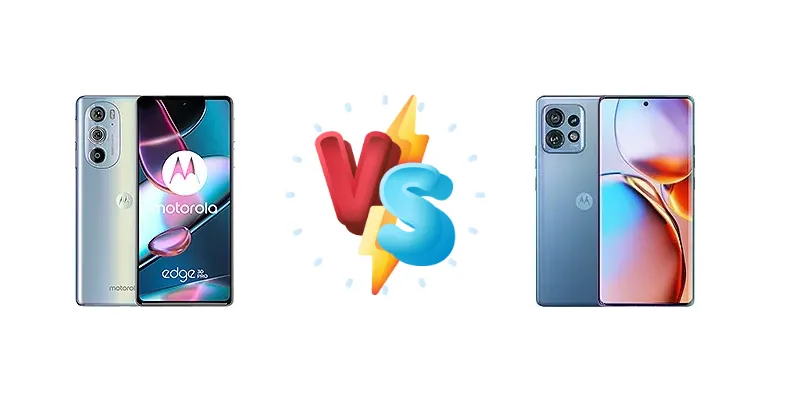
|
🏆 Quick Verdict
The Motorola Edge 40 Pro is the clear winner, offering a significantly faster processor, dramatically quicker charging, a brighter display, and improved battery life. While the 30 Pro remains a capable device, the 40 Pro's upgrades make it a worthwhile investment for most users.
| PHONES | ||
|---|---|---|
| Phone Names | Motorola Edge 30 Pro | Motorola Edge 40 Pro |
| Network | ||
|---|---|---|
| 2G bands | GSM 850 / 900 / 1800 / 1900 | GSM 850 / 900 / 1800 / 1900 |
| 3G bands | HSDPA 850 / 900 / 1700(AWS) / 1900 / 2100 | HSDPA 850 / 900 / 1700(AWS) / 1900 / 2100 |
| 4G bands | 1, 2, 3, 4, 5, 7, 8, 12, 13, 17, 18, 19, 20, 25, 26, 28, 32, 38, 39, 40, 41, 42, 43, 48, 66 - International | 1, 2, 3, 4, 5, 7, 8, 12, 13, 17, 18, 19, 20, 25, 26, 28, 32, 38, 39, 40, 41, 42, 43, 48, 66 |
| 5G bands | 1, 3, 5, 7, 8, 20, 28, 38, 40, 41, 66, 77, 78 SA/NSA/Sub6 - International | 1, 2, 3, 5, 7, 8, 20, 28, 38, 40, 41, 66, 77, 78 SA/NSA/Sub6 |
| Speed | HSPA 42.2/5.76 Mbps, LTE Cat20 2000/150 Mbps, 5G | HSPA, LTE, 5G |
| Technology | GSM / HSPA / LTE / 5G | GSM / HSPA / LTE / 5G |
| 2, 5, 7, 12, 25, 26, 29, 30, 41, 48, 66, 71, 77, 78, 260, 261 SA/NSA/Sub6/mmWave - USA | - | |
| Launch | ||
|---|---|---|
| Announced | 2022, January 24 | 2023, April 04 |
| Status | Available. Released 2022, March 04 | Available. Released 2023, April 04 |
| Body | ||
|---|---|---|
| Build | Glass front (Gorilla Glass 3), glass back (Gorilla Glass 5), plastic frame | Glass front (Gorilla Glass Victus), glass back (Gorilla Glass Victus), aluminum frame |
| Dimensions | 163.1 x 76 x 8.8 mm (6.42 x 2.99 x 0.35 in) | 161.2 x 74 x 8.6 mm (6.35 x 2.91 x 0.34 in) |
| SIM | · Nano-SIM· Nano-SIM + Nano-SIM | Nano-SIM + eSIM |
| Weight | 196 g (6.91 oz) | 199 g (7.02 oz) |
| Water-repellent design | IP68 dust/water resistant (up to 1.5m for 30 min) | |
| Display | ||
|---|---|---|
| Protection | Corning Gorilla Glass 3 | Corning Gorilla Glass Victus |
| Resolution | 1080 x 2400 pixels, 20:9 ratio (~393 ppi density) | 1080 x 2400 pixels, 20:9 ratio (~394 ppi density) |
| Size | 6.7 inches, 108.4 cm2 (~87.4% screen-to-body ratio) | 6.67 inches, 108.0 cm2 (~90.5% screen-to-body ratio) |
| Type | OLED, 1B colors, 144Hz, HDR10+ | OLED, 1B colors, 165Hz, HDR10+, Dolby Vision, 1300 nits (peak) |
| Always-on display | - | |
| Platform | ||
|---|---|---|
| CPU | Octa-core (1x3.00 GHz Cortex-X2 & 3x2.50 GHz Cortex-A710 & 4x1.80 GHz Cortex-A510) | Octa-core (1x3.2 GHz Cortex-X3 & 2x2.8 GHz Cortex-A715 & 2x2.8 GHz Cortex-A710 & 3x2.0 GHz Cortex-A510) |
| Chipset | Qualcomm SM8450 Snapdragon 8 Gen 1 (4 nm) | Qualcomm SM8550-AB Snapdragon 8 Gen 2 (4 nm) |
| GPU | Adreno 730 | Adreno 740 |
| OS | Android 12, upgradable to Android 14 | Android 13, up to 3 major Android upgrades |
| Memory | ||
|---|---|---|
| Card slot | No | No |
| Internal | 128GB 8GB RAM, 256GB 8GB RAM, 256GB 12GB RAM, 512GB 8GB RAM, 512GB 12GB RAM | 256GB 12GB RAM, 512GB 12GB RAM |
| UFS 3.1 | UFS 4.0 | |
| Main Camera | ||
|---|---|---|
| Features | Dual-LED dual-tone flash, HDR, panorama | Dual-LED flash, panorama, HDR |
| Triple | 50 MP, f/1.8, (wide), 1/1.55", 1.0µm, multi-directional PDAF, OIS 50 MP, f/2.2, 114˚ (ultrawide), 1/2.76", 0.64µm, AF Auxiliary lens | 50 MP, f/1.8, (wide), 1/1.55", 1.0µm, multi-directional PDAF, OIS 12 MP, f/1.6, (telephoto), 1/2.93", 1.22µm, PDAF, 2x optical zoom 50 MP, f/2.2, 114˚ (ultrawide), 1/2.76", 0.64µm, AF |
| Video | 8K@24/30fps, 4K@30/60fps, 1080p@30/60/120/240/960fps, 10-bit HDR10+, gyro-EIS | 8K@30fps, 4K@30/60fps, 1080p@30/60/120/240/960fps, 10-bit HDR10+, gyro-EIS |
| Selfie camera | ||
|---|---|---|
| Features | HDR | HDR |
| Single | 60 MP, f/2.2, (wide), 1/2.8", 0.61µm | 60 MP, f/2.2, (wide), 1/2.8", 0.61µm |
| Video | 4K@30fps, 1080p@30/120fps | 4K@30/60fps, 1080p@30/60fps |
| Sound | ||
|---|---|---|
| 3.5mm jack | No | No |
| 35mm jack | No | No |
| Loudspeaker | Yes, with stereo speakers | Yes, with stereo speakers |
| 24-bit/192kHz audio | - | |
| Comms | ||
|---|---|---|
| Bluetooth | 5.2, A2DP, LE, aptX HD, aptX Adaptive | 5.3, A2DP, LE |
| NFC | Yes | Yes |
| Positioning | GPS (L1+L5), GLONASS, BDS, GALILEO | GPS, GLONASS, GALILEO, BDS |
| Radio | No | No |
| USB | USB Type-C 3.1, DisplayPort 1.4 | USB Type-C 3.2, OTG, DisplayPort 1.4 |
| WLAN | Wi-Fi 802.11 a/b/g/n/ac/6e, dual-band, Wi-Fi Direct | Wi-Fi 802.11 a/b/g/n/ac/6e/7, tri-band, Wi-Fi Direct |
| Features | ||
|---|---|---|
| Sensors | Fingerprint (side-mounted), accelerometer, gyro, proximity, compass, barometer | Fingerprint (under display, optical), accelerometer, gyro, proximity, compass |
| Ready For support | Ready For 3.5 support | |
| Battery | ||
|---|---|---|
| Charging | 68W wired, 50% in 15 min, 100% in 35 min 15W wireless 5W reverse wireless | 125W wired, PD3.0, QC5, 50% in 6 min, 100% in 23 min 15W wireless 5W reverse wired 5W reverse wireless |
| Type | Li-Po 4800 mAh | Li-Po 4600 mAh |
| Misc | ||
|---|---|---|
| Colors | Cosmos Blue, Stardust White | Interstellar Black, Lunar Blue |
| Models | XT2201-1 | - |
| Price | € 475.45 | € 313.87 |
| Tests | ||
|---|---|---|
| Battery life | Endurance rating 80h | Endurance rating 117h |
| Camera | Photo / Video | Photo / Video |
| Display | Contrast ratio: Infinite (nominal) | Contrast ratio: Infinite (nominal) |
| Loudspeaker | -24.2 LUFS (Very good) | -22.6 LUFS (Excellent) |
| Performance | AnTuTu: 941895 (v9) GeekBench: 3658 (v5.1) GFXBench: 78fps (ES 3.1 onscreen) | AnTuTu: 1273764 (v9) GeekBench: 4896 (v5.1), 5352 (v6) GFXBench: 112fps (ES 3.1 onscreen) |
Motorola Edge 30 Pro
- Good value for money
- Capable performance
- Decent camera
- Wireless charging
- Older chipset
- Slower charging
- Lower brightness display
- Less battery life
Motorola Edge 40 Pro
- Blazing-fast charging (125W)
- Brighter display (1050 nits)
- Improved performance (Snapdragon 8 Gen 2)
- Excellent battery life
- Premium design
- Potentially higher price
- Reverse wireless charging is wired
Display Comparison
The Edge 40 Pro boasts a substantial upgrade in display brightness, reaching 1050 nits compared to the 30 Pro's 685 nits. Both offer excellent contrast ratios (infinite nominal), but the 40 Pro's increased brightness makes it significantly better for outdoor visibility. Both utilize OLED technology for vibrant colors and deep blacks.
Camera Comparison
While both phones offer capable camera systems, the Edge 40 Pro likely benefits from software optimizations and potentially a slightly improved sensor. Both offer excellent photo and video capabilities, but the 40 Pro's processing might result in slightly better image quality, especially in challenging lighting conditions. Specific camera specs (megapixels, aperture) would need further investigation for a definitive comparison.
Performance
The Snapdragon 8 Gen 2 in the Edge 40 Pro provides a considerable performance leap over the Snapdragon 8 Gen 1 in the 30 Pro. Expect smoother multitasking, faster app loading times, and improved gaming performance on the 40 Pro. The CPU architecture differences further contribute to the 40 Pro's edge.
Battery Life
The Edge 40 Pro demonstrates a significant improvement in battery endurance, achieving an impressive 117h rating compared to the 30 Pro's 80h. More importantly, the 40 Pro's 125W wired charging is a game-changer, allowing for a full charge in just 23 minutes, a stark contrast to the 30 Pro's 35 minutes.
Buying Guide
Who should buy the Motorola Edge 30 Pro? It's a good option for budget-conscious buyers who still want a flagship experience and don't need the absolute latest and greatest. Who should buy the Motorola Edge 40 Pro? Those seeking top-tier performance, blazing-fast charging, and a brighter, more vibrant display will find the 40 Pro to be the superior choice.