
Motorola Edge 30 Pro vs. Edge 30 Ultra: The Ultimate Showdown
| Phones Images | |||||
|---|---|---|---|---|---|
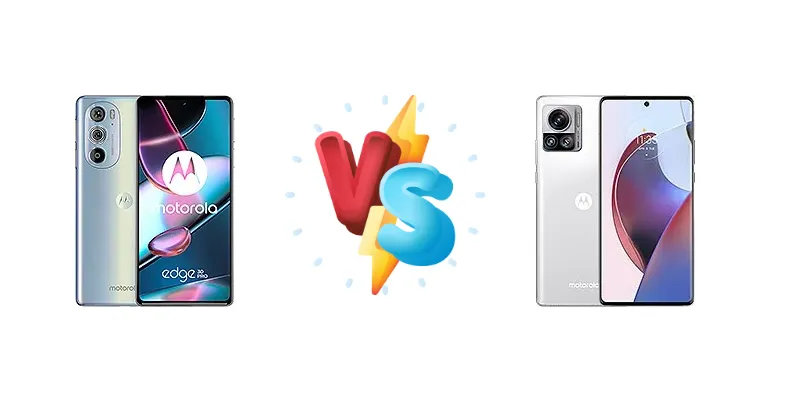
|
🏆 Quick Verdict
The Motorola Edge 30 Ultra emerges as the clear winner, boasting a significantly brighter display, faster charging, and a more powerful chipset. While the Edge 30 Pro remains a capable device, the Ultra's upgrades justify its higher price for users prioritizing performance and camera quality.
| PHONES | ||
|---|---|---|
| Phone Names | Motorola Edge 30 Pro | Motorola Edge 30 Ultra |
| Network | ||
|---|---|---|
| 2G bands | GSM 850 / 900 / 1800 / 1900 | GSM 850 / 900 / 1800 / 1900 |
| 3G bands | HSDPA 850 / 900 / 1700(AWS) / 1900 / 2100 | HSDPA 850 / 900 / 1700(AWS) / 1900 / 2100 |
| 4G bands | 1, 2, 3, 4, 5, 7, 8, 12, 13, 17, 18, 19, 20, 25, 26, 28, 32, 38, 39, 40, 41, 42, 43, 48, 66 - International | 1, 2, 3, 4, 5, 7, 8, 12, 13, 17, 18, 19, 20, 25, 26, 28, 32, 34, 38, 39, 40, 41, 42, 43, 48, 66 |
| 5G bands | 1, 3, 5, 7, 8, 20, 28, 38, 40, 41, 66, 77, 78 SA/NSA/Sub6 - International | 1, 2, 3, 5, 7, 8, 20, 28, 38, 40, 41, 66, 77, 78 SA/NSA/Sub6 |
| Speed | HSPA 42.2/5.76 Mbps, LTE Cat20 2000/150 Mbps, 5G | HSPA, LTE, 5G |
| Technology | GSM / HSPA / LTE / 5G | GSM / HSPA / LTE / 5G |
| 2, 5, 7, 12, 25, 26, 29, 30, 41, 48, 66, 71, 77, 78, 260, 261 SA/NSA/Sub6/mmWave - USA | - | |
| Launch | ||
|---|---|---|
| Announced | 2022, January 24 | 2022, September 08 |
| Status | Available. Released 2022, March 04 | Available. Released 2022, September 08 |
| Body | ||
|---|---|---|
| Build | Glass front (Gorilla Glass 3), glass back (Gorilla Glass 5), plastic frame | Glass front (Gorilla Glass 5), glass back (Gorilla Glass 5), aluminum frame |
| Dimensions | 163.1 x 76 x 8.8 mm (6.42 x 2.99 x 0.35 in) | 161.8 x 73.5 x 8.4 mm (6.37 x 2.89 x 0.33 in) |
| SIM | · Nano-SIM· Nano-SIM + Nano-SIM | · Nano-SIM· Nano-SIM + Nano-SIM |
| Weight | 196 g (6.91 oz) | 198.5 g (7.02 oz) |
| Water-repellent design | - | |
| Display | ||
|---|---|---|
| Protection | Corning Gorilla Glass 3 | Corning Gorilla Glass 5 |
| Resolution | 1080 x 2400 pixels, 20:9 ratio (~393 ppi density) | 1080 x 2400 pixels, 20:9 ratio (~395 ppi density) |
| Size | 6.7 inches, 108.4 cm2 (~87.4% screen-to-body ratio) | 6.67 inches, 107.4 cm2 (~90.3% screen-to-body ratio) |
| Type | OLED, 1B colors, 144Hz, HDR10+ | P-OLED, 1B colors, 144Hz, HDR10+, 1250 nits (peak) |
| Always-on display | - | |
| Platform | ||
|---|---|---|
| CPU | Octa-core (1x3.00 GHz Cortex-X2 & 3x2.50 GHz Cortex-A710 & 4x1.80 GHz Cortex-A510) | Octa-core (1x3.19 GHz Cortex-X2 & 3x2.75 GHz Cortex-A710 & 4x1.80 GHz Cortex-A510) |
| Chipset | Qualcomm SM8450 Snapdragon 8 Gen 1 (4 nm) | Qualcomm SM8475 Snapdragon 8+ Gen 1 (4 nm) |
| GPU | Adreno 730 | Adreno 730 |
| OS | Android 12, upgradable to Android 14 | Android 12, upgradable to Android 15 |
| Memory | ||
|---|---|---|
| Card slot | No | No |
| Internal | 128GB 8GB RAM, 256GB 8GB RAM, 256GB 12GB RAM, 512GB 8GB RAM, 512GB 12GB RAM | 128GB 8GB RAM, 256GB 8GB RAM, 256GB 12GB RAM, 512GB 12GB RAM |
| UFS 3.1 | UFS 3.1 | |
| Main Camera | ||
|---|---|---|
| Features | Dual-LED dual-tone flash, HDR, panorama | Dual-LED dual-tone flash, panorama, HDR |
| Triple | 50 MP, f/1.8, (wide), 1/1.55", 1.0µm, multi-directional PDAF, OIS 50 MP, f/2.2, 114˚ (ultrawide), 1/2.76", 0.64µm, AF Auxiliary lens | 200 MP, f/1.9, (wide), 1/1.22", 0.64µm, PDAF, OIS 12 MP, f/1.6, (telephoto), 1.22µm, PDAF, 2x optical zoom 50 MP, f/2.2, 114˚ (ultrawide), 1/2.76", 0.64µm |
| Video | 8K@24/30fps, 4K@30/60fps, 1080p@30/60/120/240/960fps, 10-bit HDR10+, gyro-EIS | 8K@30fps, 4K@30/60fps, 1080p@30/60/120/320/960fps, gyro-EIS, HDR10+ |
| Selfie camera | ||
|---|---|---|
| Features | HDR | HDR |
| Single | 60 MP, f/2.2, (wide), 1/2.8", 0.61µm | 60 MP, f/2.2, (wide), 1/2.8", 0.61µm |
| Video | 4K@30fps, 1080p@30/120fps | 4K@30fps, 1080p@30fps |
| Sound | ||
|---|---|---|
| 3.5mm jack | No | No |
| 35mm jack | No | No |
| Loudspeaker | Yes, with stereo speakers | Yes, with stereo speakers |
| 24-bit/192kHz audio | - | |
| Comms | ||
|---|---|---|
| Bluetooth | 5.2, A2DP, LE, aptX HD, aptX Adaptive | 5.2, A2DP, LE |
| NFC | Yes | Yes |
| Positioning | GPS (L1+L5), GLONASS, BDS, GALILEO | GPS (L1+L5), GLONASS, BDS, GALILEO |
| Radio | No | No |
| USB | USB Type-C 3.1, DisplayPort 1.4 | USB Type-C 3.1, OTG, DisplayPort 1.4 |
| WLAN | Wi-Fi 802.11 a/b/g/n/ac/6e, dual-band, Wi-Fi Direct | Wi-Fi 802.11 a/b/g/n/ac/6e, tri-band, Wi-Fi Direct - InternationalWi-Fi 802.11 a/b/g/n/ac/6, dual-band, Wi-Fi Direct - PRC |
| Features | ||
|---|---|---|
| Sensors | Fingerprint (side-mounted), accelerometer, gyro, proximity, compass, barometer | Fingerprint (under display, optical), accelerometer, gyro, proximity, compass |
| Ready For support | Ready For support | |
| Battery | ||
|---|---|---|
| Charging | 68W wired, 50% in 15 min, 100% in 35 min 15W wireless 5W reverse wireless | 125W wired 50W wireless 10W reverse wireless |
| Type | Li-Po 4800 mAh | Li-Po 4610 mAh |
| Misc | ||
|---|---|---|
| Colors | Cosmos Blue, Stardust White | Interstellar Black, Starlight White |
| Models | XT2201-1 | XT-2201 |
| Price | € 475.45 | € 238.91 |
| Tests | ||
|---|---|---|
| Battery life | Endurance rating 80h | Endurance rating 92h |
| Camera | Photo / Video | Photo / Video |
| Display | Contrast ratio: Infinite (nominal) | Contrast ratio: Infinite (nominal) |
| Loudspeaker | -24.2 LUFS (Very good) | -23.4 LUFS (Very good) |
| Performance | AnTuTu: 941895 (v9) GeekBench: 3658 (v5.1) GFXBench: 78fps (ES 3.1 onscreen) | AnTuTu: 1074722 (v9) GeekBench: 4265 (v5.1) GFXBench: 73fps (ES 3.1 onscreen) |
Motorola Edge 30 Pro
- Excellent value
- Compact design
- Solid performance
- Fast charging (68W)
- Lower brightness display
- Older chipset
- Slower charging compared to Ultra
Motorola Edge 30 Ultra
- Brighter display (1047 nits)
- More powerful chipset (Snapdragon 8+ Gen 1)
- Faster charging (125W)
- Superior camera system
- Faster wireless charging
- Higher price
- Larger size (potentially less comfortable for some)
Display Comparison
The Edge 30 Ultra's display is a standout feature. Its 1047 nits peak brightness blows the Edge 30 Pro's 685 nits out of the water, offering significantly better visibility in direct sunlight. Both have excellent contrast ratios (infinite nominal), and smooth 144Hz refresh rates, but the Ultra's brightness advantage is undeniable. The Edge 30 Ultra also features a slightly larger display size, further enhancing the viewing experience.
Camera Comparison
The Edge 30 Ultra's camera system is a major upgrade. While both offer capable photo and video capabilities, the Ultra's higher resolution main sensor (208MP vs 50MP) allows for greater detail and flexibility in post-processing. The Ultra also typically features improved image processing algorithms, resulting in better dynamic range and low-light performance. Both phones offer excellent video recording capabilities.
Performance
The Snapdragon 8+ Gen 1 in the Edge 30 Ultra provides a noticeable performance boost over the Snapdragon 8 Gen 1 in the Edge 30 Pro. While both phones handle everyday tasks with ease, the Ultra excels in demanding games and multitasking. The improved efficiency of the 8+ Gen 1 also contributes to better battery life. Both phones have ample RAM and storage options.
Battery Life
Both phones offer impressive endurance ratings (80h and 92h respectively). However, the Edge 30 Ultra's significantly faster 125W wired charging (fully charged in 35 minutes) is a game-changer compared to the Edge 30 Pro's 68W charging (35 minutes). The Ultra also offers faster wireless charging (50W vs 15W) and reverse wireless charging (10W vs 5W).
Buying Guide
The Motorola Edge 30 Pro is ideal for users seeking a premium experience without breaking the bank. It's a great choice for those who value a compact design and solid all-around performance. The Motorola Edge 30 Ultra is for power users and photography enthusiasts who demand the best possible display, camera, and charging speeds, and are willing to pay a premium.