
Motorola Edge 30 Fusion vs Google Pixel 7: The Ultimate Showdown
| Phones Images | |||||
|---|---|---|---|---|---|
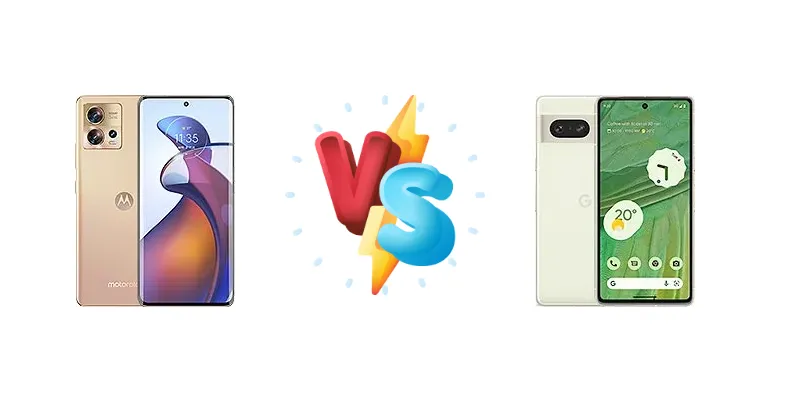
|
🏆 Quick Verdict
The Pixel 7 wins overall thanks to its superior camera processing, cleaner software experience, and faster software updates. However, the Edge 30 Fusion offers incredible value with its Snapdragon 888+ chipset and blazing-fast charging, making it a strong contender for budget-conscious buyers.
| PHONES | ||
|---|---|---|
| Phone Names | Motorola Edge 30 Fusion | Google Pixel 7 |
| Network | ||
|---|---|---|
| 2G bands | GSM 850 / 900 / 1800 / 1900 | GSM 850 / 900 / 1800 / 1900 |
| 3G bands | HSDPA 850 / 900 / 1700(AWS) / 1900 / 2100 - International | HSDPA 800 / 850 / 900 / 1700(AWS) / 1900 / 2100 |
| 4G bands | 1, 2, 3, 4, 5, 7, 8, 12, 13, 17, 18, 19, 20, 25, 26, 28, 32, 38, 39, 40, 41, 42, 43, 66 - International | 1, 2, 3, 4, 5, 7, 8, 12, 13, 14, 17, 18, 19, 20, 25, 26, 28, 29, 30, 38, 40, 41, 42, 46, 48, 66, 71 - GQML3 |
| 5G bands | 1, 3, 5, 7, 8, 20, 28, 38, 40, 41, 66, 77, 78 SA/NSA - International | 1, 2, 3, 4, 5, 7, 8, 12, 13, 14, 17, 18, 19, 20, 25, 26, 28, 29, 30, 38, 40, 41, 46, 48, 66, 71, 260, 261 SA/NSA/Sub6/mmWave - GQML3 |
| Speed | HSPA, LTE, 5G | HSPA, LTE, 5G |
| Technology | GSM / CDMA / HSPA / CDMA2000 / LTE / 5G | GSM / CDMA / HSPA / EVDO / LTE / 5G |
| 1, 2, 3, 5, 7, 8, 20, 28, 38, 41, 77, 78 SA/NSA - PRC | 1, 2, 3, 5, 7, 8, 12, 14, 20, 25, 28, 30, 38, 40, 41, 48, 66, 71, 75, 76, 77, 78 SA/NSA/Sub6 - GVU6C | |
| Launch | ||
|---|---|---|
| Announced | 2022, September 08 | 2022, October 06 |
| Status | Available. Released 2022, September 08 | Available. Released 2022, October 13 |
| Body | ||
|---|---|---|
| Build | Glass front (Gorilla Glass 5), glass back (Gorilla Glass 5), aluminum frame | Glass front (Gorilla Glass Victus), glass back (Gorilla Glass Victus), aluminum frame |
| Dimensions | 158.5 x 72 x 7.5 mm or 7.7 mm | 155.6 x 73.2 x 8.7 mm (6.13 x 2.88 x 0.34 in) |
| SIM | · Nano-SIM· Nano-SIM + Nano-SIM | Nano-SIM + eSIM |
| Weight | 168 g / 175 g (5.93 oz) | 197 g (6.95 oz) |
| Splash and dust resistant | IP68 dust/water resistant (up to 1.5m for 30 min) | |
| Display | ||
|---|---|---|
| Protection | Corning Gorilla Glass 5 | Corning Gorilla Glass Victus |
| Resolution | 1080 x 2400 pixels, 20:9 ratio (~402 ppi density) | 1080 x 2400 pixels, 20:9 ratio (~416 ppi density) |
| Size | 6.55 inches, 103.6 cm2 (~90.8% screen-to-body ratio) | 6.3 inches, 96.7 cm2 (~84.9% screen-to-body ratio) |
| Type | P-OLED, 1B colors, 144Hz, HDR10+, 1100 nits (peak) | AMOLED, 90Hz, HDR10+, 1000 nits (HBM), 1400 nits (peak) |
| - | Always-on display | |
| Platform | ||
|---|---|---|
| CPU | Octa-core (1x2.99 GHz Cortex-X1 & 3x2.42 GHz Cortex-A78 & 4x1.80 GHz Cortex-A55) | Octa-core (2x2.85 GHz Cortex-X1 & 2x2.35 GHz Cortex-A78 & 4x1.80 GHz Cortex-A55) |
| Chipset | Qualcomm SM8350 Snapdragon 888+ 5G (5 nm) | Google Tensor G2 (5 nm) |
| GPU | Adreno 660 | Mali-G710 MP7 |
| OS | Android 12, upgradable to Android 14 | Android 13, upgradable to Android 15, up to 5 major Android upgrades |
| Memory | ||
|---|---|---|
| Card slot | No | No |
| Internal | 128GB 8GB RAM, 256GB 6GB RAM, 256GB 8GB RAM, 256GB 12GB RAM, 512GB 12GB RAM | 128GB 8GB RAM, 256GB 8GB RAM |
| UFS 3.1 | UFS 3.1 | |
| Main Camera | ||
|---|---|---|
| Dual | - | 50 MP, f/1.9, 25mm (wide), 1/1.31", 1.2µm, dual pixel PDAF, OIS 12 MP, f/2.2, 114˚ (ultrawide), 1/2.9", 1.25µm |
| Features | LED flash, panorama, HDR | Laser AF, Dual-LED flash, Pixel Shift, Auto-HDR, panorama |
| Single | - | 10.8 MP, f/2.2, 21mm (ultrawide), 1/3.1", 1.22µm |
| Triple | 50 MP, f/1.8, (wide), 1/1.55", 1.0µm, multi-directional PDAF, OIS 13 MP, f/2.2, 120˚ (ultrawide), 1.12µm, AF Auxiliary lens | - |
| Video | 8K@30fps, 4K@30fps, 1080p@30/60/120fps, 720p@960fps, gyro-EIS | 4K@30/60fps, 1080p@30/60/120/240fps; gyro-EIS, OIS, 10-bit HDR |
| Selfie camera | ||
|---|---|---|
| Features | HDR | HDR, panorama |
| Single | 32 MP, f/2.5, (wide), 1/2.8", 0.8µm, AF | 10.8 MP, f/2.2, 21mm (ultrawide), 1/3.1", 1.22µm |
| Video | 4K@30fps, 1080p@30fps | 4K@30/60fps, 1080p@30/60fps |
| Sound | ||
|---|---|---|
| 3.5mm jack | No | No |
| 35mm jack | No | No |
| Loudspeaker | Yes, with stereo speakers | Yes, with stereo speakers |
| Comms | ||
|---|---|---|
| Bluetooth | 5.2, A2DP, LE, aptX HD, aptX Adaptive | 5.2, A2DP, LE, aptX HD |
| NFC | Yes | Yes |
| Positioning | GPS (L1+L5), GLONASS, BDS (B1I+B1c), GALILEO | GPS (L1+L5), GLONASS (G1), BDS (B1I+B1c+B2a), GALILEO (E1+E5a), QZSS (L1+L5) |
| Radio | No | No |
| USB | USB Type-C 3.1, OTG | USB Type-C 3.2 |
| WLAN | Wi-Fi 802.11 a/b/g/n/ac/6e, tri-band, Wi-Fi Direct | Wi-Fi 802.11 a/b/g/n/ac/6e, tri-band, Wi-Fi Direct |
| Features | ||
|---|---|---|
| Sensors | Fingerprint (under display, optical), accelerometer, gyro, proximity, compass | Fingerprint (under display, optical), accelerometer, gyro, proximity, compass, barometer |
| Ready For 3.5 support | - | |
| Battery | ||
|---|---|---|
| Charging | 68W wired, 50% in 10 min | 20W wired, PD3.0, 50% in 30 min 20W wireless Reverse wireless |
| Type | Li-Po 4400 mAh | Li-Ion 4355 mAh |
| Misc | ||
|---|---|---|
| Colors | Neptune Blue, Cosmic Grey, Solar Gold, Aurora White, Viva Magenta | Obsidian, Lemongrass, Snow |
| Models | XT2243-1 | GVU6C, GQML3, GO3Z5 |
| Price | About 150 EUR | € 199.00 / $ 179.26 / £ 189.99 / ₹ 28,499 |
| Tests | ||
|---|---|---|
| Battery life | Endurance rating 101h | Endurance rating 96h |
| Camera | Photo / Video | Photo / Video |
| Display | Contrast ratio: Infinite (nominal) | Contrast ratio: Infinite (nominal) |
| Loudspeaker | -24.6 LUFS (Very good) | -26.2 LUFS (Good) |
| Performance | AnTuTu: 827929 (v9) GeekBench: 3458 (v5.1) GFXBench: 62fps (ES 3.1 onscreen) | AnTuTu: 813114 (v9) GeekBench: 3288 (v5.1) GFXBench: 59fps (ES 3.1 onscreen) |
Motorola Edge 30 Fusion
- Blazing-fast 68W charging
- Powerful Snapdragon 888+ chipset
- Excellent value for money
- Bright and vibrant display
- Camera not as impressive as Pixel 7
- Software updates may be slower
- Design less premium than Pixel 7
Google Pixel 7
- Exceptional camera with advanced features
- Clean and smooth Android experience
- Guaranteed software updates
- Premium design
- Slower charging speed
- Tensor G2 chipset not as powerful as Snapdragon 888+ in raw performance
- Higher price point
Display Comparison
Both phones boast vibrant displays with excellent brightness. The Pixel 7 edges out the Edge 30 Fusion with a slightly higher peak brightness of 974 nits versus 946 nits, though both offer impressive outdoor visibility. Both have 'Infinite' contrast ratios, a nominal value indicating excellent contrast. The Pixel 7's display is generally considered more color-accurate out of the box.
Camera Comparison
The Google Pixel 7's camera is a major selling point. Its computational photography capabilities are unmatched, producing stunning images with excellent dynamic range and detail. The Edge 30 Fusion's camera is capable, but lacks the Pixel's sophisticated image processing. The Pixel 7 also offers features like Magic Eraser and Photo Unblur.
Performance
The Motorola Edge 30 Fusion packs a Snapdragon 888+ chipset, a powerhouse that delivers smooth performance for demanding tasks and gaming. The Pixel 7's Tensor G2 is optimized for AI and machine learning tasks, resulting in a fluid user experience and enhanced camera features. While the Snapdragon 888+ might offer a slight edge in raw processing power, the Tensor G2 excels in real-world usage and Google's ecosystem integration.
Battery Life
The Motorola Edge 30 Fusion boasts a slightly higher endurance rating (101h) compared to the Pixel 7 (96h), suggesting potentially longer battery life in typical usage. However, the Edge 30 Fusion's 68W charging is significantly faster than the Pixel 7's 20W wired charging, allowing for much quicker top-ups.
Buying Guide
The Motorola Edge 30 Fusion is ideal for users prioritizing performance and charging speed on a budget. The Google Pixel 7 is perfect for those who value a top-tier camera, a smooth Android experience, and guaranteed software updates.