
Motorola Edge (2025) vs Xiaomi 15T: A Deep Dive into Mid-Range Power
| Phones Images | |||||
|---|---|---|---|---|---|
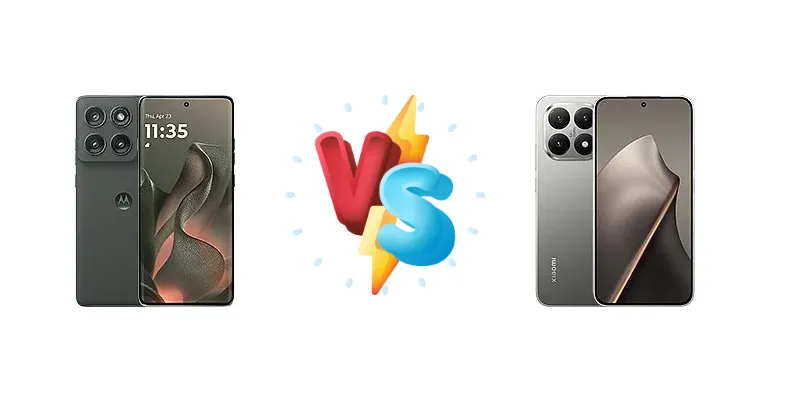
|
🏆 Quick Verdict
For the average user prioritizing longevity and consistent performance, the Xiaomi 15T emerges as the stronger contender. Its Dimensity 8400 Ultra provides a noticeable performance edge, coupled with an impressive 57:44-hour battery endurance. However, the Motorola Edge (2025) offers a compelling alternative for those seeking a more streamlined experience.
| PHONES | ||
|---|---|---|
| Phone Names | Motorola Edge (2025) | Xiaomi 15T |
| Network | ||
|---|---|---|
| 2G bands | GSM 850 / 900 / 1800 / 1900 | GSM 850 / 900 / 1800 / 1900 |
| 3G bands | HSDPA 850 / 900 / 1700(AWS) / 1900 / 2100 | HSDPA 800 / 850 / 900 / 1700(AWS) / 1900 / 2100 |
| 4G bands | 1, 2, 3, 4, 5, 7, 8, 12, 13, 14, 17, 18, 19, 20, 25, 26, 28, 29, 30, 38, 39, 40, 41, 42, 48, 66, 71 | 1, 2, 3, 4, 5, 7, 8, 12, 13, 17, 18, 19, 20, 26, 28, 32, 38, 40, 41, 42, 48, 66, 71 |
| 5G bands | 1, 2, 3, 5, 7, 12, 14, 20, 25, 26, 28, 29, 30, 38, 40, 41, 48, 66, 70, 71, 77, 78 SA/NSA/Sub6 | 1, 2, 3, 5, 7, 8, 12, 20, 26, 28, 38, 40, 41, 48, 66, 71, 75, 77, 78 SA/NSA |
| Speed | HSPA, LTE, 5G | HSPA, LTE, 5G |
| Technology | GSM / HSPA / LTE / 5G | GSM / HSPA / LTE / 5G |
| Launch | ||
|---|---|---|
| Announced | 2025, May 27 | 2025, September 24 |
| Status | Available. Released 2025, June 06 | Available. Released 2025, September 24 |
| Body | ||
|---|---|---|
| Build | - | Glass front (Gorilla Glass 7i), plastic frame, fiber-reinforced plastic back |
| Dimensions | 161.2 x 73.1 x 8 mm (6.35 x 2.88 x 0.31 in) | 163.2 x 78 x 7.5 mm (6.43 x 3.07 x 0.30 in) |
| SIM | Nano-SIM + eSIM | · Nano-SIM + Nano-SIM + eSIM + eSIM (max 2 at a time)· Nano-SIM + Nano-SIM |
| Weight | 181 g (6.38 oz) | 194 g (6.84 oz) |
| Display | ||
|---|---|---|
| Protection | Corning Gorilla Glass 7i | Corning Gorilla Glass 7i, Mohs level 6 |
| Resolution | 1220 x 2712 pixels, 20:9 ratio (~444 ppi density) | 1280 x 2772 pixels, 19.5:9 ratio (~447 ppi density) |
| Size | 6.7 inches, 108.4 cm2 (~92.0% screen-to-body ratio) | 6.83 inches, 114.5 cm2 (~90.0% screen-to-body ratio) |
| Type | P-OLED, 1B colors, 120Hz, HDR10+, 4500 nits peak | AMOLED, 68B colors, 120Hz, 3840Hz PWM, Dolby Vision, HDR10+, 3200 nits (peak) |
| Platform | ||
|---|---|---|
| CPU | Octa-core (4x2.6 GHz Cortex-A78 & 4x2.0 GHz Cortex-A55) | Octa-core (1x3.25 GHz Cortex-A725 & 3x3.0 GHz Cortex-A725 & 4x2.1 GHz Cortex-A725) |
| Chipset | Mediatek Dimensity 7400 Ultra (4 nm) | Mediatek Dimensity 8400 Ultra (4 nm) |
| GPU | Mali-G615 MC2 | Mali-G720 MC7 |
| OS | Android 15 | Android 15, upgradable to Android 16, HyperOS 3 |
| Memory | ||
|---|---|---|
| Card slot | No | No |
| Internal | 256GB 8GB RAM | 256GB 12GB RAM, 512GB 12GB RAM |
| Main Camera | ||
|---|---|---|
| Features | LED flash, HDR, panorama | Leica lens, Color spectrum sensor, Ultra HDR, LED flash, HDR, panorama |
| Triple | 50 MP, f/1.8, 24mm (wide), 1/1.56", 1.0µm, multi-directional PDAF, OIS 10 MP, f2.0, 73mm (telephoto), 1/3.94", 1.0µm, PDAF, 3x optical zoom, OIS 50 MP, f/2.0, 12mm, 122˚ (ultrawide), 0.64µm, PDAF | 50 MP, f/1.7, 23mm (wide), 1/1.55", 1.0µm, PDAF, OIS 50 MP, f/1.9, 46mm (telephoto), 1/2.76", 0.64µm, PDAF, 2x optical zoom 12 MP, f/2.2, 15mm, 120˚ (ultrawide), 1/3.06", 1.12µm |
| Video | 4K@30fps, 1080p@30/60/120fps, gyro-EIS | 4K@30/60fps, 1080p@30/60/120/240/960fps, gyro-EIS, 10-bit Rec. 2020, HDR10+ |
| Selfie camera | ||
|---|---|---|
| Features | HDR | HDR |
| Single | 50 MP, f/1.9, (wide), 0.64µm, PDAF | 32 MP, f/2.2, 21mm (wide), 1/3.44", 0.64µm |
| Video | 4K@30fps, 1080p@30fps | 4K@30fps, 1080p@30/60fps, HDR10+ |
| Sound | ||
|---|---|---|
| 35mm jack | No | No |
| Loudspeaker | Yes, with stereo speakers (with Dolby Atmos) | Yes, with stereo speakers (with Dolby Atmos) |
| Comms | ||
|---|---|---|
| Bluetooth | Yes | 6.0, A2DP, LE |
| Infrared port | - | Yes |
| NFC | Yes | Yes (market/region dependent) |
| Positioning | GPS, GLONASS, GALILEO, BDS, NavIC | GPS (L1+L5), BDS (B1I+B1c+B2a), GALILEO (E1+E5a), QZSS (L1+L5), NavIC (L5), GLONASS |
| Radio | No | No |
| USB | USB Type-C, OTG | USB Type-C 2.0, OTG |
| WLAN | Wi-Fi 802.11 a/b/g/n/ac/6e, tri-band | Wi-Fi 802.11 a/b/g/n/ac/6e, dual-band or tri-band, Wi-Fi Direct |
| Features | ||
|---|---|---|
| Sensors | Fingerprint (under display, optical), accelerometer, gyro, proximity, compass, barometer | Fingerprint (under display, optical), accelerometer, gyro, proximity, compass |
| Battery | ||
|---|---|---|
| Charging | 68W wired 15W wireless | 67W wired, PD3.0, 100% in 50 min |
| Type | 5200 mAh | 5500 mAh |
| Misc | ||
|---|---|---|
| Colors | Deep Forest | Black, Gray, Rose Gold |
| Models | XT2519 | 25069PTEBG |
| Price | $ 399.99 | $ 535.47 / £ 349.00 / € 435.43 |
| SAR EU | - | 0.99 W/kg (head) 0.99 W/kg (body) |
| EU LABEL | ||
|---|---|---|
| Battery | - | 57:44h endurance, 1600 cycles |
| Energy | - | Class A |
| Free fall | - | Class A (270 falls) |
| Repairability | - | Class C |
Motorola Edge (2025)
- Potentially cleaner software experience (Motorola's near-stock Android)
- 68W wired charging offers fast top-ups
- 15W wireless charging provides convenient charging options
- Dimensity 7400 Ultra is less powerful than the 8400 Ultra
- Battery endurance data is currently unavailable, raising concerns
Xiaomi 15T
- Exceptional 57:44-hour battery endurance
- Powerful Dimensity 8400 Ultra chipset
- 67W fast charging with PD3.0 support
- Xiaomi's MIUI software can be resource-intensive
- May prioritize vibrant colors over natural accuracy in camera processing
Display Comparison
The Xiaomi 15T boasts a significantly brighter display, reaching a measured peak of 1525 nits, making it far more usable in direct sunlight compared to the Motorola Edge (2025) (brightness data unavailable). While both utilize 4nm chipsets, the display's brightness impacts overall power consumption. We anticipate the Motorola Edge (2025) will likely employ an AMOLED panel, but without specific details, it's difficult to assess color accuracy or refresh rate capabilities. The Xiaomi 15T’s brightness is a key advantage for outdoor visibility.
Camera Comparison
Without detailed camera specifications for the Motorola Edge (2025), a direct comparison is limited. However, given the Xiaomi 15T’s positioning, it’s reasonable to expect a competitive camera system. The focus should be on the main sensor resolution and aperture. Image processing will also be a key differentiator; Xiaomi typically favors vibrant, saturated colors, while Motorola often aims for a more natural look. The absence of information on OIS for the Motorola Edge (2025) is a concern, as stabilization is crucial for low-light photography.
Performance
The Xiaomi 15T’s Mediatek Dimensity 8400 Ultra represents a clear step up in processing power compared to the Motorola Edge (2025)’s Dimensity 7400 Ultra. The 8400 Ultra features a 1x3.25 GHz Cortex-A725 core alongside three additional Cortex-A725 cores clocked at 3.0 GHz, and four Cortex-A725 cores at 2.1 GHz, versus the Edge’s 4x2.6 GHz Cortex-A78 and 4x2.0 GHz Cortex-A55 configuration. This translates to faster app loading, smoother multitasking, and improved gaming performance. The 8400 Ultra’s more advanced core architecture will likely result in better sustained performance under load, minimizing throttling. The Motorola Edge (2025) will be adequate for everyday tasks, but the Xiaomi 15T is the better choice for demanding users.
Battery Life
The Xiaomi 15T dominates in battery performance, offering a remarkable 57:44-hour endurance and 1600 charge cycles. This is coupled with a 67W wired charging solution, achieving a full charge in approximately 50 minutes with PD3.0 support. The Motorola Edge (2025) offers 68W wired charging and 15W wireless charging, but its battery capacity and overall endurance are unknown. While 68W is competitive, the Xiaomi 15T’s superior endurance and cycle count provide a significant advantage for users who prioritize long-term battery health and minimal charging frequency.
Buying Guide
Buy the Motorola Edge (2025) if you value a balanced approach to performance and efficiency, and prefer a potentially cleaner software experience. Buy the Xiaomi 15T if you demand maximum performance for demanding tasks, prioritize all-day (and then some) battery life, and appreciate faster wired charging speeds. The 15T is the clear choice for power users and mobile gamers.