
Motorola Edge (2025) vs Nothing Phone (3): A Deep Dive into Performance and Battery Life
| Phones Images | |||||
|---|---|---|---|---|---|
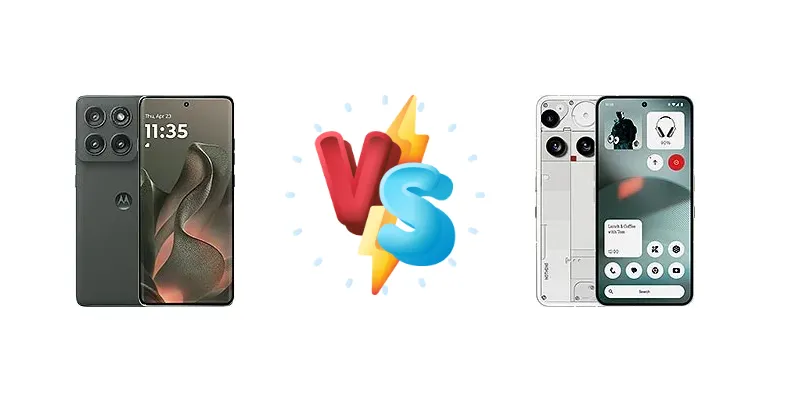
|
🏆 Quick Verdict
For the average user prioritizing longevity and consistent performance, the Nothing Phone (3) is the stronger choice. Its Snapdragon 8s Gen 4 chipset and exceptional 56:23h battery endurance outweigh the Motorola Edge (2025)'s slightly faster wired charging.
| PHONES | ||
|---|---|---|
| Phone Names | Motorola Edge (2025) | Nothing Phone (3) |
| Network | ||
|---|---|---|
| 2G bands | GSM 850 / 900 / 1800 / 1900 | GSM 850 / 900 / 1800 / 1900 |
| 3G bands | HSDPA 850 / 900 / 1700(AWS) / 1900 / 2100 | HSDPA 800 / 850 / 900 / 1700(AWS) / 1900 / 2100 |
| 4G bands | 1, 2, 3, 4, 5, 7, 8, 12, 13, 14, 17, 18, 19, 20, 25, 26, 28, 29, 30, 38, 39, 40, 41, 42, 48, 66, 71 | 1, 2, 3, 4, 6, 7, 8, 12, 17, 18, 19, 20, 25, 26, 28, 30, 34, 38, 39, 40, 41, 42, 48, 66, 71 LTE |
| 5G bands | 1, 2, 3, 5, 7, 12, 14, 20, 25, 26, 28, 29, 30, 38, 40, 41, 48, 66, 70, 71, 77, 78 SA/NSA/Sub6 | 1, 2, 3, 5, 7, 8, 12, 20, 25, 28, 30, 38, 40, 41, 48, 66, 71, 77, 78 SA/NSA |
| Speed | HSPA, LTE, 5G | HSPA, LTE, 5G |
| Technology | GSM / HSPA / LTE / 5G | GSM / HSPA / LTE / 5G |
| Launch | ||
|---|---|---|
| Announced | 2025, May 27 | 2025, July 02 |
| Status | Available. Released 2025, June 06 | Available. Released 2025, July 15 |
| Body | ||
|---|---|---|
| Build | - | Glass front (Gorilla Glass 7i), glass back (Gorilla Glass Victus), aluminum frame |
| Dimensions | 161.2 x 73.1 x 8 mm (6.35 x 2.88 x 0.31 in) | 160.6 x 75.6 x 9 mm (6.32 x 2.98 x 0.35 in) |
| SIM | Nano-SIM + eSIM | Nano-SIM + Nano-SIM + eSIM (max 2 at a time) |
| Weight | 181 g (6.38 oz) | 218 g (7.69 oz) |
| Display | ||
|---|---|---|
| Protection | Corning Gorilla Glass 7i | Corning Gorilla Glass 7i, Mohs level 5 |
| Resolution | 1220 x 2712 pixels, 20:9 ratio (~444 ppi density) | 1260 x 2800 pixels, 20:9 ratio (~460 ppi density) |
| Size | 6.7 inches, 108.4 cm2 (~92.0% screen-to-body ratio) | 6.67 inches, 107.4 cm2 (~88.5% screen-to-body ratio) |
| Type | P-OLED, 1B colors, 120Hz, HDR10+, 4500 nits peak | OLED, 1B colors, 120Hz, 960Hz PWM, HDR10+, 4500 nits (peak) |
| Platform | ||
|---|---|---|
| CPU | Octa-core (4x2.6 GHz Cortex-A78 & 4x2.0 GHz Cortex-A55) | Octa-core (1x3.21 GHz Cortex-X4 & 3x3.0 GHz Cortex-A720 & 2x2.8 GHz Cortex-A720 & 2x2.0 GHz Cortex-A720) |
| Chipset | Mediatek Dimensity 7400 Ultra (4 nm) | Qualcomm SM8735 Snapdragon 8s Gen 4 (4 nm) |
| GPU | Mali-G615 MC2 | Adreno 825 |
| OS | Android 15 | Android 15, upgradable to Android 16, Nothing OS 4.0, up to 5 major Android upgrades |
| Memory | ||
|---|---|---|
| Card slot | No | No |
| Internal | 256GB 8GB RAM | 256GB 12GB RAM, 512GB 16GB RAM |
| Main Camera | ||
|---|---|---|
| Features | LED flash, HDR, panorama | LED flash, panorama, HDR |
| Triple | 50 MP, f/1.8, 24mm (wide), 1/1.56", 1.0µm, multi-directional PDAF, OIS 10 MP, f2.0, 73mm (telephoto), 1/3.94", 1.0µm, PDAF, 3x optical zoom, OIS 50 MP, f/2.0, 12mm, 122˚ (ultrawide), 0.64µm, PDAF | 50 MP, f/1.7, 24mm (wide), 1/1.3", PDAF, OIS 50 MP, f/2.7, (periscope telephoto), 1/2.75", PDAF, 3x optical zoom. OIS 50 MP, f/2.2, 114˚ (ultrawide), 1/2.76" |
| Video | 4K@30fps, 1080p@30/60/120fps, gyro-EIS | 4K@30/60fps, 1080p@30/60fps, gyro-EIS, OIS |
| Selfie camera | ||
|---|---|---|
| Features | HDR | HDR |
| Single | 50 MP, f/1.9, (wide), 0.64µm, PDAF | 50 MP, f/2.2, (wide), 1/2.76" |
| Video | 4K@30fps, 1080p@30fps | 4K@60fps, 1080p@60fps |
| Sound | ||
|---|---|---|
| 35mm jack | No | No |
| Loudspeaker | Yes, with stereo speakers (with Dolby Atmos) | Yes, with stereo speakers |
| Comms | ||
|---|---|---|
| Bluetooth | Yes | 6.0, A2DP, LE |
| NFC | Yes | Yes |
| Positioning | GPS, GLONASS, GALILEO, BDS, NavIC | GPS (L1+L5), GLONASS, BDS, GALILEO, QZSS, NavIC, SBAS |
| Radio | No | No |
| USB | USB Type-C, OTG | USB Type-C 2.0, OTG |
| WLAN | Wi-Fi 802.11 a/b/g/n/ac/6e, tri-band | Wi-Fi 802.11 a/b/g/n/ac/6/7, tri-band, Wi-Fi Direct |
| Features | ||
|---|---|---|
| Sensors | Fingerprint (under display, optical), accelerometer, gyro, proximity, compass, barometer | Fingerprint (under display, optical), accelerometer, proximity, gyro, compass |
| Battery | ||
|---|---|---|
| Charging | 68W wired 15W wireless | 65W wired, PD3.0, PPS, QC4 15W wireless 7.5W reverse charging 5W reverse wireless |
| Type | 5200 mAh | Market-dependent versions:· Si/C 5150 mAh - International model· Si/C 5500 mAh - India model |
| Misc | ||
|---|---|---|
| Colors | Deep Forest | White, Black |
| Models | XT2519 | A024 |
| Price | $ 399.99 | $ 639.00 / £ 699.00 / € 538.99 / ₹ 49,999 |
| EU LABEL | ||
|---|---|---|
| Battery | - | 56:23h endurance, 1400 cycles |
| Energy | - | Class A |
| Free fall | - | Class C (90 falls) |
| Repairability | - | Class C |
Motorola Edge (2025)
- Faster 68W wired charging
- Potentially more affordable price point (depending on market)
- Traditional Android experience
- Less powerful chipset (Dimensity 7400 Ultra)
- Likely shorter battery life
- Limited display information
Nothing Phone (3)
- Superior Snapdragon 8s Gen 4 performance
- Exceptional battery life (56:23h endurance)
- Brighter display (1507 nits)
- Slightly slower 65W wired charging
- Unique software experience may not appeal to all
- Potentially higher price
Display Comparison
The Nothing Phone (3) boasts a significantly brighter display, reaching a measured 1507 nits, making it far more usable in direct sunlight compared to the Motorola Edge (2025) (brightness unspecified). While both support wireless charging at 15W, the Nothing Phone (3)'s display technology is likely OLED, offering superior contrast and color accuracy. The Motorola Edge (2025)'s display specs are currently limited, making a detailed comparison difficult, but the Nothing Phone (3) clearly has the advantage in brightness.
Camera Comparison
Without detailed camera specifications for the Motorola Edge (2025), a direct comparison is challenging. However, the Nothing Phone (3) is expected to feature a capable camera system, leveraging Qualcomm's image signal processor (ISP). The focus should be on the main sensor size and aperture, as these are critical for low-light performance. The Motorola Edge (2025) will need a competitive sensor and image processing pipeline to match the Nothing Phone (3)'s expected capabilities. We anticipate the Nothing Phone (3) will offer more consistent image quality across various lighting conditions.
Performance
The Nothing Phone (3)'s Qualcomm Snapdragon 8s Gen 4 (4nm) represents a clear step up in processing power compared to the Motorola Edge (2025)'s Mediatek Dimensity 7400 Ultra (4nm). The Snapdragon 8s Gen 4 features a Cortex-X4 prime core clocked at 3.21 GHz, alongside a more modern CPU architecture (Cortex-A720) than the Edge's Cortex-A78 cores. This translates to faster application loading, smoother multitasking, and improved gaming performance. While both chips are built on a 4nm process, Qualcomm's architecture generally offers better sustained performance due to superior thermal management. The Motorola Edge (2025) may be adequate for everyday tasks, but the Nothing Phone (3) is better equipped for demanding applications.
Battery Life
The Nothing Phone (3) dominates in battery life, with an impressive 56:23h endurance and a 12:56h active use score. While the Motorola Edge (2025) offers 68W wired charging, slightly faster than the Nothing Phone (3)'s 65W (with PD3.0, PPS, and QC4 support), the Nothing Phone (3)'s superior battery capacity and efficiency negate this advantage. The Nothing Phone (3) also includes 15W wireless and 7.5W reverse charging, adding to its versatility. The Motorola Edge (2025)'s 15W wireless charging is standard, but lacks the reverse charging capabilities of its competitor.
Buying Guide
Buy the Motorola Edge (2025) if you prioritize a more traditional Android experience and need the fastest possible wired charging speeds for quick top-ups. Buy the Nothing Phone (3) if you value exceptional battery life, a unique and customizable software experience, and a more efficient chipset for sustained performance during demanding tasks.