
Motorola Edge (2025) vs Google Pixel 9a: A Deep Dive into Performance and Battery Life
| Phones Images | |||||
|---|---|---|---|---|---|
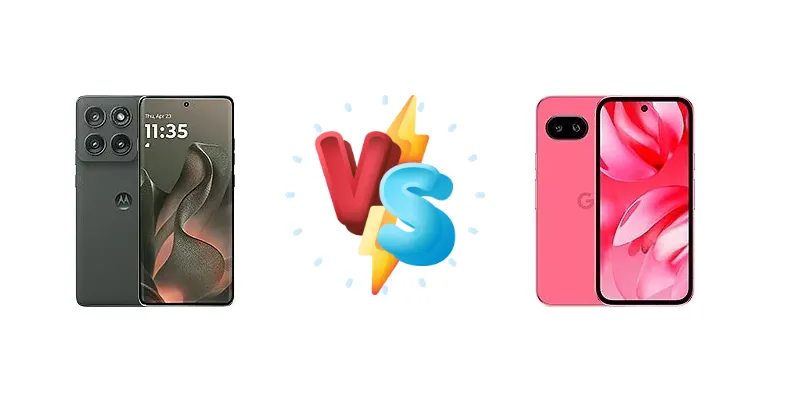
|
🏆 Quick Verdict
For the average user prioritizing long-term battery life and a refined software experience, the Google Pixel 9a emerges as the winner. Its impressive 52:19h endurance and optimized Tensor G4 chip outweigh the Motorola Edge (2025)'s faster charging and potentially higher peak CPU performance.
| PHONES | ||
|---|---|---|
| Phone Names | Motorola Edge (2025) | Google Pixel 9a |
| Network | ||
|---|---|---|
| 2G bands | GSM 850 / 900 / 1800 / 1900 | GSM 850 / 900 / 1800 / 1900 |
| 3G bands | HSDPA 850 / 900 / 1700(AWS) / 1900 / 2100 | HSDPA 800 / 850 / 900 / 1700(AWS) / 1900 / 2100 |
| 4G bands | 1, 2, 3, 4, 5, 7, 8, 12, 13, 14, 17, 18, 19, 20, 25, 26, 28, 29, 30, 38, 39, 40, 41, 42, 48, 66, 71 | 1, 2, 3, 4, 5, 7, 8, 12, 14, 17, 18, 19, 20, 21, 26, 28, 32, 38, 39, 40, 41, 42, 66, 75 - International |
| 5G bands | 1, 2, 3, 5, 7, 12, 14, 20, 25, 26, 28, 29, 30, 38, 40, 41, 48, 66, 70, 71, 77, 78 SA/NSA/Sub6 | 1, 2, 3, 5, 7, 8, 12, 20, 26, 28, 38, 40, 41, 66, 75, 77, 78, 79 SA/NSA/Sub6 - International |
| Speed | HSPA, LTE, 5G | HSPA, LTE, 5G |
| Technology | GSM / HSPA / LTE / 5G | GSM / HSPA / LTE / 5G |
| Launch | ||
|---|---|---|
| Announced | 2025, May 27 | 2025, March 19 |
| Status | Available. Released 2025, June 06 | Available. Released 2025, April 10 |
| Body | ||
|---|---|---|
| Build | - | Glass front (Gorilla Glass 3), aluminum frame, plastic back |
| Dimensions | 161.2 x 73.1 x 8 mm (6.35 x 2.88 x 0.31 in) | 154.7 x 73.3 x 8.9 mm (6.09 x 2.89 x 0.35 in) |
| SIM | Nano-SIM + eSIM | Nano-SIM + eSIM |
| Weight | 181 g (6.38 oz) | 186 g (6.56 oz) |
| Display | ||
|---|---|---|
| Protection | Corning Gorilla Glass 7i | Corning Gorilla Glass 3, Mohs level 4 |
| Resolution | 1220 x 2712 pixels, 20:9 ratio (~444 ppi density) | 1080 x 2424 pixels, 20:9 ratio (~422 ppi density) |
| Size | 6.7 inches, 108.4 cm2 (~92.0% screen-to-body ratio) | 6.3 inches, 94.7 cm2 (~83.5% screen-to-body ratio) |
| Type | P-OLED, 1B colors, 120Hz, HDR10+, 4500 nits peak | P-OLED, HDR, 120Hz, 1800 nits (HBM), 2700 nits (peak) |
| Platform | ||
|---|---|---|
| CPU | Octa-core (4x2.6 GHz Cortex-A78 & 4x2.0 GHz Cortex-A55) | Octa-core (1x3.1 GHz Cortex-X4 & 3x2.6 GHz Cortex-A720 & 4x1.9 GHz Cortex-A520) |
| Chipset | Mediatek Dimensity 7400 Ultra (4 nm) | Google Tensor G4 (4 nm) |
| GPU | Mali-G615 MC2 | Mali-G715 MP7 |
| OS | Android 15 | Android 15, upgradable to Android 16, up to 7 major Android upgrades |
| Memory | ||
|---|---|---|
| Card slot | No | No |
| Internal | 256GB 8GB RAM | 128GB 8GB RAM, 256GB 8GB RAM |
| Main Camera | ||
|---|---|---|
| Dual | - | 48 MP, f/1.7, 25mm (wide), 1/2.0", 0.8µm, dual pixel PDAF, OIS 13 MP, f/2.2, 120˚ (ultrawide), 1/3.1", 1.12µm |
| Features | LED flash, HDR, panorama | Dual-LED flash, Pixel Shift, Ultra HDR, panorama, Best Take |
| Triple | 50 MP, f/1.8, 24mm (wide), 1/1.56", 1.0µm, multi-directional PDAF, OIS 10 MP, f2.0, 73mm (telephoto), 1/3.94", 1.0µm, PDAF, 3x optical zoom, OIS 50 MP, f/2.0, 12mm, 122˚ (ultrawide), 0.64µm, PDAF | - |
| Video | 4K@30fps, 1080p@30/60/120fps, gyro-EIS | 4K@30/60fps, 1080p@30/60/120/240fps, gyro-EIS, OIS |
| Selfie camera | ||
|---|---|---|
| Features | HDR | HDR, panorama |
| Single | 50 MP, f/1.9, (wide), 0.64µm, PDAF | 13 MP, f/2.2, 20mm (ultrawide), 1/3.1", 1.12µm |
| Video | 4K@30fps, 1080p@30fps | 4K@30fps, 1080p@30fps |
| Sound | ||
|---|---|---|
| 35mm jack | No | No |
| Loudspeaker | Yes, with stereo speakers (with Dolby Atmos) | Yes, with stereo speakers |
| Comms | ||
|---|---|---|
| Bluetooth | Yes | 5.3, A2DP, LE |
| NFC | Yes | Yes |
| Positioning | GPS, GLONASS, GALILEO, BDS, NavIC | GPS (L1+L5), GLONASS, GALILEO, BDS, QZSS, NavIC |
| Radio | No | No |
| USB | USB Type-C, OTG | USB Type-C 3.2 |
| WLAN | Wi-Fi 802.11 a/b/g/n/ac/6e, tri-band | Wi-Fi 802.11 a/b/g/n/ac/6e, dual/tri-band (market/region dependent) |
| Features | ||
|---|---|---|
| Sensors | Fingerprint (under display, optical), accelerometer, gyro, proximity, compass, barometer | Fingerprint (under display, optical), accelerometer, gyro, proximity, compass, barometer |
| Battery | ||
|---|---|---|
| Charging | 68W wired 15W wireless | 23W wired, PD3.0 7.5W wireless Bypass charging |
| Type | 5200 mAh | Li-Po 5100 mAh |
| Misc | ||
|---|---|---|
| Colors | Deep Forest | Obsidian, Porcelain, Iris, Peony |
| Models | XT2519 | GXQ96, GTF7P, G3Y12 |
| Price | $ 399.99 | $ 348.12 / C$ 479.99 / £ 345.00 / € 381.99 / ₹ 41,990 |
| SAR EU | - | 0.99 W/kg (head) 1.39 W/kg (body) |
| EU LABEL | ||
|---|---|---|
| Battery | - | 52:19h endurance, 1000 cycles |
| Energy | - | Class B |
| Free fall | - | Class A (270 falls) |
| Repairability | - | Class B |
Motorola Edge (2025)
- Faster 68W wired charging
- Potentially higher CPU performance in multi-core tasks
- Wireless charging support (15W)
- Unknown battery endurance
- Motorola’s software update track record is less consistent than Google’s
Google Pixel 9a
- Exceptional battery life (52:19h endurance)
- Optimized software and guaranteed updates
- Google Tensor G4’s AI capabilities
- Slower 23W wired charging
- Lower wireless charging speed (7.5W)
Display Comparison
Display specifications are currently unavailable for both devices. However, given the market segment, we anticipate both will feature AMOLED panels. The Pixel series historically prioritizes color accuracy, while Motorola often focuses on higher refresh rates. The absence of LTPO information suggests neither phone will have dynamically adaptive refresh rates, potentially impacting battery life. Bezels are expected to be minimal on both, reflecting current design trends.
Camera Comparison
Camera details are currently limited. However, Google’s Pixel phones are renowned for their computational photography prowess, even on their 'a' series. The Tensor G4’s image signal processor (ISP) will likely deliver excellent dynamic range and low-light performance. Motorola typically focuses on megapixel count, but image quality relies heavily on software processing. Without sensor size or aperture information, it’s difficult to make a direct comparison. We anticipate the Pixel 9a will excel in image processing and consistency, while the Motorola Edge (2025) might offer more versatility with potentially higher resolution sensors.
Performance
The core performance difference lies in the chipsets. The Google Tensor G4 (4nm) utilizes a 1x3.1 GHz Cortex-X4 prime core, alongside 3x2.6 GHz Cortex-A720 cores and 4x1.9 GHz Cortex-A520 cores. This architecture emphasizes AI and machine learning tasks, benefiting Google’s software features. Conversely, the Motorola Edge (2025) employs the Mediatek Dimensity 7400 Ultra (4nm) with a 4x2.6 GHz Cortex-A78 and 4x2.0 GHz Cortex-A55 configuration. While the Dimensity 7400 Ultra’s Cortex-A78 cores are older generation, their higher clock speed suggests strong multi-core performance. The Tensor G4’s Cortex-X4 core will likely provide superior single-core performance. Both chips are built on a 4nm process, indicating comparable efficiency, but the Tensor G4’s dedicated AI cores give it an edge in tasks like image processing and voice recognition. RAM specifications are unknown, but LPDDR5x is expected on both to support the chipsets.
Battery Life
The Google Pixel 9a boasts a significant advantage in battery endurance, achieving 52:19h of total usage and 12:42h of active use. This suggests exceptional power efficiency from the Tensor G4 and optimized software. The Motorola Edge (2025) lacks published battery endurance data, but its 68W wired charging significantly surpasses the Pixel 9a’s 23W charging (with PD3.0 support). The Edge also offers 15W wireless charging, while the Pixel 9a provides 7.5W wireless charging. The Pixel 9a’s ‘bypass charging’ feature, allowing direct power from the charger to the phone bypassing the battery, will extend battery lifespan. While the Edge charges faster, the Pixel 9a’s longevity and efficiency are more compelling for most users.
Buying Guide
Buy the Motorola Edge (2025) if you frequently engage in demanding tasks like mobile gaming or video editing and value faster charging speeds. Its Dimensity 7400 Ultra offers a strong CPU performance profile. Buy the Google Pixel 9a if you prioritize all-day battery life, a clean Android experience with guaranteed updates, and efficient performance for everyday tasks. The Pixel 9a’s endurance and software optimization are its key strengths.