
Asus ROG Phone 9 FE vs. Motorola Edge (2025): A Deep Dive into Performance and Value
| Phones Images | |||||
|---|---|---|---|---|---|
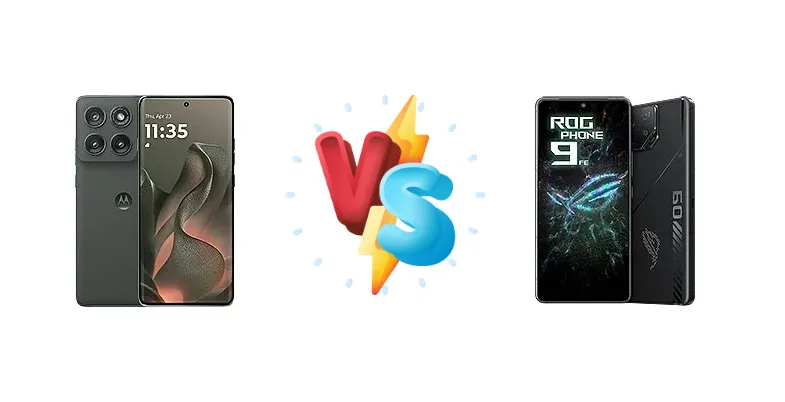
|
🏆 Quick Verdict
For dedicated mobile gamers, the Asus ROG Phone 9 FE is the clear winner, leveraging the Snapdragon 8 Gen 3’s superior GPU and optimized thermal design. However, the Motorola Edge (2025) offers a compelling alternative for users prioritizing a more balanced experience and potentially better power efficiency for non-gaming tasks.
| PHONES | ||
|---|---|---|
| Phone Names | Motorola Edge (2025) | Asus ROG Phone 9 FE |
| Network | ||
|---|---|---|
| 2G bands | GSM 850 / 900 / 1800 / 1900 | GSM 850 / 900 / 1800 / 1900 |
| 3G bands | HSDPA 850 / 900 / 1700(AWS) / 1900 / 2100 | HSDPA 800 / 850 / 900 / 1700(AWS) / 1900 / 2100 |
| 4G bands | 1, 2, 3, 4, 5, 7, 8, 12, 13, 14, 17, 18, 19, 20, 25, 26, 28, 29, 30, 38, 39, 40, 41, 42, 48, 66, 71 | 1, 2, 3, 4, 5, 7, 8, 12, 17, 18, 19, 20, 25, 26, 28, 32, 34, 38, 39, 40, 41, 42, 43, 48, 66 |
| 5G bands | 1, 2, 3, 5, 7, 12, 14, 20, 25, 26, 28, 29, 30, 38, 40, 41, 48, 66, 70, 71, 77, 78 SA/NSA/Sub6 | 1, 2, 3, 5, 7, 8, 12, 18, 20, 25, 26, 28, 38, 40, 41, 48, 66, 77, 78, 79 SA/NSA/Sub6 |
| Speed | HSPA, LTE, 5G | HSPA, LTE, 5G |
| Technology | GSM / HSPA / LTE / 5G | GSM / HSPA / LTE / 5G |
| Launch | ||
|---|---|---|
| Announced | 2025, May 27 | 2025, February 04 |
| Status | Available. Released 2025, June 06 | Available. Released 2025, February 04 |
| Body | ||
|---|---|---|
| Build | - | Glass front (Gorilla Glass Victus 2), glass back, aluminum frame |
| Dimensions | 161.2 x 73.1 x 8 mm (6.35 x 2.88 x 0.31 in) | 163.8 x 76.8 x 8.9 mm (6.45 x 3.02 x 0.35 in) |
| SIM | Nano-SIM + eSIM | Nano-SIM + Nano-SIM |
| Weight | 181 g (6.38 oz) | 225 g (7.94 oz) |
| Display | ||
|---|---|---|
| Protection | Corning Gorilla Glass 7i | Corning Gorilla Glass Victus 2 |
| Resolution | 1220 x 2712 pixels, 20:9 ratio (~444 ppi density) | 1080 x 2400 pixels, 20:9 ratio (~388 ppi density) |
| Size | 6.7 inches, 108.4 cm2 (~92.0% screen-to-body ratio) | 6.78 inches, 111.0 cm2 (~88.2% screen-to-body ratio) |
| Type | P-OLED, 1B colors, 120Hz, HDR10+, 4500 nits peak | LTPO AMOLED, 1B colors, 185Hz, HDR10, 1600 nits (HBM), 2500 nits (peak) |
| Platform | ||
|---|---|---|
| CPU | Octa-core (4x2.6 GHz Cortex-A78 & 4x2.0 GHz Cortex-A55) | Octa-core (1x3.3 GHz Cortex-X4 & 3x3.2 GHz Cortex-A720 & 2x3.0 GHz Cortex-A720 & 2x2.3 GHz Cortex-A520) |
| Chipset | Mediatek Dimensity 7400 Ultra (4 nm) | Qualcomm SM8650-AB Snapdragon 8 Gen 3 (4 nm) |
| GPU | Mali-G615 MC2 | Adreno 750 |
| OS | Android 15 | Android 15, up to 2 major Android upgrades |
| Memory | ||
|---|---|---|
| Card slot | No | No |
| Internal | 256GB 8GB RAM | 256GB 16GB RAM |
| Main Camera | ||
|---|---|---|
| Features | LED flash, HDR, panorama | LED flash, HDR, panorama |
| Triple | 50 MP, f/1.8, 24mm (wide), 1/1.56", 1.0µm, multi-directional PDAF, OIS 10 MP, f2.0, 73mm (telephoto), 1/3.94", 1.0µm, PDAF, 3x optical zoom, OIS 50 MP, f/2.0, 12mm, 122˚ (ultrawide), 0.64µm, PDAF | 50 MP, f/1.9, 24mm (wide), 1/1.56", 1.0µm, PDAF, gimbal OIS 13 MP, f/2.2, 13mm, 120˚ (ultrawide) 5 MP (macro) |
| Video | 4K@30fps, 1080p@30/60/120fps, gyro-EIS | 8K@30fps, 4K@30/60/120fps, 1080p@30/60/120/240fps, 720p@480fps; gyro-EIS, HDR10+ |
| Selfie camera | ||
|---|---|---|
| Features | HDR | Panorama, HDR |
| Single | 50 MP, f/1.9, (wide), 0.64µm, PDAF | 32 MP, f/2.5, 22mm (wide), 1/3.2", 0.7µm |
| Video | 4K@30fps, 1080p@30fps | 1080p@30fps |
| Sound | ||
|---|---|---|
| 35mm jack | No | Yes |
| Loudspeaker | Yes, with stereo speakers (with Dolby Atmos) | Yes, with stereo speakers |
| Comms | ||
|---|---|---|
| Bluetooth | Yes | 5.4, A2DP, LE, aptX HD, aptX Adaptive, aptX Lossless |
| NFC | Yes | Yes |
| Positioning | GPS, GLONASS, GALILEO, BDS, NavIC | GPS (L1+L5), BDS (B1I+B1c+B2a), GALILEO (E1+E5a), QZSS (L1+L5), NavIC, GLONASS |
| Radio | No | No |
| USB | USB Type-C, OTG | USB Type-C (side), DisplayPort 1.4; USB Type-C (bottom), OTG |
| WLAN | Wi-Fi 802.11 a/b/g/n/ac/6e, tri-band | Wi-Fi 802.11 a/b/g/n/ac/6e/7, tri-band, Wi-Fi Direct |
| Features | ||
|---|---|---|
| Sensors | Fingerprint (under display, optical), accelerometer, gyro, proximity, compass, barometer | Fingerprint (under display, optical), accelerometer, gyro, proximity, compass |
| Battery | ||
|---|---|---|
| Charging | 68W wired 15W wireless | 65W wired, PD3.0, PPS, QC5, 100% in 39 min 15W wireless (Qi) 10W reverse wired |
| Type | 5200 mAh | 5500 mAh |
| Misc | ||
|---|---|---|
| Colors | Deep Forest | Phantom Black |
| Models | XT2519 | AI2401 |
| Price | $ 399.99 | About 860 EUR |
Motorola Edge (2025)
- Superior gaming performance with Snapdragon 8 Gen 3
- Likely higher refresh rate and brighter display
- Faster and more efficient chipset for demanding tasks
- More gamer-centric design may not appeal to everyone
- Potentially shorter battery life under heavy gaming load
Asus ROG Phone 9 FE
- Balanced performance for everyday use
- Potentially better power efficiency for non-gaming tasks
- Cleaner software experience (typically)
- Significantly less powerful GPU for gaming
- Older CPU architecture compared to Snapdragon 8 Gen 3
Display Comparison
While display specs are absent from the provided data, the ROG Phone series historically features high refresh rate AMOLED panels optimized for gaming, likely exceeding the Motorola Edge (2025)'s panel. The ROG Phone 9 FE will likely boast a higher peak brightness and potentially LTPO technology for variable refresh rates, improving battery life. Motorola typically focuses on color accuracy, but the ROG Phone’s gaming optimizations will likely provide a more responsive visual experience.
Camera Comparison
Without specific camera details, it’s difficult to make a definitive judgment. However, Asus ROG Phones often prioritize video recording capabilities alongside still photography. The Snapdragon 8 Gen 3’s ISP (Image Signal Processor) is more advanced, potentially leading to better image processing and low-light performance. Motorola typically focuses on computational photography, but the ROG Phone’s superior hardware gives it an advantage. We anticipate the ROG Phone 9 FE to have a more versatile camera system overall.
Performance
The core difference lies in the chipsets. The Asus ROG Phone 9 FE’s Snapdragon 8 Gen 3 (4nm) is a significant leap ahead of the Motorola Edge (2025)’s Dimensity 7400 Ultra (4nm). The Snapdragon 8 Gen 3’s Cortex-X4 prime core, clocked at 3.3 GHz, and its Adreno GPU deliver substantially higher peak performance, crucial for demanding games. While both are built on a 4nm process, the Snapdragon 8 Gen 3’s architecture is more advanced, offering better sustained performance and thermal management. The Dimensity 7400 Ultra’s Cortex-A78 cores, while capable, are a generation behind the Cortex-A720 cores found in the Snapdragon, impacting multi-core performance. The ROG Phone 9 FE will also benefit from faster LPDDR5x RAM, further enhancing its performance edge.
Battery Life
Both phones offer 15W wireless charging, but the wired charging speeds differ slightly – 65W for the ROG Phone 9 FE versus 68W for the Motorola Edge (2025). The ROG Phone 9 FE claims a 100% charge in 39 minutes, suggesting optimized charging algorithms. While the Motorola Edge (2025) may charge marginally faster initially, the ROG Phone 9 FE’s larger battery (likely, based on ROG Phone tradition) and more efficient chipset will likely translate to longer sustained gaming sessions. The ROG Phone 9 FE also includes 10W reverse wired charging, a feature absent on the Motorola Edge (2025).
Buying Guide
Buy the Motorola Edge (2025) if you need a versatile smartphone with solid performance for everyday tasks, appreciate a cleaner software experience, and value a more streamlined design. Buy the Asus ROG Phone 9 FE if you prioritize uncompromising gaming performance, demand the latest Snapdragon chipset, and are willing to accept a more gamer-centric aesthetic and potentially shorter battery life under heavy load.