
Motorola Edge (2023) vs Samsung Galaxy S23 FE: Which Mid-Range Phone Reigns Supreme?
| Phones Images | |||||
|---|---|---|---|---|---|
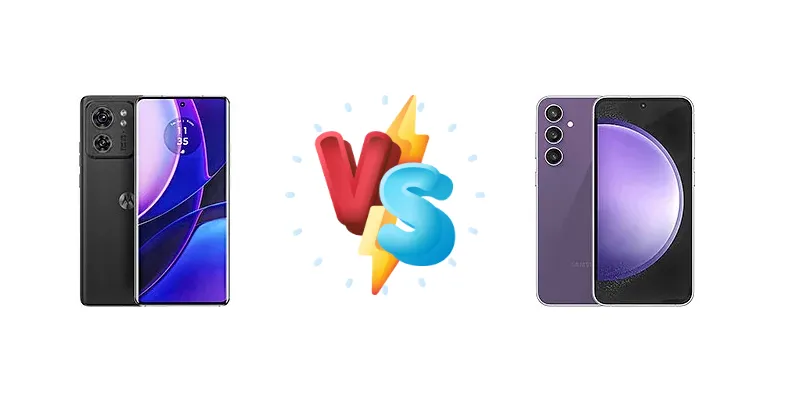
|
🏆 Quick Verdict
For the average user, the Samsung Galaxy S23 FE emerges as the stronger contender. While the Motorola Edge (2023) boasts faster 68W charging, the S23 FE’s superior chipset (Snapdragon 8 Gen 1 in the US, Exynos 2200 internationally), brighter display, and more polished software experience justify the slight price premium.
| PHONES | ||
|---|---|---|
| Phone Names | Motorola Edge (2023) | Samsung Galaxy S23 FE |
| Network | ||
|---|---|---|
| 2G bands | GSM 850 / 900 / 1800 / 1900 | GSM 850 / 900 / 1800 / 1900 |
| 3G bands | HSDPA 850 / 900 / 1700(AWS) / 1900 / 2100 | HSDPA 850 / 900 / 1700(AWS) / 1900 / 2100 |
| 4G bands | 1, 2, 3, 4, 5, 7, 8, 12, 13, 14, 17, 18, 19, 20, 25, 26, 29, 30, 38, 39, 40, 41, 48, 66, 71 | 1, 2, 3, 4, 5, 7, 8, 12, 13, 17, 20, 26, 28, 38, 40, 41, 66 - International |
| 5G bands | 1, 2, 3, 5, 7, 12, 14, 20, 25, 26, 29, 30, 38, 40, 41, 48, 66, 70, 71, 77, 78 SA/NSA/Sub6 | 1, 2, 3, 5, 7, 8, 20, 28, 38, 40, 41, 66, 77, 78 SA/NSA/Sub6 - International |
| Speed | HSPA, LTE, 5G | HSPA, LTE, 5G |
| Technology | GSM / HSPA / LTE / 5G | GSM / HSPA / LTE / 5G |
| Launch | ||
|---|---|---|
| Announced | 2023, October 11 | 2023, October 04 |
| Status | Available. Released 2023, October 11 | Available. Released 2023, October 05 |
| Body | ||
|---|---|---|
| Build | Glass front, aluminum frame, silicone polymer back (eco leather) | Glass front (Gorilla Glass 5), glass back (Gorilla Glass 5), aluminum frame |
| Dimensions | 158.4 x 72 x 7.6 mm (6.24 x 2.83 x 0.30 in) | 158 x 76.5 x 8.2 mm (6.22 x 3.01 x 0.32 in) |
| SIM | Nano-SIM + eSIM | · Nano-SIM· Nano-SIM + Nano-SIM· Nano-SIM + Nano-SIM + eSIM (max 2 at a time) |
| Weight | 168 g (5.93 oz) | 209 g (7.37 oz) |
| Display | ||
|---|---|---|
| Protection | - | Corning Gorilla Glass 5 |
| Resolution | 1080 x 2400 pixels, 20:9 ratio (~402 ppi density) | 1080 x 2340 pixels, 19.5:9 ratio (~403 ppi density) |
| Size | 6.6 inches, 103.6 cm2 (~90.8% screen-to-body ratio) | 6.4 inches, 100.5 cm2 (~83.2% screen-to-body ratio) |
| Type | P-OLED, 1B colors, 144Hz, HDR10+, 1200 nits (peak) | Dynamic AMOLED 2X, 120Hz, HDR10+, 1450 nits (peak) |
| Platform | ||
|---|---|---|
| CPU | Octa-core (2x2.5 GHz Cortex-A78 & 6x2.0 GHz Cortex-A55) | Octa-core (1x2.8 GHz Cortex-X2 & 3x2.50 GHz Cortex-A710 & 4x1.8 GHz Cortex-A510) - InternationalOcta-core (1x3.00 GHz Cortex-X2 & 3x2.50 GHz Cortex-A710 & 4x1.80 GHz Cortex-A510) - USA |
| Chipset | MediaTek Dimensity 7030 (6 nm) | Exynos 2200 (4 nm) - InternationalQualcomm SM8450 Snapdragon 8 Gen 1 (4 nm) - USA |
| GPU | Mali-G610 MC3 | Xclipse 920 - InternationalAdreno 730 - USA |
| OS | Android 13, planned upgrade to Android 14 | Android 13, up to 4 major Android upgrades, One UI 8 |
| Memory | ||
|---|---|---|
| Card slot | No | No |
| Internal | 256GB 8GB RAM | 128GB 8GB RAM, 256GB 8GB RAM |
| Main Camera | ||
|---|---|---|
| Dual | 50 MP, f/1.4, (wide), 1/1.5", 1.0µm, multi-directional PDAF, OIS 13 MP, f/2.2, 120˚ (ultrawide), 1.12µm, AF | - |
| Features | Dual-LED flash, HDR, panorama | LED flash, HDR, panorama |
| Triple | - | 50 MP, f/1.8, 23mm (wide), 1/1.57", 1.0µm, dual pixel PDAF, OIS 8 MP, f/2.4, 76mm (telephoto), 1/4.5", 1.0µm, PDAF, OIS, 3x optical zoom 12 MP, f/2.2, 13mm, 123˚ (ultrawide), 1/3.0", 1.12µm |
| Video | 4K@30fps, 1080p@30/60fps, HDR, gyro-EIS | 8K@24fps, 4K@30/60fps, 1080p@30/60/120/240fps |
| Selfie camera | ||
|---|---|---|
| Features | HDR | - |
| Single | 32 MP, f/2.4, (wide), 0.8µm | 10 MP, f/2.4, 25mm (wide), 1/3.0", 1.22µm |
| Video | 4K@30fps, 1080p@30fps | 4K@30/60fps, 1080p@30/60fps; gyro-EIS |
| Sound | ||
|---|---|---|
| 35mm jack | No | No |
| Loudspeaker | Yes, with stereo speakers | Yes, with stereo speakers |
| Comms | ||
|---|---|---|
| Bluetooth | 5.2, A2DP, LE | 5.3, A2DP, LE |
| NFC | Yes | Yes |
| Positioning | GPS, GLONASS, GALILEO | GPS, GLONASS, GALILEO, BDS |
| Radio | No | Unspecified |
| USB | USB Type-C 2.0 | USB Type-C, OTG |
| WLAN | Wi-Fi 802.11 a/b/g/n/ac/6e/k/v/r, tri-band, Wi-Fi Direct | Wi-Fi 802.11 a/b/g/n/ac/6e, dual-band, Wi-Fi Direct |
| Features | ||
|---|---|---|
| Sensors | Fingerprint (under display, optical), accelerometer, gyro, proximity, compass, barometer | Fingerprint (under display, optical), accelerometer, gyro, compass |
| Battery | ||
|---|---|---|
| Charging | 68W wired 15W wireless | 25W wired, PD3.0, 50% in 30 min 15W wireless Reverse wireless |
| Type | Li-Po 4400 mAh | Li-Ion 4500 mAh |
| Misc | ||
|---|---|---|
| Colors | Eclipse Black | Mint, Cream, Graphite, Purple, Indigo, Tangerine |
| Models | - | SM-S711B, SM-S711B/DS, SM-S711U1, SM-S711U, SM-S711W, SM-S7110, SM-S711N |
| Price | $ 189.95 | $ 219.95 / C$ 327.90 / £ 248.99 / € 272.00 / ₹ 34,999 |
| SAR | - | 0.80 W/kg (head) 0.72 W/kg (body) |
| SAR EU | - | 0.76 W/kg (head) 1.04 W/kg (body) |
Motorola Edge (2023)
- Extremely fast 68W wired charging
- Clean Android software experience
- Potentially more affordable price point
- Less powerful chipset (Dimensity 7030)
- Less detailed display specifications
- Camera system likely less versatile
Samsung Galaxy S23 FE
- More powerful chipset (Snapdragon 8 Gen 1/Exynos 2200)
- Brighter and more color-accurate display
- More refined software experience
- Reverse wireless charging
- Slower 25W wired charging
- Regional chipset variations (Exynos vs Snapdragon)
- Potentially higher price
Display Comparison
The Samsung Galaxy S23 FE boasts a significantly brighter display, reaching a measured 985 nits, compared to an unstated value for the Motorola Edge (2023). This brightness advantage translates to better outdoor visibility. While both support wireless charging, the S23 FE’s display likely benefits from Samsung’s established display technology, offering superior color accuracy and viewing angles. The Edge (2023) display specs are less detailed, suggesting a potentially less premium panel.
Camera Comparison
The Samsung Galaxy S23 FE’s camera system is expected to offer a more versatile and refined experience. While specific sensor details are missing, Samsung’s image processing algorithms are generally more mature. The Motorola Edge (2023) camera specs are less detailed, and the inclusion of a 2MP macro lens suggests a focus on quantity over quality. The S23 FE’s OIS (Optical Image Stabilization) is likely more effective, resulting in sharper photos and smoother videos, especially in low-light conditions. The S23 FE’s video capabilities are also expected to be superior.
Performance
The chipset is where the biggest divergence lies. The Motorola Edge (2023) utilizes the MediaTek Dimensity 7030 (6nm), while the S23 FE ships with either the Exynos 2200 (4nm - International) or the Qualcomm Snapdragon 8 Gen 1 (4nm - USA). The Snapdragon 8 Gen 1 and Exynos 2200, built on a smaller 4nm process, offer a substantial performance advantage over the 6nm Dimensity 7030, particularly in GPU-intensive tasks. The S23 FE’s CPU configuration, featuring a Cortex-X2 prime core, further enhances its multi-core performance. The S23 FE’s RAM configuration (likely LPDDR5) also contributes to smoother multitasking.
Battery Life
The Samsung Galaxy S23 FE achieves an impressive 8:28h of active use, demonstrating strong battery optimization. While the Motorola Edge (2023)’s battery capacity is unstated, the S23 FE’s endurance is a clear advantage. The Edge (2023) compensates with 68W wired charging, significantly faster than the S23 FE’s 25W charging (50% in 30 minutes). However, the S23 FE offers 15W wireless charging *and* reverse wireless charging, adding convenience. The faster wired charging of the Edge (2023) is beneficial, but the S23 FE’s overall battery life and wireless charging features provide a more well-rounded experience.
Buying Guide
Buy the Motorola Edge (2023) if you prioritize extremely fast charging speeds and a clean Android experience. Its 68W wired charging is a significant advantage for those who frequently need to top up their battery. Buy the Samsung Galaxy S23 FE if you value a more refined software experience, a brighter and more color-accurate display, and generally stronger performance, especially in graphics-intensive tasks, despite the regional chipset differences.