
Motorola Edge (2023) vs OnePlus 11R: A Deep Dive into Performance and Value
| Phones Images | |||||
|---|---|---|---|---|---|
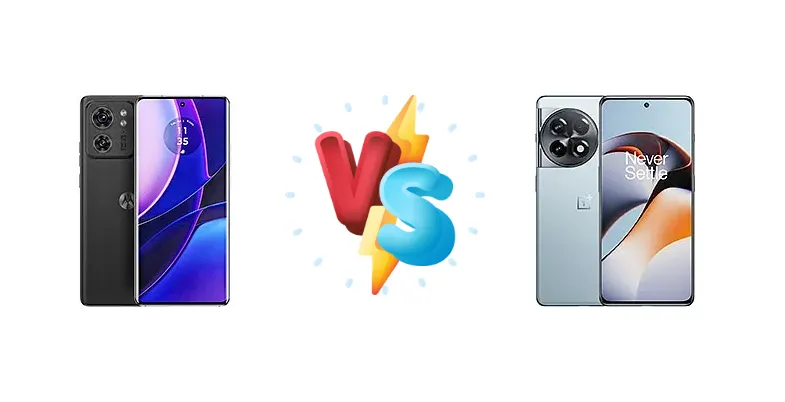
|
🏆 Quick Verdict
For users prioritizing sustained performance and faster charging, the OnePlus 11R is the clear winner. Its Snapdragon 8+ Gen 1, built on a 4nm process, offers a significant advantage over the Motorola Edge (2023)'s Dimensity 7030, especially during demanding tasks. However, the Edge (2023) remains a strong contender for those seeking a more balanced package with wireless charging.
| PHONES | ||
|---|---|---|
| Phone Names | Motorola Edge (2023) | OnePlus 11R |
| Network | ||
|---|---|---|
| 2G bands | GSM 850 / 900 / 1800 / 1900 | GSM 850 / 900 / 1800 / 1900 |
| 3G bands | HSDPA 850 / 900 / 1700(AWS) / 1900 / 2100 | HSDPA 850 / 900 / 1700(AWS) / 2100 |
| 4G bands | 1, 2, 3, 4, 5, 7, 8, 12, 13, 14, 17, 18, 19, 20, 25, 26, 29, 30, 38, 39, 40, 41, 48, 66, 71 | 1, 3, 4, 5, 8, 28, 34, 38, 39, 40, 41 |
| 5G bands | 1, 2, 3, 5, 7, 12, 14, 20, 25, 26, 29, 30, 38, 40, 41, 48, 66, 70, 71, 77, 78 SA/NSA/Sub6 | 1, 3, 5, 8, 28, 40, 41, 77, 78 SA/NSA |
| Speed | HSPA, LTE, 5G | HSPA, LTE (3CA), 5G |
| Technology | GSM / HSPA / LTE / 5G | GSM / CDMA / HSPA / LTE / 5G |
| - | CDMA 800 | |
| Launch | ||
|---|---|---|
| Announced | 2023, October 11 | 2023, February 07 |
| Status | Available. Released 2023, October 11 | Available. Released 2023, February 21 |
| Body | ||
|---|---|---|
| Build | Glass front, aluminum frame, silicone polymer back (eco leather) | Glass front, glass back (Gorilla Glass 5), plastic frame |
| Dimensions | 158.4 x 72 x 7.6 mm (6.24 x 2.83 x 0.30 in) | 163.4 x 74.3 x 8.7 mm (6.43 x 2.93 x 0.34 in) |
| SIM | Nano-SIM + eSIM | Nano-SIM + Nano-SIM |
| Weight | 168 g (5.93 oz) | 204 g (7.20 oz) |
| Display | ||
|---|---|---|
| Resolution | 1080 x 2400 pixels, 20:9 ratio (~402 ppi density) | 1240 x 2772 pixels, 20:9 ratio (~451 ppi density) |
| Size | 6.6 inches, 103.6 cm2 (~90.8% screen-to-body ratio) | 6.74 inches, 109.2 cm2 (~90.0% screen-to-body ratio) |
| Type | P-OLED, 1B colors, 144Hz, HDR10+, 1200 nits (peak) | Fluid AMOLED, 1B colors, 120Hz, HDR10+, 1450 nits (peak) |
| Platform | ||
|---|---|---|
| CPU | Octa-core (2x2.5 GHz Cortex-A78 & 6x2.0 GHz Cortex-A55) | Octa-core (1x3.0 GHz Cortex-X2 & 3x2.5 GHz Cortex-A710 & 4x1.80 GHz Cortex-A510) |
| Chipset | MediaTek Dimensity 7030 (6 nm) | Qualcomm SM8475 Snapdragon 8+ Gen 1 (4 nm) |
| GPU | Mali-G610 MC3 | Adreno 730 |
| OS | Android 13, planned upgrade to Android 14 | Android 13, upgradable to Android 15, OxygenOS 15 |
| Memory | ||
|---|---|---|
| Card slot | No | No |
| Internal | 256GB 8GB RAM | 128GB 8GB RAM, 256GB 16GB RAM, 512GB 18GB RAM |
| - | UFS 3.1 | |
| Main Camera | ||
|---|---|---|
| Dual | 50 MP, f/1.4, (wide), 1/1.5", 1.0µm, multi-directional PDAF, OIS 13 MP, f/2.2, 120˚ (ultrawide), 1.12µm, AF | - |
| Features | Dual-LED flash, HDR, panorama | Color spectrum sensor, LED flash, HDR, panorama |
| Single | - | 16 MP, f/2.4, 24mm (wide), 1/3.09", 1.0µm |
| Triple | - | 50 MP, f/1.8, 24mm (wide), 1/1.56", 1.0µm, multi-directional PDAF, OIS 8 MP, f/2.2, 120˚ (ultrawide), 1/4.0", 1.12µm 2 MP (macro) |
| Video | 4K@30fps, 1080p@30/60fps, HDR, gyro-EIS | 4K@30/60fps, 1080p@30/60/240fps, gyro-EIS |
| Selfie camera | ||
|---|---|---|
| Features | HDR | HDR |
| Single | 32 MP, f/2.4, (wide), 0.8µm | 16 MP, f/2.4, 24mm (wide), 1/3.09", 1.0µm |
| Video | 4K@30fps, 1080p@30fps | 1080p@30fps |
| Sound | ||
|---|---|---|
| 3.5mm jack | - | No |
| 35mm jack | No | No |
| Loudspeaker | Yes, with stereo speakers | Yes, with stereo speakers |
| - | 24-bit/192kHz audio | |
| Comms | ||
|---|---|---|
| Bluetooth | 5.2, A2DP, LE | 5.3, A2DP, LE, aptX HD |
| Infrared port | - | Yes |
| NFC | Yes | Yes |
| Positioning | GPS, GLONASS, GALILEO | GPS (L1+L5), GLONASS (G1), BDS (B1I+B1c+B2a), GALILEO (E1+E5a), QZSS (L1+L5) |
| Radio | No | No |
| USB | USB Type-C 2.0 | USB Type-C 2.0 |
| WLAN | Wi-Fi 802.11 a/b/g/n/ac/6e/k/v/r, tri-band, Wi-Fi Direct | Wi-Fi 802.11 a/b/g/n/ac/6, dual-band |
| Features | ||
|---|---|---|
| Sensors | Fingerprint (under display, optical), accelerometer, gyro, proximity, compass, barometer | Fingerprint (under display, optical), accelerometer, gyro, proximity, compass |
| Battery | ||
|---|---|---|
| Charging | 68W wired 15W wireless | 100W wired |
| Type | Li-Po 4400 mAh | Li-Po 5000 mAh |
| Misc | ||
|---|---|---|
| Colors | Eclipse Black | Galactic Silver, Sonic Black, Solar Red |
| Models | - | CPH2487 |
| Price | $ 189.95 | About 600 EUR |
| SAR | - | 1.16 W/kg (head) 0.61 W/kg (body) |
Motorola Edge (2023)
- Wireless charging support for added convenience.
- Potentially more refined software experience (Motorola's near-stock Android).
- Balanced feature set appealing to a wider audience.
- Less powerful chipset compared to the Snapdragon 8+ Gen 1.
- Slower wired charging speed (68W vs 100W).
OnePlus 11R
- Flagship-level Snapdragon 8+ Gen 1 processor for superior performance.
- Ultra-fast 100W wired charging for minimal downtime.
- Excellent thermal management due to the 4nm process.
- Lacks wireless charging support.
- OxygenOS can be more feature-rich (and potentially bloated) than Motorola's software.
Display Comparison
While both phones likely feature high refresh rate displays (data not provided, assumed based on market segment), the core difference lies under the hood. The Motorola Edge (2023) utilizes the MediaTek Dimensity 7030, a 6nm chip, while the OnePlus 11R boasts the Qualcomm Snapdragon 8+ Gen 1, fabricated on a more efficient 4nm process. This process node difference is crucial; the 4nm Snapdragon will inherently generate less heat under load, potentially leading to more consistent performance and less throttling during extended gaming sessions. The Dimensity 7030, while capable, will likely require more aggressive thermal management to maintain stable performance.
Camera Comparison
Without detailed camera specifications, a direct comparison is limited. However, the chipset's ISP (Image Signal Processor) plays a vital role. The Snapdragon 8+ Gen 1’s ISP is generally considered more advanced, offering better image processing capabilities, especially in low-light conditions. Motorola typically focuses on software-driven image enhancement, but the raw processing power of the Snapdragon 8+ Gen 1 gives the OnePlus 11R an edge. The absence of detailed sensor information makes a definitive statement impossible, but the 11R likely benefits from a more capable ISP.
Performance
The CPU architectures are vastly different. The OnePlus 11R’s Snapdragon 8+ Gen 1 features a prime Cortex-X2 core clocked at 3.0 GHz, designed for peak performance, alongside three Cortex-A710 cores at 2.5 GHz and four Cortex-A510 efficiency cores at 1.8 GHz. This configuration is a significant step up from the Motorola Edge (2023)'s Dimensity 7030, which uses two Cortex-A78 cores at 2.5 GHz and six Cortex-A55 cores at 2.0 GHz. The Cortex-X2 offers a substantial performance boost over the A78, and the A710 cores are more powerful than the A55s. This translates to faster app loading times, smoother multitasking, and a more responsive user experience on the OnePlus 11R, particularly in demanding applications and games. The 4nm process further enhances the 11R’s sustained performance.
Battery Life
The OnePlus 11R’s 100W wired charging is a game-changer. It can likely charge from 0-100% in under 30 minutes, a significant advantage over the Motorola Edge (2023)'s 68W charging. While the Edge (2023) offers 15W wireless charging – a feature absent on the 11R – the sheer speed of the 11R’s wired charging is a compelling benefit for users who prioritize quick top-ups. Battery capacity (not provided) will influence overall endurance, but the faster charging of the 11R mitigates concerns about battery life for many users.
Buying Guide
Buy the Motorola Edge (2023) if you value wireless charging convenience, a more streamlined software experience, and a generally balanced feature set. Buy the OnePlus 11R if you prioritize gaming performance, rapid 100W charging, and don't mind a slightly more aggressive software approach. The 11R is the better choice for power users and mobile gamers.