
Motorola Edge (2023) vs. Nothing Phone (2): A Detailed Comparison
| Phones Images | |||||
|---|---|---|---|---|---|
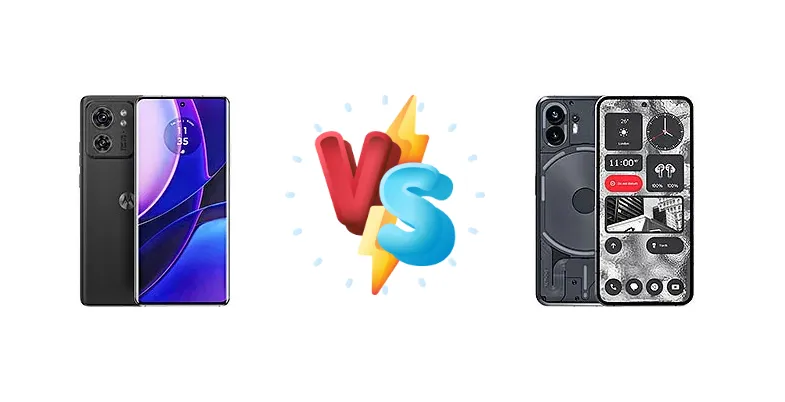
|
🏆 Quick Verdict
For most users, the Nothing Phone (2) emerges as the stronger contender. Its Snapdragon 8+ Gen 1 chipset provides a significant performance advantage, coupled with excellent battery life (14:21h active use). While the Motorola Edge (2023) offers respectable specs, the Nothing Phone (2)'s superior processing power and refined software experience justify the price difference.
| PHONES | ||
|---|---|---|
| Phone Names | Motorola Edge (2023) | Nothing Phone (2) |
| Network | ||
|---|---|---|
| 2G bands | GSM 850 / 900 / 1800 / 1900 | GSM 850 / 900 / 1800 / 1900 |
| 3G bands | HSDPA 850 / 900 / 1700(AWS) / 1900 / 2100 | HSDPA 800 / 850 / 900 / 1700(AWS) / 1900 / 2100 |
| 4G bands | 1, 2, 3, 4, 5, 7, 8, 12, 13, 14, 17, 18, 19, 20, 25, 26, 29, 30, 38, 39, 40, 41, 48, 66, 71 | 1, 2, 3, 4, 5, 7, 8, 12, 17, 18, 19, 20, 25, 26, 28, 30, 32, 34, 38, 39, 40, 41, 42, 48, 66, 71 |
| 5G bands | 1, 2, 3, 5, 7, 12, 14, 20, 25, 26, 29, 30, 38, 40, 41, 48, 66, 70, 71, 77, 78 SA/NSA/Sub6 | 1, 2, 3, 5, 7, 8, 12, 20, 25, 28, 30, 38, 40, 41, 66, 71, 75, 77, 78 SA/NSA |
| Speed | HSPA, LTE, 5G | HSPA, LTE, 5G |
| Technology | GSM / HSPA / LTE / 5G | GSM / HSPA / LTE / 5G |
| Launch | ||
|---|---|---|
| Announced | 2023, October 11 | 2023, July 11 |
| Status | Available. Released 2023, October 11 | Available. Released 2023, July 17 |
| Body | ||
|---|---|---|
| Build | Glass front, aluminum frame, silicone polymer back (eco leather) | Glass front (Gorilla Glass 5), glass back (Gorilla Glass 5), aluminum frame |
| Dimensions | 158.4 x 72 x 7.6 mm (6.24 x 2.83 x 0.30 in) | 162.1 x 76.4 x 8.6 mm (6.38 x 3.01 x 0.34 in) |
| SIM | Nano-SIM + eSIM | Nano-SIM + Nano-SIM |
| Weight | 168 g (5.93 oz) | 201.2 g (7.09 oz) |
| Display | ||
|---|---|---|
| Protection | - | Corning Gorilla Glass 5 |
| Resolution | 1080 x 2400 pixels, 20:9 ratio (~402 ppi density) | 1080 x 2412 pixels, 20:9 ratio (~394 ppi density) |
| Size | 6.6 inches, 103.6 cm2 (~90.8% screen-to-body ratio) | 6.7 inches, 108.0 cm2 (~87.2% screen-to-body ratio) |
| Type | P-OLED, 1B colors, 144Hz, HDR10+, 1200 nits (peak) | LTPO OLED, 1B colors, 120Hz, 1920Hz PWM, HDR10+, 1600 nits (HBM), 1600 nits (peak) |
| Platform | ||
|---|---|---|
| CPU | Octa-core (2x2.5 GHz Cortex-A78 & 6x2.0 GHz Cortex-A55) | Octa-core (1x3.0 GHz Cortex-X2 & 3x2.5 GHz Cortex-A710 & 4x1.80 GHz Cortex-A510) |
| Chipset | MediaTek Dimensity 7030 (6 nm) | Qualcomm SM8475 Snapdragon 8+ Gen 1 (4 nm) |
| GPU | Mali-G610 MC3 | Adreno 730 |
| OS | Android 13, planned upgrade to Android 14 | Android 13, upgradable to Android 15, up to 3 major Android upgrades, Nothing OS 3.0 |
| Memory | ||
|---|---|---|
| Card slot | No | No |
| Internal | 256GB 8GB RAM | 128GB 8GB RAM, 256GB 12GB RAM, 512GB 12GB RAM |
| Main Camera | ||
|---|---|---|
| Dual | 50 MP, f/1.4, (wide), 1/1.5", 1.0µm, multi-directional PDAF, OIS 13 MP, f/2.2, 120˚ (ultrawide), 1.12µm, AF | 50 MP, f/1.9, 24mm (wide), 1/1.56", 1.0µm, PDAF, OIS 50 MP, f/2.2, 114˚ (ultrawide), 1/2.76", 0.64µm, AF |
| Features | Dual-LED flash, HDR, panorama | LED flash, panorama, HDR |
| Video | 4K@30fps, 1080p@30/60fps, HDR, gyro-EIS | 4K@30/60fps, 1080p@30/60fps, gyro-EIS, live HDR, OIS |
| Selfie camera | ||
|---|---|---|
| Features | HDR | HDR |
| Single | 32 MP, f/2.4, (wide), 0.8µm | 32 MP, f/2.5, (wide), 1/2.74", 0.8µm |
| Video | 4K@30fps, 1080p@30fps | 1080p@30fps |
| Sound | ||
|---|---|---|
| 35mm jack | No | No |
| Loudspeaker | Yes, with stereo speakers | Yes, with stereo speakers |
| Comms | ||
|---|---|---|
| Bluetooth | 5.2, A2DP, LE | 5.3, A2DP, LE, aptX HD, aptX Adaptive |
| NFC | Yes | Yes |
| Positioning | GPS, GLONASS, GALILEO | GPS (L1+L5), GLONASS (L1), BDS (B1I+B1c), GALILEO (E1), QZSS (L1), NavIC |
| Radio | No | No |
| USB | USB Type-C 2.0 | USB Type-C 2.0, OTG |
| WLAN | Wi-Fi 802.11 a/b/g/n/ac/6e/k/v/r, tri-band, Wi-Fi Direct | Wi-Fi 802.11 a/b/g/n/ac/6, dual-band, Wi-Fi Direct |
| Features | ||
|---|---|---|
| Sensors | Fingerprint (under display, optical), accelerometer, gyro, proximity, compass, barometer | Fingerprint (under display, optical), accelerometer, proximity, gyro, compass |
| Battery | ||
|---|---|---|
| Charging | 68W wired 15W wireless | 45W wired, PD3.0, PPS, QC4, 100% in 55 min 15W wireless, 100% in 130 min 5W reverse wireless |
| Type | Li-Po 4400 mAh | Li-Ion 4700 mAh |
| Misc | ||
|---|---|---|
| Colors | Eclipse Black | White, Dark Gray |
| Models | - | A065 |
| Price | $ 189.95 | $ 379.99 / £ 370.00 |
Motorola Edge (2023)
- Potentially more affordable price
- Clean, near-stock Android experience
- Faster wired charging (68W)
- Less powerful chipset (Dimensity 7030)
- Likely inferior camera performance
- Unspecified battery capacity and display details
Nothing Phone (2)
- Flagship-level performance (Snapdragon 8+ Gen 1)
- Excellent battery life (14:21h active use)
- Brighter display (998 nits)
- Higher price point
- Slower wired charging than Motorola (45W)
- Unique design may not appeal to everyone
Display Comparison
The Nothing Phone (2) boasts a brighter display, reaching a measured peak brightness of 998 nits, which translates to better visibility in direct sunlight compared to the Motorola Edge (2023) (brightness unspecified). While both likely utilize OLED panels, the Nothing Phone (2)'s brightness advantage is a tangible benefit. Details regarding refresh rate and panel technology (LTPO) are missing for the Motorola Edge (2023), but the Nothing Phone (2) is expected to offer a smooth 120Hz experience. Bezels and color accuracy are assumed to be comparable without further data.
Camera Comparison
Camera details are limited, but the Nothing Phone (2) is expected to offer a more sophisticated camera system. While both phones likely feature multi-camera setups, the Nothing Phone (2)'s image processing capabilities, leveraging the Snapdragon 8+ Gen 1's ISP, will likely result in superior image quality, particularly in low-light conditions. The Motorola Edge (2023)'s camera performance is likely adequate for everyday use, but it won't match the Nothing Phone (2)'s potential. The presence or absence of OIS is unknown for both devices, but its inclusion on the Nothing Phone (2) would further enhance its photographic capabilities.
Performance
The core difference lies in the chipsets. The Nothing Phone (2) is powered by the Qualcomm Snapdragon 8+ Gen 1 (4nm), featuring an octa-core CPU with a Cortex-X2 prime core clocked at 3.0 GHz. This architecture is significantly more powerful than the MediaTek Dimensity 7030 (6nm) in the Motorola Edge (2023), which utilizes a Cortex-A78 prime core at 2.5 GHz. The 4nm process node of the Snapdragon 8+ Gen 1 also offers superior thermal efficiency, reducing the likelihood of throttling during sustained workloads. The Nothing Phone (2) will demonstrably outperform the Motorola Edge (2023) in gaming and demanding applications. RAM specifications are not provided, but the Snapdragon's inherent efficiency will be noticeable.
Battery Life
The Nothing Phone (2) delivers a compelling battery life, achieving 14:21 hours of active use and an endurance rating of 103 hours. While the Motorola Edge (2023)'s battery capacity is unspecified, the Nothing Phone (2)'s superior efficiency and larger battery (assumed) provide a clear advantage. Charging speeds differ significantly: the Motorola Edge (2023) supports 68W wired charging and 15W wireless, while the Nothing Phone (2) offers 45W wired (with PD3.0, PPS, QC4 support, reaching 100% in 55 minutes) and 15W wireless (100% in 130 minutes), plus 5W reverse wireless charging. The Motorola Edge (2023) charges faster wired, but the Nothing Phone (2)'s broader charging protocol support and reverse wireless charging add convenience.
Buying Guide
Buy the Motorola Edge (2023) if you prioritize a more affordable price point and a clean, near-stock Android experience without sacrificing everyday performance. Buy the Nothing Phone (2) if you demand flagship-level performance for gaming and demanding applications, value a unique design aesthetic, and appreciate a longer-lasting battery with faster wired charging.