
Motorola Edge (2022) vs. Edge+ (2020): A Detailed Showdown
| Phones Images | |||||
|---|---|---|---|---|---|
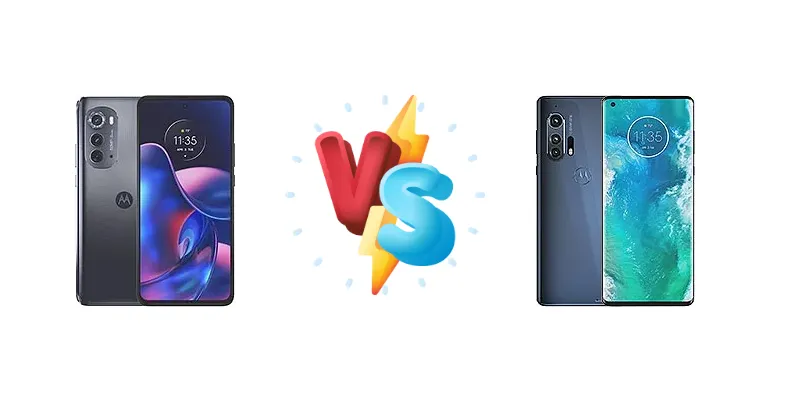
|
🏆 Quick Verdict
The Motorola Edge+ (2020) edges out the Edge (2022) thanks to its superior Snapdragon 865 performance and exceptional battery life. While the Edge (2022) offers faster charging and a slightly more modern chipset, the Edge+ remains a strong contender, especially considering its likely lower price now.
| PHONES | ||
|---|---|---|
| Phone Names | Motorola Edge (2022) | Motorola Edge+ (2020) |
| Network | ||
|---|---|---|
| 2G bands | GSM 850 / 900 / 1800 / 1900 | GSM 850 / 900 / 1800 / 1900 |
| 3G bands | HSDPA 850 / 900 / 1700(AWS) / 1900 / 2100 | HSDPA 850 / 900 / 1700(AWS) / 1900 / 2100 - Global |
| 4G bands | 1, 2, 3, 4, 5, 7, 8, 12, 13, 14, 20, 29, 30, 40, 41, 48, 66 | 1, 2, 3, 4, 5, 7, 8, 12, 13, 17, 20, 25, 26, 28, 29, 30, 34, 38, 39, 40, 41, 42, 46, 66, 71 - Global |
| 5G bands | 2, 5, 30, 66 SA/NSA | 5, 41, 66, 71, 77, 78 Sub6 - Global |
| Speed | HSPA, LTE, 5G | HSPA 42.2/5.76 Mbps, LTE-A (6CA) Cat20 2000/200 Mbps, 5G 4 Gbps DL |
| Technology | GSM / HSPA / LTE / 5G | GSM / CDMA / HSPA / EVDO / LTE / 5G |
| SA/NSA/Sub6/mmWave | 2, 5, 66, 260, 261 mmWave/Sub6 - Verizon | |
| Launch | ||
|---|---|---|
| Announced | 2022, August 18 | 2020, April 22 |
| Status | Available. Released 2022, September 22 | Available. Released 2020, May 14 |
| Body | ||
|---|---|---|
| Build | Glass front, plastic frame, plastic back | Glass front (Gorilla Glass 5), aluminum frame |
| Dimensions | 160.9 x 74.2 x 8 mm (6.33 x 2.92 x 0.31 in) | 161.1 x 71.4 x 9.6 mm (6.34 x 2.81 x 0.38 in) |
| SIM | Nano-SIM + eSIM | Nano-SIM |
| Weight | 170 g (6.00 oz) | 203 g (7.16 oz) |
| Water-repellent design | Water-repellent coating | |
| Display | ||
|---|---|---|
| Protection | - | Corning Gorilla Glass 5 |
| Resolution | 1080 x 2400 pixels, 20:9 ratio (~399 ppi density) | 1080 x 2340 pixels, 19.5:9 ratio (~385 ppi density) |
| Size | 6.6 inches, 105.2 cm2 (~88.1% screen-to-body ratio) | 6.7 inches, 110.2 cm2 (~95.8% screen-to-body ratio) |
| Type | OLED, 1B colors, 144Hz, HDR10+ | OLED, 1B colors, 90Hz, HDR10+ |
| Platform | ||
|---|---|---|
| CPU | Octa-core (2x2.5 GHz Cortex-A78 & 6x2.0 GHz Cortex-A55) | Octa-core (1x2.84 GHz Cortex-A77 & 3x2.42 GHz Cortex-A77 & 4x1.80 GHz Cortex-A55) |
| Chipset | MediaTek Dimensity 1050 (6 nm) | Qualcomm SM8250 Snapdragon 865 5G (7 nm+) |
| GPU | Arm Mali-G610 MC3 | Adreno 650 |
| OS | Android 12, upgradable to Android 14 | Android 10 |
| Memory | ||
|---|---|---|
| Card slot | No | No |
| Internal | 128GB 6GB RAM, 128GB 8GB RAM, 256GB 8GB RAM | 256GB 12GB RAM |
| - | UFS 3.0 | |
| Main Camera | ||
|---|---|---|
| Features | LED flash, HDR, panorama | Dual-LED dual-tone flash, panorama, HDR |
| Triple | 50 MP, f/1.8, (wide), 1/1.55", 1.0µm, multi-directional PDAF, OIS 13 MP, f/1.5, 120˚ (ultrawide), 1.12µm Auxiliary lens | 108 MP, f/1.8, (wide), 1/1.33", 0.8µm, PDAF, OIS 8 MP, f/2.4, 81mm (telephoto), 3x optical zoom, PDAF, OIS 16 MP, f/2.2, 13mm (ultrawide), 1.0µm, AF TOF 3D, (depth) |
| Video | 4K@30fps, 1080p@30/60/120fps, gyro-EIS | 6K@30fps, 4K@30fps, 1080p@30/60/120fps, gyro-EIS |
| Selfie camera | ||
|---|---|---|
| Features | HDR | HDR |
| Single | 32 MP, f/2.5, (wide), 0.7µm | 25 MP, f/2.0, (wide), 0.9µm |
| Video | 1080p@30fps | 1080p@30/120fps |
| Sound | ||
|---|---|---|
| 3.5mm jack | No | Yes |
| 35mm jack | No | - |
| Loudspeaker | Yes, with stereo speakers | Yes, with stereo speakers |
| Comms | ||
|---|---|---|
| Bluetooth | 5.2, A2DP, LE | 5.1, A2DP, LE |
| NFC | Yes | Yes |
| Positioning | GPS, GLONASS, BDS, GALILEO | GPS (L1+L5), GLONASS, BDS, GALILEO |
| Radio | No | No |
| USB | USB Type-C 2.0, OTG | USB Type-C 3.1 |
| WLAN | Wi-Fi 802.11 a/b/g/n/ac/6e, tri-band, Wi-Fi Direct | Wi-Fi 802.11 a/b/g/n/ac/6, dual-band, Wi-Fi Direct |
| Features | ||
|---|---|---|
| Sensors | Fingerprint (under display, optical), accelerometer, gyro, proximity, compass, barometer | Fingerprint (under display, optical), accelerometer, gyro, proximity, compass, barometer |
| Battery | ||
|---|---|---|
| Charging | 30W wired 15W wireless 5W reverse wired | 18W wired 15W wireless 5W reverse wireless |
| Type | Li-Po 5000 mAh | Li-Po 5000 mAh, non-removable |
| Misc | ||
|---|---|---|
| Colors | Grey | Smokey Sangria, Thunder Grey, Baltic Gray |
| Models | - | XT2061-3 |
| Price | $ 98.84 | About 670 EUR |
| Tests | ||
|---|---|---|
| Battery life | - | Endurance rating 100h |
| Camera | - | Photo / Video |
| Display | - | Contrast ratio: Infinite (nominal) |
| Loudspeaker | - | -25.3 LUFS (Very good) |
| Performance | - | AnTuTu: 574155 (v8) GeekBench: 3295 (v5.1) GFXBench: 48fps (ES 3.1 onscreen) |
Motorola Edge (2022)
- Faster Charging (30W wired)
- 144Hz Display
- More Recent Chipset (Dimensity 1050)
- Reverse Wireless Charging
- Slightly Lower Performance than Snapdragon 865
- Battery Life Not as Impressive as Edge+ (2020)
Motorola Edge+ (2020)
- Superior Performance (Snapdragon 865)
- Exceptional Battery Life
- Excellent Camera Quality
- Premium Build Quality
- Slower Charging (18W wired)
- Older Chipset
- May be more expensive depending on retailer
Display Comparison
The Motorola Edge (2022) typically features a 6.6-inch OLED display with a 144Hz refresh rate, offering smoother visuals. The Edge+ (2020) has a 6.7-inch OLED display, with a contrast ratio advertised as 'infinite' (nominal), suggesting excellent blacks and vibrant colors. While both offer excellent image quality, the Edge (2022)'s higher refresh rate provides a more fluid experience for gaming and scrolling.
Camera Comparison
The Edge+ (2020) typically features a triple-camera system with a 108MP main sensor, offering excellent image quality and versatility. The Edge (2022) has a triple camera system, but sensor details vary. Both phones capture good photos, but the Edge+ (2020) often produces more detailed and vibrant images, particularly in well-lit conditions. Video recording capabilities are comparable.
Performance
The Edge+ (2020) utilizes the Snapdragon 865, a flagship chipset from 2020, still capable of handling demanding tasks. The Edge (2022) features the MediaTek Dimensity 1050, a more recent chipset. While the Dimensity 1050 is efficient, the Snapdragon 865 generally offers a slight edge in raw processing power and sustained performance, especially in graphically intensive applications. The Cortex-A77 cores in the 865 are generally faster than the Cortex-A78 cores in the Dimensity 1050.
Battery Life
The Edge+ (2020) shines in battery life, often achieving impressive endurance ratings (around 100 hours). The Edge (2022) offers decent battery life, but it doesn't quite match the longevity of the Edge+ (2020). The Edge (2022) does have faster 30W wired charging and 15W wireless charging, while the Edge+ (2020) has 18W wired and 15W wireless.
Buying Guide
Who should buy the Motorola Edge (2022)? Users prioritizing faster charging speeds and a more recent chipset for smoother everyday tasks. Who should buy the Motorola Edge+ (2020)? Those seeking top-tier performance, outstanding battery life, and a premium camera experience, particularly at a potentially discounted price.