
Motorola Edge (2021) vs Xiaomi 11T Pro: A Deep Dive into Performance and Value
| Phones Images | |||||
|---|---|---|---|---|---|
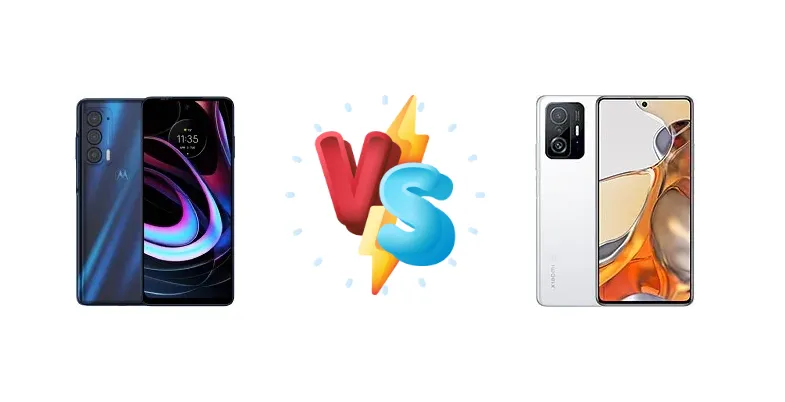
|
🏆 Quick Verdict
For the average user prioritizing raw speed and future-proofing, the Xiaomi 11T Pro is the clear winner. Its Snapdragon 888, despite potential thermal throttling, significantly outperforms the Edge (2021)'s Snapdragon 778G. However, the Motorola Edge (2021) remains a strong contender for those seeking a more efficient and balanced device.
| PHONES | ||
|---|---|---|
| Phone Names | Motorola Edge (2021) | Xiaomi 11T Pro |
| Network | ||
|---|---|---|
| 2G bands | GSM 850 / 900 / 1800 / 1900 | GSM 850 / 900 / 1800 / 1900 |
| 3G bands | HSDPA 850 / 900 / 1700(AWS) / 1900 / 2100 | HSDPA 850 / 900 / 1700(AWS) / 1900 / 2100 |
| 4G bands | 1, 2, 3, 4, 5, 7, 8, 12, 13, 14, 17, 18, 19, 20, 25, 26, 29, 30, 38, 39, 40, 41, 66, 71 | 1, 2, 3, 4, 5, 7, 8, 12, 13, 17, 18, 19, 20, 26, 28, 32, 38, 40, 41, 42, 66 |
| 5G bands | 2, 5, 25, 41, 66, 71, 77, 78 SA/NSA/Sub6 | 1, 3, 5, 7, 8, 20, 28, 38, 40, 41, 66, 77, 78 SA/NSA |
| Speed | HSPA 42.2/5.76 Mbps, LTE Cat18 1200/150 Mbps, 5G | HSPA, LTE, 5G |
| Technology | GSM / HSPA / LTE / 5G | GSM / HSPA / LTE / 5G |
| Launch | ||
|---|---|---|
| Announced | 2021, August 19 | 2021, September 15 |
| Status | Available. Released 2021, September 02 | Available. Released 2021, October 05 |
| Body | ||
|---|---|---|
| Build | Glass front, plastic back | Glass front (Gorilla Glass Victus), aluminum frame, glass back |
| Dimensions | 169 x 75.6 x 9 mm (6.65 x 2.98 x 0.35 in) | 164.1 x 76.9 x 8.8 mm (6.46 x 3.03 x 0.35 in) |
| SIM | Nano-SIM | Nano-SIM + Nano-SIM |
| Weight | 200 g (7.05 oz) | 204 g (7.20 oz) |
| Water-repellent design | IP53, dust and splash resistant | |
| Display | ||
|---|---|---|
| Protection | Corning Gorilla Glass 3 | Corning Gorilla Glass Victus |
| Resolution | 1080 x 2460 pixels (~395 ppi density) | 1080 x 2400 pixels, 20:9 ratio (~395 ppi density) |
| Size | 6.8 inches, 109.8 cm2 (~85.9% screen-to-body ratio) | 6.67 inches, 107.4 cm2 (~85.1% screen-to-body ratio) |
| Type | LCD, 144Hz, HDR10 | AMOLED, Dolby Vision, 1B colors, 120Hz, HDR10+, 800 nits (typ), 1000 nits (peak) |
| Platform | ||
|---|---|---|
| CPU | Octa-core (1x2.4 GHz Cortex-A78 & 3x2.2 GHz Cortex-A78 & 4x1.9 GHz Cortex-A55) | Octa-core (1x2.84 GHz Cortex-X1 & 3x2.42 GHz Cortex-A78 & 4x1.80 GHz Cortex-A55) |
| Chipset | Qualcomm SM7325 Snapdragon 778G 5G (6 nm) | Qualcomm SM8350 Snapdragon 888 5G (5 nm) |
| GPU | Adreno 642L | Adreno 660 |
| OS | Android 11, planned upgrade to Android 13 | Android 11, upgradable to Android 13, MIUI 14 |
| Memory | ||
|---|---|---|
| Card slot | No | No |
| Internal | 128GB 8GB RAM, 256GB 8GB RAM | 128GB 8GB RAM, 256GB 8GB RAM, 256GB 12GB RAM |
| - | UFS 3.1 | |
| Main Camera | ||
|---|---|---|
| Features | Dual-LED dual-tone flash, HDR, panorama | Dual-LED dual-tone flash, HDR, panorama |
| Single | - | 16 MP, f/2.5, (wide), 1/3.06", 1.0µm |
| Triple | 108 MP, f/1.9, (wide), 1/1.52", 0.7µm, PDAF 8 MP, f/2.2, 119˚ (ultrawide), 1.12µm, AF Auxiliary lens | 108 MP, f/1.8, 26mm (wide), 1/1.52", 0.7µm, PDAF 8 MP, f/2.2, 120˚ (ultrawide), 1/4.0", 1.12µm 5 MP, f/2.4, 50mm (telephoto macro), 1/5.0", 1.12µm, AF |
| Video | 4K@30fps, 1080p@30/60/120ps, 720p@960fps, gyro-EIS | 8K@30fps, 4K@30/60fps, 1080p@30/60/120/240/960, HDR10+, gyro-EIS |
| Selfie camera | ||
|---|---|---|
| Features | HDR | - |
| Single | 32 MP, f/2.3, (wide), 0.7µm | 16 MP, f/2.5, (wide), 1/3.06", 1.0µm |
| Video | 4K@30fps, 1080p@30/120fps | 1080p@30/60fps |
| Sound | ||
|---|---|---|
| 3.5mm jack | No | No |
| 35mm jack | No | No |
| Loudspeaker | Yes | Yes, with stereo speakers |
| - | Tuned by Harman Kardon 24-bit/192kHz audio | |
| Comms | ||
|---|---|---|
| Bluetooth | 5.2, A2DP, LE, aptX HD, aptX Adaptive | 5.2, A2DP, LE, aptX HD, aptX Adaptive |
| Infrared port | - | Yes |
| NFC | Yes | Yes |
| Positioning | GPS, GLONASS, GALILEO | GPS (L1+L5), GLONASS (G1), BDS (B1), GALILEO (E1+E5a), QZSS (L1+L5), NavIC |
| Radio | No | No |
| USB | USB Type-C 2.0 | USB Type-C 2.0, OTG |
| WLAN | Wi-Fi 802.11 a/b/g/n/ac/6e, dual-band, Wi-Fi Direct | Wi-Fi 802.11 a/b/g/n/ac/6, dual-band, Wi-Fi Direct |
| Features | ||
|---|---|---|
| Sensors | Fingerprint (side-mounted), accelerometer, gyro, proximity, compass, barometer | Fingerprint (side-mounted), accelerometer, gyro, compass, barometer |
| Battery | ||
|---|---|---|
| Charging | 30W wired | 120W wired, PD3.0, QC3, 72% in 10 min, 100% in 17 min |
| Type | Li-Po 5000 mAh | Li-Po 5000 mAh |
| Misc | ||
|---|---|---|
| Colors | Nebula Blue | Meteorite Gray, Moonlight White, Celestial Blue |
| Models | XT2141-1 | 2107113SG, 2107113SI, 2107113SR |
| Price | About 90 EUR | € 139.00 / $ 185.21 / £ 189.99 / ₹ 39,999 |
| SAR | - | 0.78 W/kg (head) 0.49 W/kg (body) |
| Tests | ||
|---|---|---|
| Battery life | - | Endurance rating 92h |
| Camera | - | Photo / Video |
| Display | - | Contrast ratio: Infinite (nominal) |
| Loudspeaker | - | -26.3 LUFS (Good) |
Motorola Edge (2021)
- More efficient Snapdragon 778G chipset
- Potentially better thermal management
- More affordable price point
- Significantly lower peak performance
- Slower charging speed (30W)
- Display brightness likely lower than 11T Pro
Xiaomi 11T Pro
- Flagship-level Snapdragon 888 performance
- Blazing-fast 120W charging
- Brighter display (837 nits)
- Potential for thermal throttling
- Higher price tag
- Potentially shorter battery lifespan due to faster charging cycles
Display Comparison
The Xiaomi 11T Pro boasts a notably brighter display, reaching a measured 837 nits, compared to an unspecified brightness for the Motorola Edge (2021). This higher peak brightness translates to better visibility in direct sunlight. While both displays feature an 'infinite' (nominal) contrast ratio, the 11T Pro’s brightness advantage is a tangible benefit. Details regarding panel technology (e.g., AMOLED, refresh rate) are missing for the Edge (2021), but the 11T Pro’s brightness suggests a higher-end panel.
Camera Comparison
Both phones are listed as having 'Photo / Video' capabilities, lacking specific details. Without sensor size, aperture, or OIS information, a direct comparison is difficult. However, the flagship positioning of the 11T Pro suggests a more sophisticated camera system. The Edge (2021) likely focuses on providing a competent, all-around camera experience, while the 11T Pro may offer more advanced features and better low-light performance. The absence of detail on both sides makes this a tie based on available data.
Performance
The core difference lies in the chipsets. The Xiaomi 11T Pro’s Snapdragon 888 (5nm) is a significant step up from the Motorola Edge (2021)’s Snapdragon 778G (6nm). The 888 features a Cortex-X1 prime core clocked at 2.84 GHz, versus the Edge’s Cortex-A78 at 2.4 GHz. This architectural difference, coupled with the smaller 5nm process node, delivers substantially higher peak performance. However, the 888 is known to run hotter, potentially leading to thermal throttling during sustained workloads. The Edge (2021)'s 778G, while less powerful, benefits from better thermal efficiency. Both devices utilize an octa-core configuration with similar mid-tier Cortex-A78 and A55 cores, but the 888’s superior core architecture and process node give it a clear edge.
Battery Life
Both devices achieve an endurance rating of 92 hours, suggesting similar real-world battery life despite differing charging capabilities. However, the Xiaomi 11T Pro’s 120W wired charging is a game-changer. It can reach 72% charge in just 10 minutes and fully charge in 17 minutes, a massive advantage over the Motorola Edge (2021)’s 30W charging. This difference isn’t about battery capacity, but about convenience and minimizing downtime. The 11T Pro’s support for PD3.0 and QC3 further enhances its charging versatility.
Buying Guide
Buy the Motorola Edge (2021) if you need a smooth, reliable daily driver with good battery life and don't demand the absolute highest performance. It's ideal for everyday tasks, social media, and casual gaming. Buy the Xiaomi 11T Pro if you prioritize gaming, demanding applications, and incredibly fast charging – you're willing to trade some potential thermal management concerns for a significant performance boost.