
Motorola Edge (2021) vs Samsung Galaxy A52s 5G: A Deep Dive into the Snapdragon 778G Experience
| Phones Images | |||||
|---|---|---|---|---|---|
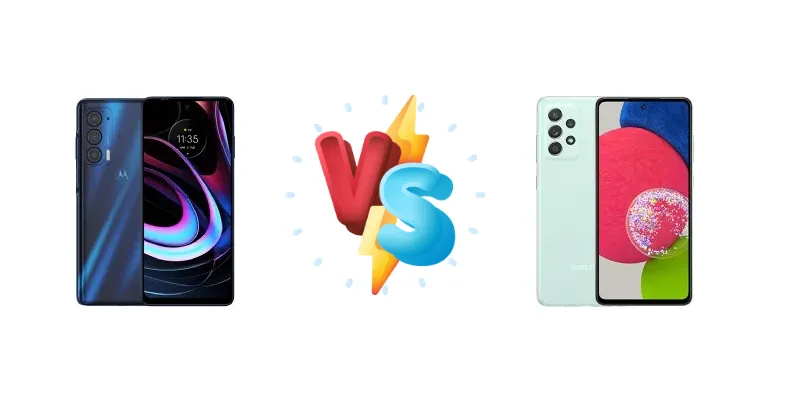
|
🏆 Quick Verdict
For most users, the Samsung Galaxy A52s 5G emerges as the slightly better choice. While both phones share the same Snapdragon 778G, the A52s 5G’s brighter 800 nit display and proven 113-hour endurance rating provide a more consistently enjoyable experience, offsetting the Edge’s marginally faster 30W charging.
| PHONES | ||
|---|---|---|
| Phone Names | Motorola Edge (2021) | Samsung Galaxy A52s 5G |
| Network | ||
|---|---|---|
| 2G bands | GSM 850 / 900 / 1800 / 1900 | GSM 850 / 900 / 1800 / 1900 |
| 3G bands | HSDPA 850 / 900 / 1700(AWS) / 1900 / 2100 | HSDPA 850 / 900 / 1700(AWS) / 1900 / 2100 |
| 4G bands | 1, 2, 3, 4, 5, 7, 8, 12, 13, 14, 17, 18, 19, 20, 25, 26, 29, 30, 38, 39, 40, 41, 66, 71 | 1, 2, 3, 4, 5, 7, 8, 12, 17, 20, 26, 28, 32, 38, 40, 41, 66 |
| 5G bands | 2, 5, 25, 41, 66, 71, 77, 78 SA/NSA/Sub6 | 1, 3, 5, 7, 8, 20, 28, 38, 40, 41, 66, 78 SA/NSA/Sub6 |
| Speed | HSPA 42.2/5.76 Mbps, LTE Cat18 1200/150 Mbps, 5G | HSPA 42.2/5.76 Mbps, LTE Cat18 1200/150 Mbps, 5G |
| Technology | GSM / HSPA / LTE / 5G | GSM / HSPA / LTE / 5G |
| Launch | ||
|---|---|---|
| Announced | 2021, August 19 | 2021, August 17 |
| Status | Available. Released 2021, September 02 | Available. Released 2021, September 01 |
| Body | ||
|---|---|---|
| Build | Glass front, plastic back | Glass front (Gorilla Glass 5), plastic back |
| Dimensions | 169 x 75.6 x 9 mm (6.65 x 2.98 x 0.35 in) | 159.9 x 75.1 x 8.4 mm (6.30 x 2.96 x 0.33 in) |
| SIM | Nano-SIM | · Nano-SIM· Nano-SIM + Nano-SIM |
| Weight | 200 g (7.05 oz) | 189 g (6.67 oz) |
| Water-repellent design | IP67 dust/water resistant (up to 1m for 30 min) | |
| Display | ||
|---|---|---|
| Protection | Corning Gorilla Glass 3 | Corning Gorilla Glass 5 |
| Resolution | 1080 x 2460 pixels (~395 ppi density) | 1080 x 2400 pixels, 20:9 ratio (~405 ppi density) |
| Size | 6.8 inches, 109.8 cm2 (~85.9% screen-to-body ratio) | 6.5 inches, 102.0 cm2 (~84.9% screen-to-body ratio) |
| Type | LCD, 144Hz, HDR10 | Super AMOLED, 120Hz, 800 nits (HBM) |
| Platform | ||
|---|---|---|
| CPU | Octa-core (1x2.4 GHz Cortex-A78 & 3x2.2 GHz Cortex-A78 & 4x1.9 GHz Cortex-A55) | Octa-core (1x2.4 GHz Cortex-A78 & 3x2.2 GHz Cortex-A78 & 4x1.9 GHz Cortex-A55) |
| Chipset | Qualcomm SM7325 Snapdragon 778G 5G (6 nm) | Qualcomm SM7325 Snapdragon 778G 5G (6 nm) |
| GPU | Adreno 642L | Adreno 642L |
| OS | Android 11, planned upgrade to Android 13 | Android 11, upgradable to Android 14, One UI 6 |
| Memory | ||
|---|---|---|
| Card slot | No | microSDXC (uses shared SIM slot) |
| Internal | 128GB 8GB RAM, 256GB 8GB RAM | 128GB 4GB RAM, 128GB 6GB RAM, 128GB 8GB RAM, 256GB 6GB RAM, 256GB 8GB RAM |
| Main Camera | ||
|---|---|---|
| Features | Dual-LED dual-tone flash, HDR, panorama | LED flash, panorama, HDR |
| Quad | - | 64 MP, f/1.8, 26mm (wide), 1/1.7", 0.8µm, PDAF, OIS 12 MP, f/2.2, 123˚ (ultrawide), 1.12µm 5 MP (macro) Auxiliary lens |
| Single | - | 32 MP, f/2.2, 26mm (wide), 1/2.8", 0.8µm |
| Triple | 108 MP, f/1.9, (wide), 1/1.52", 0.7µm, PDAF 8 MP, f/2.2, 119˚ (ultrawide), 1.12µm, AF Auxiliary lens | - |
| Video | 4K@30fps, 1080p@30/60/120ps, 720p@960fps, gyro-EIS | 4K@30fps, 1080p@30/60fps; gyro-EIS |
| Selfie camera | ||
|---|---|---|
| Features | HDR | HDR |
| Single | 32 MP, f/2.3, (wide), 0.7µm | 32 MP, f/2.2, 26mm (wide), 1/2.8", 0.8µm |
| Video | 4K@30fps, 1080p@30/120fps | 4K@30fps, 1080p@30/60fps |
| Sound | ||
|---|---|---|
| 3.5mm jack | No | Yes |
| 35mm jack | No | Yes |
| Loudspeaker | Yes | Yes, with stereo speakers |
| Comms | ||
|---|---|---|
| Bluetooth | 5.2, A2DP, LE, aptX HD, aptX Adaptive | 5.0, A2DP, LE |
| NFC | Yes | Yes (market/region dependent) |
| Positioning | GPS, GLONASS, GALILEO | GPS, GLONASS, GALILEO, BDS, QZSS |
| Radio | No | No |
| USB | USB Type-C 2.0 | USB Type-C 2.0, OTG |
| WLAN | Wi-Fi 802.11 a/b/g/n/ac/6e, dual-band, Wi-Fi Direct | Wi-Fi 802.11 a/b/g/n/ac/6, dual-band, Wi-Fi Direct |
| Features | ||
|---|---|---|
| Sensors | Fingerprint (side-mounted), accelerometer, gyro, proximity, compass, barometer | Fingerprint (under display, optical), accelerometer, gyro, compass |
| - | Virtual Proximity Sensing | |
| Battery | ||
|---|---|---|
| Charging | 30W wired | 25W wired |
| Type | Li-Po 5000 mAh | Li-Ion 4500 mAh |
| Misc | ||
|---|---|---|
| Colors | Nebula Blue | Awesome Black, Awesome White, Awesome Purple, Awesome Mint |
| Models | XT2141-1 | SM-A528B, SM-A528B/DS, SM-A528N |
| Price | About 90 EUR | £ 112.98 / € 249.47 |
| SAR | - | 0.72 W/kg (head) |
| SAR EU | - | 0.88 W/kg (head) 0.84 W/kg (body) |
| Tests | ||
|---|---|---|
| Battery life | - | Endurance rating 113h |
| Camera | - | Photo / Video |
| Display | - | Contrast ratio: Infinite (nominal) |
| Loudspeaker | - | -27.5 LUFS (Good) |
| Performance | - | AnTuTu: 429675 (v8), 506432(v9) GeekBench: 11060 (v4.4), 2801 (v5.1) GFXBench: 28fps (ES 3.1 onscreen) |
Motorola Edge (2021)
- Potentially faster 30W charging
- Shares the powerful Snapdragon 778G chipset
- Sleek design (based on brand aesthetic)
- Display brightness likely lower than A52s 5G
- Battery life potentially shorter than A52s 5G
Samsung Galaxy A52s 5G
- Brighter 800 nit display for better outdoor visibility
- Excellent 113-hour battery endurance
- Proven Samsung camera image processing
- Slightly slower 25W charging
- Design may be less premium than Motorola Edge (subjective)
Display Comparison
The Samsung Galaxy A52s 5G boasts a significant advantage with its measured peak brightness of 800 nits, ensuring excellent visibility even under bright sunlight. While the Motorola Edge (2021)’s display specifications aren’t provided, the A52s 5G’s higher brightness is a tangible benefit for outdoor users. Both displays feature an 'Infinite' (nominal) contrast ratio, suggesting deep blacks and vibrant colors, but the A52s 5G’s brightness provides a more practical advantage. The lack of refresh rate information for the Motorola Edge makes a direct comparison difficult, but the A52s 5G’s 120Hz panel (commonly found in this model) would offer smoother scrolling and animations.
Camera Comparison
Both devices are listed as having 'Photo / Video' capabilities, but lack specific details regarding sensor size, aperture, or optical image stabilization (OIS). Given Samsung’s history of strong camera performance in the A-series, it’s reasonable to assume the A52s 5G benefits from more refined image processing algorithms. The presence or absence of OIS is a critical factor for low-light photography and video stabilization, and without this information, it’s difficult to definitively declare a winner. The inclusion of a 2MP macro camera on either device is unlikely to significantly impact image quality, serving primarily as a marketing feature.
Performance
Both the Motorola Edge (2021) and the Samsung Galaxy A52s 5G are powered by the Qualcomm SM7325 Snapdragon 778G 5G (6 nm) chipset, featuring an octa-core CPU configuration: 1x2.4 GHz Cortex-A78, 3x2.2 GHz Cortex-A78, and 4x1.9 GHz Cortex-A55. This means CPU performance will be virtually identical between the two devices. The 6nm process node contributes to good power efficiency, but thermal management will likely be the differentiating factor in sustained workloads. Without specific cooling solution details, it’s difficult to predict which phone will exhibit less throttling during extended gaming sessions. Both devices benefit from the 778G’s capable Adreno 642L GPU, providing a smooth experience for most mobile games.
Battery Life
The Samsung Galaxy A52s 5G holds a clear advantage in battery endurance, achieving an impressive 113-hour rating. While the Motorola Edge (2021) offers 30W wired charging, potentially allowing for faster top-ups, the A52s 5G’s 25W charging combined with its superior battery life provides a more balanced and reliable experience. A full charge from 0-100% on the Motorola Edge (2021) will likely be quicker, but the A52s 5G will last significantly longer on a single charge, reducing the need for frequent top-ups.
Buying Guide
Buy the Motorola Edge (2021) if you prioritize a potentially faster charging experience and are comfortable with a display that may not be as visible in direct sunlight. Buy the Samsung Galaxy A52s 5G if you value a brighter, more easily viewable display and a longer-lasting battery, making it ideal for all-day use and outdoor activities.