
Motorola Edge 2021 vs LG V60 ThinQ 5G: A Head-to-Head Showdown
| Phones Images | |||||
|---|---|---|---|---|---|
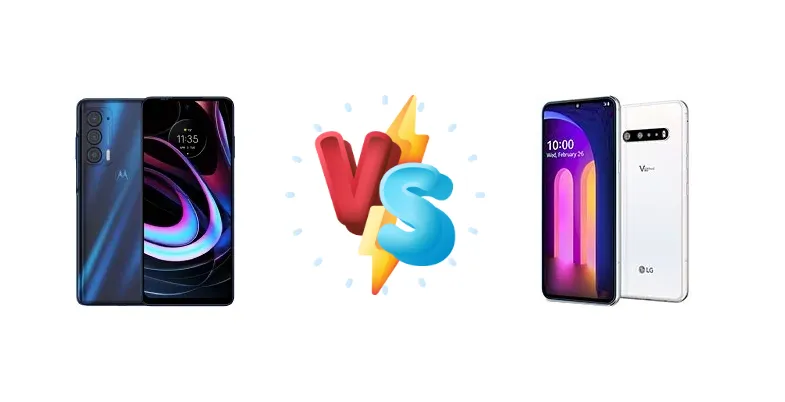
|
🏆 Quick Verdict
The LG V60 ThinQ 5G edges out the Motorola Edge (2021) thanks to its superior flagship Snapdragon 865 chipset, versatile camera system, and exceptional battery life. While the Edge offers a more modern design, the V60's performance and longevity make it the stronger choice.
| PHONES | ||
|---|---|---|
| Phone Names | Motorola Edge (2021) | LG V60 ThinQ 5G |
| Network | ||
|---|---|---|
| 2G bands | GSM 850 / 900 / 1800 / 1900 | GSM 850 / 900 / 1800 / 1900 |
| 3G bands | HSDPA 850 / 900 / 1700(AWS) / 1900 / 2100 | HSDPA 850 / 900 / 1700(AWS) / 1900 / 2100 |
| 4G bands | 1, 2, 3, 4, 5, 7, 8, 12, 13, 14, 17, 18, 19, 20, 25, 26, 29, 30, 38, 39, 40, 41, 66, 71 | 2, 4, 5, 12, 25, 26, 41, 46, 48, 66, 71 - USA |
| 5G bands | 2, 5, 25, 41, 66, 71, 77, 78 SA/NSA/Sub6 | 2, 25, 41, 66, 71 SA/NSA/Sub6 |
| Speed | HSPA 42.2/5.76 Mbps, LTE Cat18 1200/150 Mbps, 5G | HSPA 42.2/5.76 Mbps, LTE (7CA) Cat22, 5G |
| Technology | GSM / HSPA / LTE / 5G | GSM / CDMA / HSPA / EVDO / LTE / 5G |
| - | CDMA2000 1xEV-DO | |
| Launch | ||
|---|---|---|
| Announced | 2021, August 19 | 2020, February 26. Released 2020, March 20 |
| Status | Available. Released 2021, September 02 | Discontinued |
| Body | ||
|---|---|---|
| Build | Glass front, plastic back | Glass front (Gorilla Glass 5), glass back (Gorilla Glass 6), aluminum frame |
| Dimensions | 169 x 75.6 x 9 mm (6.65 x 2.98 x 0.35 in) | 169.3 x 77.6 x 8.9 mm (6.67 x 3.06 x 0.35 in) |
| SIM | Nano-SIM | · Nano-SIM· Nano-SIM + Nano-SIM |
| Weight | 200 g (7.05 oz) | 213 g (Global)/ 218 g (Verizon) (7.51 oz) |
| Water-repellent design | IP68 dust/water resistant (up to 1.5m for 30 min) MIL-STD-810G compliant* Method 516.6, Procedure IV "Transit Drop" *does not guarantee ruggedness or use in extreme conditions | |
| Display | ||
|---|---|---|
| Protection | Corning Gorilla Glass 3 | Corning Gorilla Glass 5 |
| Resolution | 1080 x 2460 pixels (~395 ppi density) | 1080 x 2460 pixels (~395 ppi density) |
| Size | 6.8 inches, 109.8 cm2 (~85.9% screen-to-body ratio) | 6.8 inches, 109.8 cm2 (~83.6% screen-to-body ratio) |
| Type | LCD, 144Hz, HDR10 | P-OLED, HDR10+ |
| - | Always-on display | |
| Platform | ||
|---|---|---|
| CPU | Octa-core (1x2.4 GHz Cortex-A78 & 3x2.2 GHz Cortex-A78 & 4x1.9 GHz Cortex-A55) | Octa-core (1x2.84 GHz Cortex-A77 & 3x2.42 GHz Cortex-A77 & 4x1.80 GHz Cortex-A55) |
| Chipset | Qualcomm SM7325 Snapdragon 778G 5G (6 nm) | Qualcomm SM8250 Snapdragon 865 5G (7 nm+) |
| GPU | Adreno 642L | Adreno 650 |
| OS | Android 11, planned upgrade to Android 13 | Android 10, upgradable to Android 13 |
| Memory | ||
|---|---|---|
| Card slot | No | microSDXC (uses shared SIM slot) - dual-SIM model |
| Internal | 128GB 8GB RAM, 256GB 8GB RAM | 128GB 8GB RAM, 256GB 8GB RAM |
| - | UFS 2.1 | |
| Main Camera | ||
|---|---|---|
| Dual | - | 64 MP, f/1.8, 27mm (standard), 1/1.72", 0.8µm, dual pixel PDAF, OIS 13 MP, f/1.9, 12mm (ultrawide), 1/3.4", 1.0µm 0.3 MP, TOF 3D, f/1.4, (depth) |
| Features | Dual-LED dual-tone flash, HDR, panorama | Dual-LED dual-tone flash, HDR, panorama |
| Triple | 108 MP, f/1.9, (wide), 1/1.52", 0.7µm, PDAF 8 MP, f/2.2, 119˚ (ultrawide), 1.12µm, AF Auxiliary lens | - |
| Video | 4K@30fps, 1080p@30/60/120ps, 720p@960fps, gyro-EIS | 8K@30fps, 4K@30/60fps, 1080p, HDR10+, 24-bit/192kHz stereo sound rec., gyro-EIS |
| Selfie camera | ||
|---|---|---|
| Features | HDR | HDR |
| Single | 32 MP, f/2.3, (wide), 0.7µm | 10 MP, f/1.9, 30mm (standard), 1/3.1", 1.22µm |
| Video | 4K@30fps, 1080p@30/120fps | 4K@30fps, gyro-EIS |
| Sound | ||
|---|---|---|
| 3.5mm jack | No | Yes |
| 35mm jack | No | Yes |
| Loudspeaker | Yes | Yes, with stereo speakers |
| - | 32-bit/192kHz audio 24-bit/192kHz audio recording | |
| Comms | ||
|---|---|---|
| Bluetooth | 5.2, A2DP, LE, aptX HD, aptX Adaptive | 5.1, A2DP, LE, aptX HD |
| NFC | Yes | Yes |
| Positioning | GPS, GLONASS, GALILEO | GPS, GLONASS, GALILEO, BDS |
| Radio | No | FM radio (USA model only) |
| USB | USB Type-C 2.0 | USB Type-C 3.1, OTG |
| WLAN | Wi-Fi 802.11 a/b/g/n/ac/6e, dual-band, Wi-Fi Direct | Wi-Fi 802.11 a/b/g/n/ac/6, dual-band, Wi-Fi Direct, DLNA |
| Features | ||
|---|---|---|
| Sensors | Fingerprint (side-mounted), accelerometer, gyro, proximity, compass, barometer | Fingerprint (under display, optical), accelerometer, gyro, proximity, compass, barometer |
| Battery | ||
|---|---|---|
| Charging | 30W wired | Wired, PD2.0, QC4 Wireless |
| Type | Li-Po 5000 mAh | Li-Po 5000 mAh |
| Misc | ||
|---|---|---|
| Colors | Nebula Blue | Classy Blue, Classy White |
| Models | XT2141-1 | LM-V600, A001LG |
| Price | About 90 EUR | About 700 EUR |
| Tests | ||
|---|---|---|
| Battery life | - | Endurance rating 103h |
Motorola Edge (2021)
- Sleek and modern design
- High refresh rate display (144Hz)
- High-resolution main camera (108MP)
- Competitive price
- Less powerful chipset than V60
- No wireless charging
- Camera system less versatile than V60
- Battery life not as impressive as V60
LG V60 ThinQ 5G
- Powerful Snapdragon 865 chipset
- Versatile camera system with telephoto lens
- Exceptional battery life (103h endurance)
- Wireless charging support
- PD2.0 and QC4 fast charging
- Older design
- Can be harder to find new
- Software support ended (LG exit)
Display Comparison
The Motorola Edge (2021) boasts a vibrant 6.8-inch OLED display with a 144Hz refresh rate, offering incredibly smooth scrolling and visuals. The LG V60 ThinQ 5G features a 6.8-inch OLED display with a 120Hz refresh rate. While both are excellent, the Edge's higher refresh rate provides a slightly more fluid experience, though the V60's display is known for its accurate color reproduction.
Camera Comparison
The LG V60 ThinQ 5G features a versatile triple-camera system with a 64MP main sensor, a 13MP ultrawide lens, and a 10MP telephoto lens. It's known for its excellent image quality and manual controls. The Motorola Edge (2021) has a 108MP main sensor, an 8MP ultrawide, and a 2MP depth sensor. While the Edge's main sensor offers high resolution, the V60's overall camera system is more well-rounded.
Performance
Here's where the LG V60 ThinQ 5G truly shines. Its Snapdragon 865 chipset is significantly more powerful than the Edge's Snapdragon 778G. Expect faster app loading times, smoother multitasking, and better performance in demanding games. The Edge is still capable, but the V60 offers a noticeable performance advantage.
Battery Life
Both phones offer large batteries, but the LG V60 ThinQ 5G takes the crown with its exceptional endurance rating of 103 hours. The Motorola Edge (2021) provides decent battery life, but it doesn't match the V60's longevity. The V60 also supports faster charging (PD2.0, QC4) and wireless charging, which the Edge lacks.
Buying Guide
The Motorola Edge (2021) is ideal for users prioritizing a sleek design and a smooth, everyday experience. The LG V60 ThinQ 5G is best suited for power users, photographers, and those who demand long-lasting battery performance and a robust feature set.