
Motorola Edge (2021) vs Google Pixel 6a: A Head-to-Head Showdown
| Phones Images | |||||
|---|---|---|---|---|---|
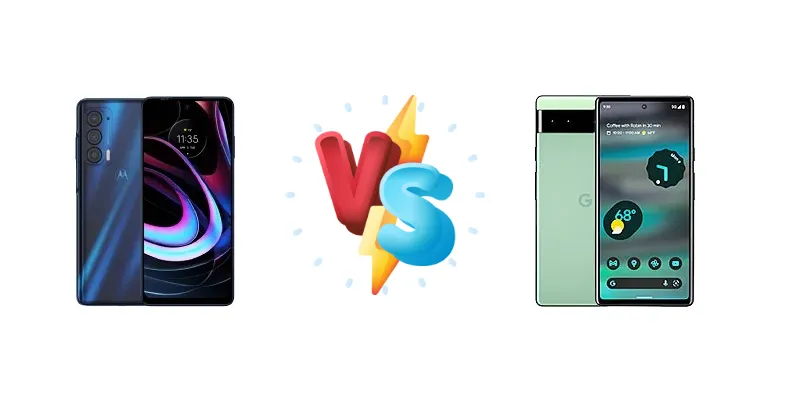
|
🏆 Quick Verdict
The Pixel 6a wins overall thanks to its superior camera, smoother software experience, and Google Tensor chip's AI capabilities. While the Edge 2021 boasts faster charging and a slightly more vibrant display, the Pixel 6a's strengths outweigh its weaknesses for most users.
| PHONES | ||
|---|---|---|
| Phone Names | Motorola Edge (2021) | Google Pixel 6a |
| Network | ||
|---|---|---|
| 2G bands | GSM 850 / 900 / 1800 / 1900 | GSM 850 / 900 / 1800 / 1900 |
| 3G bands | HSDPA 850 / 900 / 1700(AWS) / 1900 / 2100 | HSDPA 800 / 850 / 900 / 1700(AWS) / 1900 / 2100 |
| 4G bands | 1, 2, 3, 4, 5, 7, 8, 12, 13, 14, 17, 18, 19, 20, 25, 26, 29, 30, 38, 39, 40, 41, 66, 71 | 1, 2, 3, 4, 5, 7, 8, 12, 13, 14, 17, 18, 19, 20, 25, 26, 28, 29, 30, 38, 39, 40, 41, 42, 48, 66, 71 - GX7AS, GB62Z (USA/Canada) |
| 5G bands | 2, 5, 25, 41, 66, 71, 77, 78 SA/NSA/Sub6 | 1, 2, 3, 5, 7, 8, 12, 20, 25, 28, 30, 38, 40, 41, 48, 66, 71, 77, 78 SA/NSA/Sub6 - GX7AS (USA/Canada) |
| Speed | HSPA 42.2/5.76 Mbps, LTE Cat18 1200/150 Mbps, 5G | HSPA, LTE, 5G |
| Technology | GSM / HSPA / LTE / 5G | GSM / HSPA / LTE / 5G |
| - | 1, 2, 3, 5, 7, 8, 12, 20, 25, 28, 30, 40, 48, 66, 71, 77, 78 SA/NSA/Sub6 - G1AZG (International) | |
| Launch | ||
|---|---|---|
| Announced | 2021, August 19 | 2022, May 11 |
| Status | Available. Released 2021, September 02 | Available. Released 2022, July 21 |
| Body | ||
|---|---|---|
| Build | Glass front, plastic back | Glass front (Gorilla Glass 3), aluminum frame, plastic back |
| Dimensions | 169 x 75.6 x 9 mm (6.65 x 2.98 x 0.35 in) | 152.2 x 71.8 x 8.9 mm (5.99 x 2.83 x 0.35 in) |
| SIM | Nano-SIM | Nano-SIM + eSIM |
| Weight | 200 g (7.05 oz) | 178 g (6.28 oz) |
| Water-repellent design | IP67 dust/water resistant (up to 1m for 30 min) | |
| Display | ||
|---|---|---|
| Protection | Corning Gorilla Glass 3 | Corning Gorilla Glass 3 |
| Resolution | 1080 x 2460 pixels (~395 ppi density) | 1080 x 2400 pixels, 20:9 ratio (~429 ppi density) |
| Size | 6.8 inches, 109.8 cm2 (~85.9% screen-to-body ratio) | 6.1 inches, 90.7 cm2 (~83.0% screen-to-body ratio) |
| Type | LCD, 144Hz, HDR10 | OLED, HDR |
| - | Always-on display | |
| Platform | ||
|---|---|---|
| CPU | Octa-core (1x2.4 GHz Cortex-A78 & 3x2.2 GHz Cortex-A78 & 4x1.9 GHz Cortex-A55) | Octa-core (2x2.80 GHz Cortex-X1 & 2x2.25 GHz Cortex-A76 & 4x1.80 GHz Cortex-A55) |
| Chipset | Qualcomm SM7325 Snapdragon 778G 5G (6 nm) | Google Tensor (5 nm) |
| GPU | Adreno 642L | Mali-G78 MP20 |
| OS | Android 11, planned upgrade to Android 13 | Android 12, upgradable to Android 15, up to 5 major Android upgrades |
| Memory | ||
|---|---|---|
| Card slot | No | No |
| Internal | 128GB 8GB RAM, 256GB 8GB RAM | 128GB 6GB RAM |
| - | UFS 3.1 | |
| Main Camera | ||
|---|---|---|
| Dual | - | 12.2 MP, f/1.7, 27mm, (wide), 1/2.55", 1.4µm, dual pixel PDAF, OIS 12 MP, f/2.2, 17mm, 114˚ (ultrawide), 1.25µm |
| Features | Dual-LED dual-tone flash, HDR, panorama | Dual-LED flash, Pixel Shift, Auto-HDR, panorama |
| Single | - | 8 MP, f/2.0, 24mm (wide), 1.12µm |
| Triple | 108 MP, f/1.9, (wide), 1/1.52", 0.7µm, PDAF 8 MP, f/2.2, 119˚ (ultrawide), 1.12µm, AF Auxiliary lens | - |
| Video | 4K@30fps, 1080p@30/60/120ps, 720p@960fps, gyro-EIS | 4K@30/60fps, 1080p@30/60/120/240fps; gyro-EIS, OIS |
| Selfie camera | ||
|---|---|---|
| Features | HDR | HDR, panorama |
| Single | 32 MP, f/2.3, (wide), 0.7µm | 8 MP, f/2.0, 24mm (wide), 1.12µm |
| Video | 4K@30fps, 1080p@30/120fps | 1080p@30fps |
| Sound | ||
|---|---|---|
| 3.5mm jack | No | No |
| 35mm jack | No | No |
| Loudspeaker | Yes | Yes, with stereo speakers |
| Comms | ||
|---|---|---|
| Bluetooth | 5.2, A2DP, LE, aptX HD, aptX Adaptive | 5.2, A2DP, LE |
| NFC | Yes | Yes |
| Positioning | GPS, GLONASS, GALILEO | GPS, GLONASS, GALILEO, QZSS |
| Radio | No | No |
| USB | USB Type-C 2.0 | USB Type-C 3.1 |
| WLAN | Wi-Fi 802.11 a/b/g/n/ac/6e, dual-band, Wi-Fi Direct | Wi-Fi 802.11 a/b/g/n/ac/6e, dual-band, Wi-Fi Direct |
| Features | ||
|---|---|---|
| Sensors | Fingerprint (side-mounted), accelerometer, gyro, proximity, compass, barometer | Fingerprint (under display, optical), accelerometer, gyro, proximity, compass, barometer |
| Battery | ||
|---|---|---|
| Charging | 30W wired | 18W wired, PD3.0 |
| Type | Li-Po 5000 mAh | Li-Po 4410 mAh |
| Misc | ||
|---|---|---|
| Colors | Nebula Blue | Chalk, Charcoal, Sage |
| Models | XT2141-1 | GX7AS, GB62Z, G1AZG, GB17L |
| Price | About 90 EUR | $ 138.99 / C$ 228.74 / ₹ 23,999 |
| Tests | ||
|---|---|---|
| Battery life | - | Endurance rating 94h |
| Display | - | Contrast ratio: Infinite (nominal) |
Motorola Edge (2021)
- Faster Charging (30W)
- Larger Display (6.8-inch)
- High Refresh Rate (144Hz)
- Competitive Price
- Weaker Processor
- Less impressive camera
- Software updates may be slower
Google Pixel 6a
- Superior Camera Performance
- Google Tensor Chip (AI capabilities)
- Clean Android Experience
- Guaranteed Software Updates
- Brighter Display
- Slower Charging (18W)
- Smaller Display (6.1-inch)
- 60Hz Refresh Rate
Display Comparison
The Motorola Edge (2021) features a 6.8-inch OLED display with a 144Hz refresh rate, offering a smooth and immersive visual experience. The Pixel 6a has a 6.1-inch OLED display with a 60Hz refresh rate. While the Edge's higher refresh rate is noticeable, the Pixel 6a's measured 876 nits brightness provides better outdoor visibility, and its infinite contrast ratio suggests excellent blacks. The Edge's larger size might be preferable for media consumption, but the Pixel 6a's display is arguably more practical and vibrant.
Camera Comparison
The Pixel 6a's camera is a standout feature. Its 12.2MP main sensor and 12MP ultrawide lens, combined with Google's exceptional image processing, consistently produce stunning photos with accurate colors and excellent dynamic range. The Edge 2021's 108MP main sensor, 8MP ultrawide, and 2MP depth sensor offer versatility, but image quality often falls short of the Pixel 6a, particularly in challenging lighting conditions. The Pixel 6a's computational photography is simply superior.
Performance
The Google Pixel 6a's Google Tensor chip provides a significant performance advantage over the Snapdragon 778G in the Edge 2021. The Tensor chip excels in AI tasks and machine learning, resulting in faster image processing and smoother overall performance. While the Edge 2021's Snapdragon 778G is still capable, the Pixel 6a feels noticeably snappier and more responsive, especially when multitasking or using demanding apps. Gaming performance is also generally better on the Pixel 6a.
Battery Life
Both phones offer excellent battery life, with an endurance rating of 94 hours. However, the Motorola Edge (2021) has a clear advantage in charging speed with its 30W wired charging, compared to the Pixel 6a's 18W charging. While both will last a full day, the Edge 2021 can be topped up much faster.
Buying Guide
Who should buy the Motorola Edge (2021)? Users prioritizing fast charging, a slightly larger display, and a more traditional Android experience. Who should buy the Google Pixel 6a? Those seeking a top-tier camera, clean software, guaranteed updates, and Google's AI-powered features.