
Asus ROG Phone 5s vs. Motorola Edge (2021): A Deep Dive into Performance and Value
| Phones Images | |||||
|---|---|---|---|---|---|
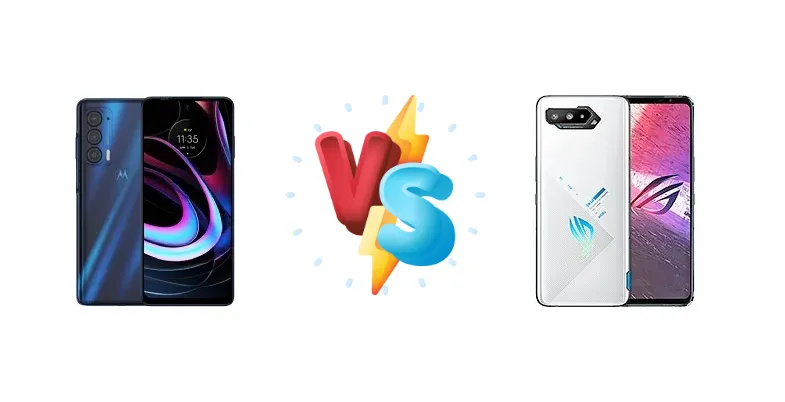
|
🏆 Quick Verdict
For the average user prioritizing everyday tasks and occasional gaming, the Motorola Edge (2021) offers excellent value. However, the Asus ROG Phone 5s is the clear winner for serious mobile gamers who demand the highest frame rates and sustained performance, justifying its higher price with a superior chipset and charging capabilities.
| PHONES | ||
|---|---|---|
| Phone Names | Motorola Edge (2021) | Asus ROG Phone 5s |
| Network | ||
|---|---|---|
| 2G bands | GSM 850 / 900 / 1800 / 1900 | GSM 850 / 900 / 1800 / 1900 |
| 3G bands | HSDPA 850 / 900 / 1700(AWS) / 1900 / 2100 | HSDPA 800 / 850 / 900 / 1700(AWS) / 1800 / 1900 / 2100 - Version 1 |
| 4G bands | 1, 2, 3, 4, 5, 7, 8, 12, 13, 14, 17, 18, 19, 20, 25, 26, 29, 30, 38, 39, 40, 41, 66, 71 | 1, 2, 3, 4, 5, 7, 8, 12, 13, 17, 18, 19, 20, 25, 26, 28, 29, 30, 32, 34, 38, 39, 40, 41, 42, 48, 66, 71 - Version 1 |
| 5G bands | 2, 5, 25, 41, 66, 71, 77, 78 SA/NSA/Sub6 | 1, 2, 3, 5, 7, 8, 12, 20, 25, 28, 38, 40, 41, 66, 71, 77, 78, 79 SA/NSA - Version 1 |
| Speed | HSPA 42.2/5.76 Mbps, LTE Cat18 1200/150 Mbps, 5G | HSPA 42.2/5.76 Mbps, LTE (7CA) Cat20 1400/150 Mbps, 5G 4 Gbps DL |
| Technology | GSM / HSPA / LTE / 5G | GSM / HSPA / LTE / 5G |
| - | 2, 3, 5, 7, 12, 20, 25, 28, 38, 40, 66, 71, 77, 78, 79 SA/NSA - Version 4 | |
| Launch | ||
|---|---|---|
| Announced | 2021, August 19 | 2021, August 16 |
| Status | Available. Released 2021, September 02 | Available. Released 2021, August 26 |
| Body | ||
|---|---|---|
| Build | Glass front, plastic back | Glass front (Gorilla Glass Victus), glass back (Gorilla Glass 3), aluminum frame |
| Dimensions | 169 x 75.6 x 9 mm (6.65 x 2.98 x 0.35 in) | 172.8 x 77.3 x 9.9 mm (6.80 x 3.04 x 0.39 in) |
| SIM | Nano-SIM | Nano-SIM + Nano-SIM |
| Weight | 200 g (7.05 oz) | 238 g (8.40 oz) |
| Water-repellent design | RGB light panel (on the back) Pressure sensitive zones (Gaming triggers) | |
| Display | ||
|---|---|---|
| Protection | Corning Gorilla Glass 3 | Corning Gorilla Glass Victus |
| Resolution | 1080 x 2460 pixels (~395 ppi density) | 1080 x 2448 pixels (~395 ppi density) |
| Size | 6.8 inches, 109.8 cm2 (~85.9% screen-to-body ratio) | 6.78 inches, 109.5 cm2 (~82.0% screen-to-body ratio) |
| Type | LCD, 144Hz, HDR10 | AMOLED, 1B colors, 144Hz, HDR10+, 800 nits (typ), 1200 nits (peak) |
| Platform | ||
|---|---|---|
| CPU | Octa-core (1x2.4 GHz Cortex-A78 & 3x2.2 GHz Cortex-A78 & 4x1.9 GHz Cortex-A55) | Octa-core (1x2.99 GHz Cortex-X1 & 3x2.42 GHz Cortex-A78 & 4x1.80 GHz Cortex-A55) |
| Chipset | Qualcomm SM7325 Snapdragon 778G 5G (6 nm) | Qualcomm SM8350 Snapdragon 888+ 5G (5 nm) |
| GPU | Adreno 642L | Adreno 660 |
| OS | Android 11, planned upgrade to Android 13 | Android 11, upgradable to Android 13, ROG UI |
| Memory | ||
|---|---|---|
| Card slot | No | No |
| Internal | 128GB 8GB RAM, 256GB 8GB RAM | 128GB 8GB RAM, 128GB 12GB RAM, 256GB 12GB RAM, 256GB 16GB RAM, 512GB 16GB RAM, 512GB 18GB RAM |
| - | UFS 3.1 | |
| Main Camera | ||
|---|---|---|
| Features | Dual-LED dual-tone flash, HDR, panorama | LED flash, HDR, panorama |
| Triple | 108 MP, f/1.9, (wide), 1/1.52", 0.7µm, PDAF 8 MP, f/2.2, 119˚ (ultrawide), 1.12µm, AF Auxiliary lens | 64 MP, f/1.8, 26mm (wide), 1/1.73", 0.8µm, PDAF 13 MP, f/2.4, 11mm, 125˚ (ultrawide) 5 MP (macro) |
| Video | 4K@30fps, 1080p@30/60/120ps, 720p@960fps, gyro-EIS | 8K@30fps, 4K@30/60/120fps, 1080p@30/60/120/240fps, 720p@480fps; gyro-EIS |
| Selfie camera | ||
|---|---|---|
| Features | HDR | Panorama, HDR |
| Single | 32 MP, f/2.3, (wide), 0.7µm | 24 MP, f/2.5, 27mm (wide), 0.9µm |
| Video | 4K@30fps, 1080p@30/120fps | 1080p@30fps |
| Sound | ||
|---|---|---|
| 3.5mm jack | No | Yes |
| 35mm jack | No | Yes |
| Loudspeaker | Yes | Yes, with stereo speakers (2 amplifiers) |
| - | 24-bit/192kHz audio | |
| Comms | ||
|---|---|---|
| Bluetooth | 5.2, A2DP, LE, aptX HD, aptX Adaptive | 5.2, A2DP, LE, aptX HD, aptX Adaptive |
| NFC | Yes | Yes |
| Positioning | GPS, GLONASS, GALILEO | GPS (L1+L5), GLONASS (L1), BDS (B1I+B1c+B2a), GALILEO (E1+E5a), QZSS (L1+L5), NavIC (L5) |
| Radio | No | No |
| USB | USB Type-C 2.0 | USB Type-C 3.1 (side), USB Type-C 2.0 (bottom), OTG, accessory connector |
| WLAN | Wi-Fi 802.11 a/b/g/n/ac/6e, dual-band, Wi-Fi Direct | Wi-Fi 802.11 a/b/g/n/ac/6e, dual-band, Wi-Fi Direct |
| Features | ||
|---|---|---|
| Sensors | Fingerprint (side-mounted), accelerometer, gyro, proximity, compass, barometer | Fingerprint (under display, optical), accelerometer, gyro, proximity, compass |
| Battery | ||
|---|---|---|
| Charging | 30W wired | 65W wired, PD3.0, QC5, 70% in 30 min, 100% in 52 min 10W reverse wired |
| Type | Li-Po 5000 mAh | Li-Po 6000 mAh |
| Misc | ||
|---|---|---|
| Colors | Nebula Blue | Phantom Black, Storm White |
| Models | XT2141-1 | ZS676KS |
| Price | About 90 EUR | About 1030 EUR |
Motorola Edge (2021)
- More affordable price point
- Balanced performance for everyday tasks
- Sleek and modern design
- Less powerful processor for demanding games
- Slower charging speed
Asus ROG Phone 5s
- Flagship Snapdragon 888+ processor
- Ultra-fast 65W charging
- Optimized for gaming with advanced features
- Higher price tag
- Larger and heavier design
Display Comparison
While both phones likely feature high refresh rate displays (data not provided, but standard for both segments), the core difference lies in the processing power driving them. The Motorola Edge (2021) utilizes the Snapdragon 778G, a 6nm chip, while the ROG Phone 5s boasts the Snapdragon 888+ built on a more efficient 5nm process. This node difference translates to better thermal efficiency for the ROG Phone 5s, allowing it to sustain peak performance for longer periods during graphically intensive games. The ROG Phone 5s’s display is also likely tuned for lower latency and higher color accuracy, crucial for competitive gaming.
Camera Comparison
Without detailed camera specs, it’s difficult to make a definitive comparison. However, given the ROG Phone 5s’s focus on gaming, its camera system is likely optimized for quick snapshots and social media sharing, while the Motorola Edge (2021) may prioritize image quality and versatility. The ROG Phone 5s may lack features like advanced computational photography found in flagship devices, while the Edge could offer a more balanced camera experience. The ROG Phone 5s’s camera is likely tuned for speed and convenience, while the Edge aims for a more refined photographic output.
Performance
The Snapdragon 888+ in the Asus ROG Phone 5s represents a significant leap in performance over the Snapdragon 778G found in the Motorola Edge (2021). The 888+ features a Cortex-X1 prime core clocked at 2.99 GHz, compared to the Edge’s Cortex-A78 core at 2.4 GHz. This architectural advantage, combined with the 5nm process, results in substantially faster CPU and GPU performance. The ROG Phone 5s is better equipped to handle demanding games at maximum settings and maintain stable frame rates. The Edge’s 778G is still capable, but will likely require compromises in graphical settings for optimal performance in the most demanding titles.
Battery Life
The Asus ROG Phone 5s’s 65W wired charging is a game-changer, achieving 70% charge in just 30 minutes and 100% in 52 minutes. This is significantly faster than the Motorola Edge (2021)’s 30W charging. While the Edge’s battery capacity is unknown, the ROG Phone 5s’s faster charging mitigates any potential capacity disadvantage. The ROG Phone 5s also offers 10W reverse wired charging, a feature absent on the Edge, allowing it to top up accessories or other devices.
Buying Guide
Buy the Motorola Edge (2021) if you need a well-rounded smartphone with a smooth user experience, a capable camera, and solid battery life for daily use. It’s ideal for professionals, students, and anyone who wants a reliable device without breaking the bank. Buy the Asus ROG Phone 5s if you prioritize uncompromising gaming performance, rapid charging, and a feature set tailored to competitive mobile gaming, even if it means sacrificing some portability and mainstream appeal.