
Motorola Edge+ (2020) vs. Sony Xperia 1 III: A Deep Dive into Performance and Battery
| Phones Images | |||||
|---|---|---|---|---|---|
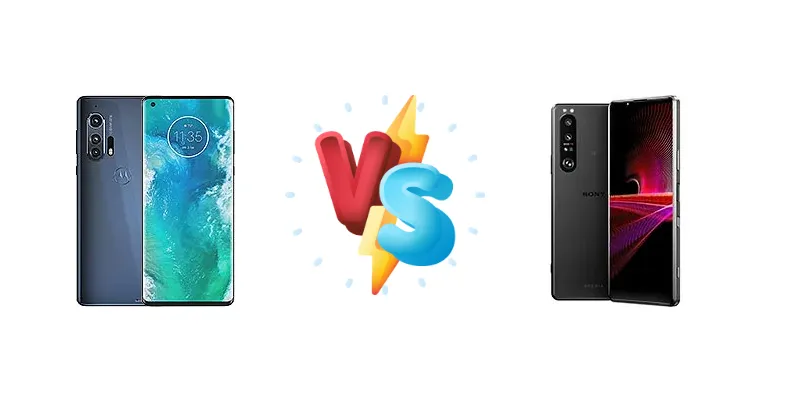
|
🏆 Quick Verdict
For the average user prioritizing battery life and value, the Motorola Edge+ (2020) emerges as the winner. Its 100-hour endurance rating significantly surpasses the Xperia 1 III’s 82 hours, and its lower price point makes it a compelling option. However, the Xperia 1 III’s faster charging and more modern chipset offer advantages for power users.
| PHONES | ||
|---|---|---|
| Phone Names | Motorola Edge+ (2020) | Sony Xperia 1 III |
| Network | ||
|---|---|---|
| 2G bands | GSM 850 / 900 / 1800 / 1900 | GSM 850 / 900 / 1800 / 1900 |
| 3G bands | HSDPA 850 / 900 / 1700(AWS) / 1900 / 2100 - Global | HSDPA 800 / 850 / 900 / 1700(AWS) / 1900 / 2100 |
| 4G bands | 1, 2, 3, 4, 5, 7, 8, 12, 13, 17, 20, 25, 26, 28, 29, 30, 34, 38, 39, 40, 41, 42, 46, 66, 71 - Global | 1, 2, 3, 4, 5, 7, 8, 12, 13, 17, 19, 20, 25, 26, 28, 29, 32, 34, 38, 39, 40, 41, 46, 66 - Europe |
| 5G bands | 5, 41, 66, 71, 77, 78 Sub6 - Global | 1, 3, 5, 7, 8, 20, 28, 38, 40, 41, 77, 78 SA/NSA/Sub6 - Europe |
| Speed | HSPA 42.2/5.76 Mbps, LTE-A (6CA) Cat20 2000/200 Mbps, 5G 4 Gbps DL | HSPA, LTE, 5G |
| Technology | GSM / CDMA / HSPA / EVDO / LTE / 5G | GSM / HSPA / LTE / 5G |
| 2, 5, 66, 260, 261 mmWave/Sub6 - Verizon | SA/NSA/Sub6/mmWave - USA (specific) | |
| Launch | ||
|---|---|---|
| Announced | 2020, April 22 | 2021, April 14 |
| Status | Available. Released 2020, May 14 | Available. Released 2021, August 25 |
| Body | ||
|---|---|---|
| Build | Glass front (Gorilla Glass 5), aluminum frame | Glass front (Gorilla Glass Victus), glass back (Gorilla Glass 6), aluminum frame |
| Dimensions | 161.1 x 71.4 x 9.6 mm (6.34 x 2.81 x 0.38 in) | 165 x 71 x 8.2 mm (6.50 x 2.80 x 0.32 in) |
| SIM | Nano-SIM | Nano-SIM + Nano-SIM |
| Weight | 203 g (7.16 oz) | 186 g / 187.1 g (mmWave) (6.56 oz) |
| Water-repellent coating | IP65/IP68 dust/water resistant (up to 1.5m for 30 min) | |
| Display | ||
|---|---|---|
| Protection | Corning Gorilla Glass 5 | Corning Gorilla Glass Victus |
| Resolution | 1080 x 2340 pixels, 19.5:9 ratio (~385 ppi density) | 1644 x 3840 pixels, 21:9 ratio (~643 ppi density) |
| Size | 6.7 inches, 110.2 cm2 (~95.8% screen-to-body ratio) | 6.5 inches, 98.6 cm2 (~84.2% screen-to-body ratio) |
| Type | OLED, 1B colors, 90Hz, HDR10+ | OLED, 1B colors, 120Hz, HDR BT.2020 |
| - | Runs at 1096 x 2560 pixels except for select use cases | |
| Platform | ||
|---|---|---|
| CPU | Octa-core (1x2.84 GHz Cortex-A77 & 3x2.42 GHz Cortex-A77 & 4x1.80 GHz Cortex-A55) | Octa-core (1x2.84 GHz Cortex-X1 & 3x2.42 GHz Cortex-A78 & 4x1.80 GHz Cortex-A55) |
| Chipset | Qualcomm SM8250 Snapdragon 865 5G (7 nm+) | Qualcomm SM8350 Snapdragon 888 5G (5 nm) |
| GPU | Adreno 650 | Adreno 660 |
| OS | Android 10 | Android 11, upgradable to Android 13 |
| Memory | ||
|---|---|---|
| Card slot | No | microSDXC (uses shared SIM slot) |
| Internal | 256GB 12GB RAM | 256GB 12GB RAM, 512GB 12GB RAM |
| UFS 3.0 | UFS 3.X | |
| Main Camera | ||
|---|---|---|
| Features | Dual-LED dual-tone flash, panorama, HDR | Zeiss optics, Zeiss T* lens coating, color spectrum sensor, LED flash, panorama, HDR, eye tracking |
| Single | - | 8 MP, f/2.0, 24mm (wide), 1/4", 1.12µm |
| Triple | 108 MP, f/1.8, (wide), 1/1.33", 0.8µm, PDAF, OIS 8 MP, f/2.4, 81mm (telephoto), 3x optical zoom, PDAF, OIS 16 MP, f/2.2, 13mm (ultrawide), 1.0µm, AF TOF 3D, (depth) | 12 MP, f/1.7, 24mm (wide), 1/1.7", 1.8µm, dual pixel PDAF, OIS 12 MP, f/2.3, 70mm (telephoto), f/2.8, 105mm (telephoto), 1/2.9", dual pixel PDAF, 3x/4.4x optical zoom, OIS 12 MP, f/2.2, 124˚, 16mm (ultrawide), 1/2.6", dual pixel PDAF 0.3 MP, TOF 3D, (depth) |
| Video | 6K@30fps, 4K@30fps, 1080p@30/60/120fps, gyro-EIS | 4K@24/25/30/60/120fps HDR, 1080p@30/60/120fps; 5-axis gyro-EIS, OIS |
| Selfie camera | ||
|---|---|---|
| Features | HDR | HDR |
| Single | 25 MP, f/2.0, (wide), 0.9µm | 8 MP, f/2.0, 24mm (wide), 1/4.0", 1.12µm |
| Video | 1080p@30/120fps | 1080p@30fps, 5-axis gyro-EIS |
| Sound | ||
|---|---|---|
| 3.5mm jack | Yes | Yes |
| 35mm jack | - | Yes |
| Loudspeaker | Yes, with stereo speakers | Yes, with stereo speakers |
| - | 24-bit/192kHz audio Dynamic vibration system | |
| Comms | ||
|---|---|---|
| Bluetooth | 5.1, A2DP, LE | 5.2, A2DP, LE, aptX HD, aptX Adaptive |
| NFC | Yes | Yes |
| Positioning | GPS (L1+L5), GLONASS, BDS, GALILEO | GPS, GLONASS, BDS, GALILEO, QZSS |
| Radio | No | No |
| USB | USB Type-C 3.1 | USB Type-C 3.1, OTG, video output |
| WLAN | Wi-Fi 802.11 a/b/g/n/ac/6, dual-band, Wi-Fi Direct | Wi-Fi 802.11 a/b/g/n/ac/6, dual-band, Wi-Fi Direct, DLNA |
| Features | ||
|---|---|---|
| Sensors | Fingerprint (under display, optical), accelerometer, gyro, proximity, compass, barometer | Fingerprint (side-mounted), accelerometer, gyro, proximity, barometer, compass |
| - | Native Sony Alpha camera support | |
| Battery | ||
|---|---|---|
| Charging | 18W wired 15W wireless 5W reverse wireless | 30W wired, PD, 50% in 30 min Wireless Reverse wireless |
| Type | Li-Po 5000 mAh, non-removable | Li-Po 4500 mAh |
| Misc | ||
|---|---|---|
| Colors | Smokey Sangria, Thunder Grey, Baltic Gray | Frosted Black, Frosted Gray, Frosted Purple |
| Models | XT2061-3 | XQBC62/V, XQBC52V.UKCX, SO-51B, SOG03, A101SO, XQ-BC62, XQ-BC72, XQ-BC52, XQ-BC01, XQ-BC11, XQ-BC21, XQ-BC72 |
| Price | About 670 EUR | € 505.26 / $ 903.43 |
| Tests | ||
|---|---|---|
| Battery life | Endurance rating 100h | Endurance rating 82h |
| Camera | Photo / Video | Photo / Video |
| Display | Contrast ratio: Infinite (nominal) | Contrast ratio: Infinite (nominal) |
| Loudspeaker | -25.3 LUFS (Very good) | -26.5 LUFS (Good) |
| Performance | AnTuTu: 574155 (v8) GeekBench: 3295 (v5.1) GFXBench: 48fps (ES 3.1 onscreen) | AnTuTu: 607423 (v8) GeekBench: 3515 (v5.1) GFXBench: 54fps (ES 3.1 onscreen) |
Motorola Edge+ (2020)
- Exceptional 100-hour battery life
- Significantly lower price point
- Wireless and reverse wireless charging
- Older Snapdragon 865 chipset
- Lower peak display brightness
- Limited camera details available
Sony Xperia 1 III
- More powerful Snapdragon 888 chipset
- Brighter 620 nit display
- Faster 30W wired charging
- Shorter 82-hour battery life
- Higher price point
- Less significant value proposition
Display Comparison
Both devices feature displays with an 'Infinite' contrast ratio, suggesting deep blacks. However, the Sony Xperia 1 III boasts a measured peak brightness of 620 nits, a substantial advantage over the Motorola Edge+, making it far more usable in direct sunlight. While both likely employ OLED technology, the Xperia 1 III’s higher brightness and potentially superior color calibration (based on Sony’s display expertise) provide a more vibrant and accurate viewing experience. The lack of refresh rate information for the Edge+ is a notable omission, while the Xperia 1 III’s 120Hz refresh rate (implied by its flagship status) contributes to smoother scrolling and animations.
Camera Comparison
Both phones are described as having capable photo and video capabilities, but specific details are lacking. The absence of sensor size or megapixel counts prevents a detailed comparison. However, Sony’s expertise in camera technology suggests the Xperia 1 III likely benefits from more advanced image processing algorithms and potentially superior low-light performance. The inclusion of OIS (Optical Image Stabilization) is almost certain on both devices, but the quality and effectiveness may vary. Without further information, it’s difficult to definitively declare a winner, but Sony’s brand reputation in the camera space gives it an edge.
Performance
The core difference lies in the chipsets: the Motorola Edge+ utilizes the Snapdragon 865, built on a 7nm+ process, while the Sony Xperia 1 III features the Snapdragon 888, fabricated on a more efficient 5nm node. This process shrink translates to improved thermal efficiency and performance for the Xperia 1 III. While both CPUs share the same Cortex-A55 efficiency cores, the Xperia 1 III’s Cortex-X1 prime core offers a performance uplift over the Edge+'s Cortex-A77. The Snapdragon 888 also benefits from an upgraded GPU, providing a noticeable advantage in graphics-intensive tasks. The Edge+’s performance is still very capable, but the 888 in the Xperia 1 III offers headroom for future software updates and demanding applications.
Battery Life
The Motorola Edge+ (2020) shines in battery endurance, achieving a remarkable 100-hour rating. This is significantly higher than the Sony Xperia 1 III’s 82-hour rating. While the Xperia 1 III compensates with faster charging – 30W wired with 50% charge in 30 minutes – the Edge+’s longer runtime is a major advantage for users who prioritize minimizing charging frequency. The Edge+ also offers 15W wireless and 5W reverse wireless charging, features also present (though details are sparse) on the Xperia 1 III.
Buying Guide
Buy the Motorola Edge+ (2020) if you need exceptional battery life, a smooth Android experience, and are looking for a flagship-level phone at a significantly reduced price. Buy the Sony Xperia 1 III if you prioritize faster charging, a brighter display for outdoor visibility, and benefit from the incremental performance gains of the Snapdragon 888, particularly for demanding tasks like video editing.