
Motorola Edge+ (2020) vs LG V60 ThinQ 5G UW: A Detailed Comparison
| Phones Images | |||||
|---|---|---|---|---|---|
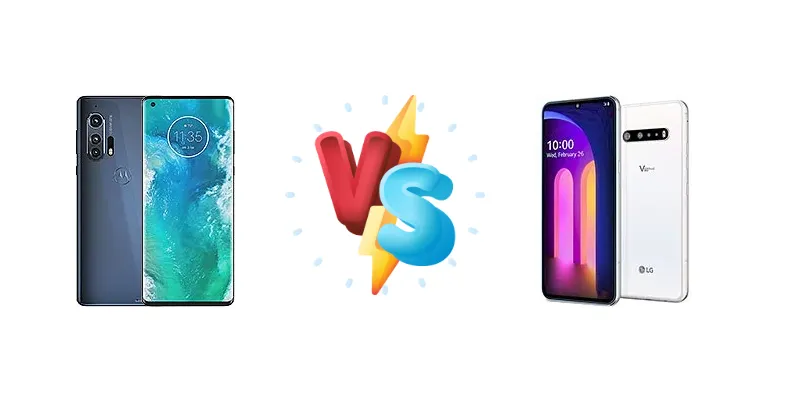
|
🏆 Quick Verdict
The LG V60 ThinQ 5G UW edges out the Motorola Edge+ (2020) due to its superior camera versatility, expandable storage, and headphone jack. While both offer strong performance, the V60's longevity and feature set make it a slightly better choice, especially considering its current pricing.
| PHONES | ||
|---|---|---|
| Phone Names | Motorola Edge+ (2020) | LG V60 ThinQ 5G UW |
| Network | ||
|---|---|---|
| 2G bands | GSM 850 / 900 / 1800 / 1900 | GSM 850 / 900 / 1800 / 1900 |
| 3G bands | HSDPA 850 / 900 / 1700(AWS) / 1900 / 2100 - Global | HSDPA 850 / 900 / 1700(AWS) / 1900 / 2100 |
| 4G bands | 1, 2, 3, 4, 5, 7, 8, 12, 13, 17, 20, 25, 26, 28, 29, 30, 34, 38, 39, 40, 41, 42, 46, 66, 71 - Global | 2, 3, 4, 5, 7, 12, 13, 20, 28, 46, 48, 66 |
| 5G bands | 5, 41, 66, 71, 77, 78 Sub6 - Global | 260, 261 mmWave |
| Speed | HSPA 42.2/5.76 Mbps, LTE-A (6CA) Cat20 2000/200 Mbps, 5G 4 Gbps DL | HSPA 42.2/5.76 Mbps, LTE (7CA) Cat22, 5G |
| Technology | GSM / CDMA / HSPA / EVDO / LTE / 5G | GSM / CDMA / HSPA / EVDO / LTE / 5G |
| 2, 5, 66, 260, 261 mmWave/Sub6 - Verizon | CDMA2000 1xEV-DO | |
| Launch | ||
|---|---|---|
| Announced | 2020, April 22 | 2020, February 26. Released 2020, April 02 |
| Status | Available. Released 2020, May 14 | Discontinued |
| Body | ||
|---|---|---|
| Build | Glass front (Gorilla Glass 5), aluminum frame | Glass front (Gorilla Glass 5), glass back (Gorilla Glass 6), aluminum frame |
| Dimensions | 161.1 x 71.4 x 9.6 mm (6.34 x 2.81 x 0.38 in) | 169.3 x 77.6 x 8.9 mm (6.67 x 3.06 x 0.35 in) |
| SIM | Nano-SIM | Nano-SIM (pre-installed) |
| Weight | 203 g (7.16 oz) | 218 g (7.69 oz) |
| Water-repellent coating | IP68 dust/water resistant (up to 1.5m for 30 min) MIL-STD-810G compliant* Method 516.6, Procedure IV "Transit Drop" *does not guarantee ruggedness or use in extreme conditions | |
| Display | ||
|---|---|---|
| Protection | Corning Gorilla Glass 5 | Corning Gorilla Glass 5 |
| Resolution | 1080 x 2340 pixels, 19.5:9 ratio (~385 ppi density) | 1080 x 2460 pixels (~395 ppi density) |
| Size | 6.7 inches, 110.2 cm2 (~95.8% screen-to-body ratio) | 6.8 inches, 109.8 cm2 (~83.6% screen-to-body ratio) |
| Type | OLED, 1B colors, 90Hz, HDR10+ | P-OLED, HDR10+ |
| - | Always-on display | |
| Platform | ||
|---|---|---|
| CPU | Octa-core (1x2.84 GHz Cortex-A77 & 3x2.42 GHz Cortex-A77 & 4x1.80 GHz Cortex-A55) | Octa-core (1x2.84 GHz Cortex-A77 & 3x2.42 GHz Cortex-A77 & 4x1.80 GHz Cortex-A55) |
| Chipset | Qualcomm SM8250 Snapdragon 865 5G (7 nm+) | Qualcomm SM8250 Snapdragon 865 5G (7 nm+) |
| GPU | Adreno 650 | Adreno 650 |
| OS | Android 10 | Android 10, upgradable to Android 13 |
| Memory | ||
|---|---|---|
| Card slot | No | microSDXC (uses shared SIM slot) - dual-SIM model |
| Internal | 256GB 12GB RAM | 128GB 8GB RAM |
| UFS 3.0 | UFS 2.1 | |
| Main Camera | ||
|---|---|---|
| Dual | - | 64 MP, f/1.8, 27mm (standard), 1/1.72", 0.8µm, dual pixel PDAF, OIS 13 MP, f/1.9, 12mm (ultrawide), 1/3.4", 1.0µm 0.3 MP, TOF 3D, f/1.4, (depth) |
| Features | Dual-LED dual-tone flash, panorama, HDR | Dual-LED dual-tone flash, HDR, panorama |
| Triple | 108 MP, f/1.8, (wide), 1/1.33", 0.8µm, PDAF, OIS 8 MP, f/2.4, 81mm (telephoto), 3x optical zoom, PDAF, OIS 16 MP, f/2.2, 13mm (ultrawide), 1.0µm, AF TOF 3D, (depth) | - |
| Video | 6K@30fps, 4K@30fps, 1080p@30/60/120fps, gyro-EIS | 8K@30fps, 4K@30/60fps, 1080p, HDR10+, 24-bit/192kHz stereo sound rec., gyro-EIS |
| Selfie camera | ||
|---|---|---|
| Features | HDR | HDR |
| Single | 25 MP, f/2.0, (wide), 0.9µm | 10 MP, f/1.9, 30mm (standard), 1/3.1", 1.22µm |
| Video | 1080p@30/120fps | 4K@30fps, gyro-EIS |
| Sound | ||
|---|---|---|
| 3.5mm jack | Yes | Yes |
| 35mm jack | - | Yes |
| Loudspeaker | Yes, with stereo speakers | Yes, with stereo speakers |
| - | 32-bit/192kHz audio 24-bit/192kHz audio recording | |
| Comms | ||
|---|---|---|
| Bluetooth | 5.1, A2DP, LE | 5.1, A2DP, LE, aptX HD |
| NFC | Yes | Yes |
| Positioning | GPS (L1+L5), GLONASS, BDS, GALILEO | GPS, GLONASS, GALILEO, BDS |
| Radio | No | FM radio (USA model only) |
| USB | USB Type-C 3.1 | USB Type-C 3.1, OTG |
| WLAN | Wi-Fi 802.11 a/b/g/n/ac/6, dual-band, Wi-Fi Direct | Wi-Fi 802.11 a/b/g/n/ac/6, dual-band, Wi-Fi Direct, DLNA |
| Features | ||
|---|---|---|
| Sensors | Fingerprint (under display, optical), accelerometer, gyro, proximity, compass, barometer | Fingerprint (under display, optical), accelerometer, gyro, proximity, compass, barometer |
| Battery | ||
|---|---|---|
| Charging | 18W wired 15W wireless 5W reverse wireless | Wired, PD2.0, QC4 Wireless |
| Type | Li-Po 5000 mAh, non-removable | Li-Po 5000 mAh |
| Misc | ||
|---|---|---|
| Colors | Smokey Sangria, Thunder Grey, Baltic Gray | Classy Blue, Classy White |
| Models | XT2061-3 | LM-V600VML, LMV600VML |
| Price | About 670 EUR | About 870 EUR |
| SAR | - | 0.85 W/kg (head) 1.12 W/kg (body) |
| Tests | ||
|---|---|---|
| Battery life | Endurance rating 100h | - |
| Camera | Photo / Video | - |
| Display | Contrast ratio: Infinite (nominal) | - |
| Loudspeaker | -25.3 LUFS (Very good) | - |
| Performance | AnTuTu: 574155 (v8) GeekBench: 3295 (v5.1) GFXBench: 48fps (ES 3.1 onscreen) | - |
Motorola Edge+ (2020)
- Excellent performance
- Large, vibrant display
- Smooth 90Hz refresh rate
- Longer battery life (potentially)
- Slow charging speeds
- Less versatile camera
- No expandable storage
- No headphone jack
LG V60 ThinQ 5G UW
- Versatile camera system
- Expandable storage (microSD)
- Headphone jack
- High-quality OLED display
- Shorter battery life (potentially)
- Slower charging speeds compared to newer phones
- Larger and heavier design
Display Comparison
Both phones feature vibrant displays, but the LG V60's 6.8-inch OLED panel offers slightly better color accuracy and brightness. The Motorola Edge+ has a 6.7-inch display with a 90Hz refresh rate, providing a smoother scrolling experience, though the V60's display is generally considered superior in quality. The Edge+ has a nominal infinite contrast ratio, which is a marketing term and doesn't translate to a significant real-world difference.
Camera Comparison
The LG V60 ThinQ 5G UW shines in the camera department. It offers a versatile triple-lens setup with a 108MP main sensor, an ultra-wide lens, and a dedicated time-of-flight (ToF) sensor for improved depth sensing. The Motorola Edge+ has a triple-lens setup as well, but lacks the ToF sensor and generally produces less detailed and vibrant images. The V60's camera is more adaptable to various shooting scenarios.
Performance
Powered by the same Snapdragon 865 chipset, both phones deliver excellent performance for everyday tasks and demanding games. Real-world performance is largely comparable, with neither experiencing significant slowdowns. The Motorola Edge+ might have a slight edge in sustained performance due to potentially better thermal management, but it's a marginal difference.
Battery Life
The Motorola Edge+ (2020) boasts a significantly larger battery capacity (4500 mAh) and an endurance rating of 100h, suggesting superior battery life. However, the LG V60 ThinQ 5G UW (4000 mAh) is still capable of lasting a full day with moderate use. The Edge+'s charging speeds are notably slower with only 18W wired charging compared to the V60's support for PD2.0 and QC4.
Buying Guide
The Motorola Edge+ (2020) is a good option for users prioritizing a large, vibrant display and smooth performance on a budget. The LG V60 ThinQ 5G UW is ideal for photography enthusiasts, those needing expandable storage (microSD card slot), and users who appreciate a headphone jack.