
Motorola Edge 20 vs Xiaomi Mi 11 Lite 5G: A Detailed Comparison
| Phones Images | |||||
|---|---|---|---|---|---|
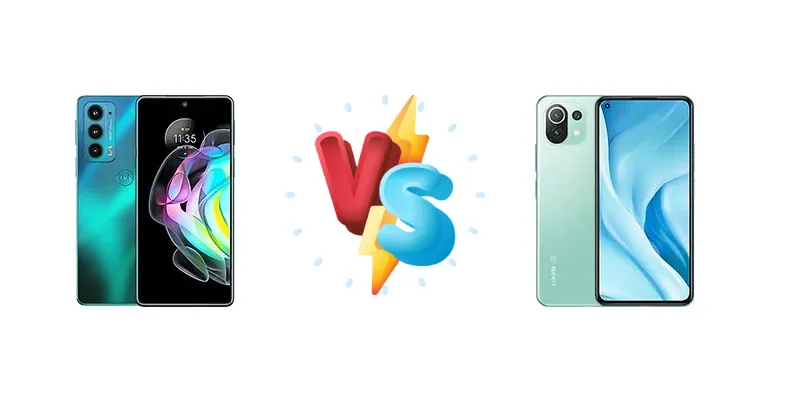
|
🏆 Quick Verdict
For most users, the Xiaomi Mi 11 Lite 5G emerges as the stronger choice. Its superior battery endurance – boasting a 106-hour rating compared to the Edge 20’s 86 hours – and faster 33W charging with PD3.0/QC4 support provide a more convenient and reliable daily experience. While the Edge 20 offers a comparable processor, the Mi 11 Lite 5G’s efficiency gives it the edge.
| PHONES | ||
|---|---|---|
| Phone Names | Motorola Edge 20 | Xiaomi Mi 11 Lite 5G |
| Network | ||
|---|---|---|
| 2G bands | GSM 850 / 900 / 1800 / 1900 | GSM 850 / 900 / 1800 / 1900 |
| 3G bands | HSDPA 850 / 900 / 1700(AWS) / 1900 / 2100 | HSDPA 850 / 900 / 1700(AWS) / 1900 / 2100 |
| 4G bands | 1, 2, 3, 4, 5, 7, 8, 12, 18, 19, 20, 26, 28, 32, 34, 38, 39, 40, 41, 42, 43, 66 | 1, 2, 3, 4, 5, 6, 7, 8, 12, 13, 17, 20, 28, 32, 38, 40, 41, 66 - International |
| 5G bands | 1, 3, 5, 7, 8, 28, 38, 41, 66, 77, 78 SA/NSA/Sub6 | 1, 3, 5, 7, 8, 20, 28, 38, 40, 41, 66, 77, 78 SA/NSA - International |
| Speed | HSPA 42.2/5.76 Mbps, LTE Cat18 1200/150 Mbps, 5G | HSPA, LTE, 5G |
| Technology | GSM / HSPA / LTE / 5G | GSM / CDMA / HSPA / EVDO / LTE / 5G |
| - | 1, 3, 41, 77, 78 SA/NSA - China | |
| Launch | ||
|---|---|---|
| Announced | 2021, July 29 | 2021, March 29 |
| Status | Available. Released 2021, August 16 | Available. Released 2021, April 16 |
| Body | ||
|---|---|---|
| Build | Glass front (Gorilla Glass 5), aluminum frame, glass back (Gorilla Glass 3) | Glass front (Gorilla Glass 6), glass back |
| Dimensions | 163 x 76 x 7 mm (6.42 x 2.99 x 0.28 in) | 160.5 x 75.7 x 6.8 mm (6.32 x 2.98 x 0.27 in) |
| SIM | Nano-SIM + Nano-SIM | Nano-SIM + Nano-SIM |
| Weight | 163 g (5.75 oz) | 159 g (5.61 oz) |
| Water-repellent design | IP53, dust and splash resistant | |
| Display | ||
|---|---|---|
| Protection | Corning Gorilla Glass 5 | Corning Gorilla Glass 6 |
| Resolution | 1080 x 2400 pixels, 19.5:9 ratio (~385 ppi density) | 1080 x 2400 pixels, 20:9 ratio (~402 ppi density) |
| Size | 6.7 inches, 110.2 cm2 (~89.0% screen-to-body ratio) | 6.55 inches, 103.6 cm2 (~85.3% screen-to-body ratio) |
| Type | OLED, 1B colors, 144Hz, HDR10+ | AMOLED, 1B colors, HDR10+, 90Hz, 500 nits (typ), 800 nits |
| Platform | ||
|---|---|---|
| CPU | Octa-core (1x2.4 GHz Cortex-A78 & 3x2.2 GHz Cortex-A78 & 4x1.9 GHz Cortex-A55) | Octa-core (1x2.4 GHz Kryo 670 & 3x2.2 GHz Kryo 670 & 4x1.90 GHz Kryo 670) |
| Chipset | Qualcomm SM7325 Snapdragon 778G 5G (6 nm) | Qualcomm SM7350-AB Snapdragon 780G (5 nm) |
| GPU | Adreno 642L | Adreno 642 |
| OS | Android 11, upgradable to Android 13 | Android 11, upgradable to Android 13, MIUI 14 |
| Memory | ||
|---|---|---|
| Card slot | No | microSDXC (uses shared SIM slot) |
| Internal | 128GB 6GB RAM, 128GB 8GB RAM, 256GB 8GB RAM | 64GB 6GB RAM, 128GB 6GB RAM, 128GB 8GB RAM, 256GB 8GB RAM |
| UFS | UFS 2.2 | |
| Main Camera | ||
|---|---|---|
| Features | Dual-LED dual-tone flash, HDR, panorama | Dual-LED dual-tone flash, HDR, panorama |
| Single | - | 20 MP, f/2.2, 27mm (wide), 1/3.4", 0.8µm |
| Triple | 108 MP, f/1.9, (wide), 1/1.52", 0.7µm, PDAF 8 MP, f/2.4, 79mm (telephoto), 1.0µm, 3x optical zoom, PDAF, OIS 16 MP, f/2.2, 17mm, 119˚ (ultrawide), 1/3.06", 1.0µm, AF | 64 MP, f/1.8, 26mm (wide), 1/1.97", 0.7µm, PDAF 8 MP, f/2.2, 119˚ (ultrawide), 1/4.0", 1.12µm 5 MP (macro), AF |
| Video | 4K@30fps, 1080p@30/60/120/240fps, 720p@960fps, gyro-EIS | 4K@30fps, 1080p@30/60/120fps; gyro-EIS |
| Selfie camera | ||
|---|---|---|
| Features | HDR | HDR, panorama |
| Single | 32 MP, f/2.3, (wide), 0.7µm | 20 MP, f/2.2, 27mm (wide), 1/3.4", 0.8µm |
| Video | 1080p@30fps | 1080p@30/60fps, 720p@120fps |
| Sound | ||
|---|---|---|
| 3.5mm jack | No | No |
| 35mm jack | No | No |
| Loudspeaker | Yes | Yes, with dual speakers |
| - | 24-bit/192kHz audio | |
| Comms | ||
|---|---|---|
| Bluetooth | 5.2, A2DP, LE, aptX HD, aptX Adaptive | 5.2, A2DP, LE |
| Infrared port | - | Yes |
| NFC | Yes | Yes (market/region dependent) |
| Positioning | GPS, GLONASS, BDS, GALILEO | GPS (L1+L5), GLONASS (G1), BDS (B1I+B1c+B2a), GALILEO (E1+E5a), QZSS (L1+L5), NavIC (L5) |
| Radio | No | No |
| USB | USB Type-C 2.0 | USB Type-C 2.0, OTG |
| WLAN | Wi-Fi 802.11 a/b/g/n/ac/6e, dual-band, Wi-Fi Direct | Wi-Fi 802.11 a/b/g/n/ac/6, dual-band, Wi-Fi Direct |
| Features | ||
|---|---|---|
| Sensors | Fingerprint (side-mounted), accelerometer, gyro, proximity, compass | Fingerprint (side-mounted), accelerometer, gyro, compass |
| - | Virtual proximity sensing | |
| Battery | ||
|---|---|---|
| Charging | 30W wired | 33W wired, PD3.0, QC4 |
| Type | Li-Po 4000 mAh | Li-Po 4250 mAh |
| Misc | ||
|---|---|---|
| Colors | Frosted Grey, Frosted White, Frosted Emerald | Truffle Black, Mint Green, Citrus Yellow |
| Models | XT2143-1 | M2101K9G, M2101K9C, M2101K9R |
| Price | About 140 EUR | About 120 EUR |
| SAR | - | 1.03 W/kg (head) 1.06 W/kg (body) |
| SAR EU | - | 0.56 W/kg (head) 0.89 W/kg (body) |
| Tests | ||
|---|---|---|
| Battery life | Endurance rating 86h | Endurance rating 106h |
| Camera | Photo / Video | Photo / Video |
| Display | Contrast ratio: Infinite (nominal) | Contrast ratio: Infinite (nominal) |
| Loudspeaker | -28.7 LUFS (Average) | -23.6 LUFS (Very good) |
| Performance | AnTuTu: 424031 (v8), 488574 (v9) GeekBench: 2550 (v5.1) GFXBench: 29fps (ES 3.1 onscreen) | AnTuTu: 465534 (v8) | 522490 (v9) GeekBench: 2909 (v5.1) GFXBench: 35fps (ES 3.1 onscreen) |
Motorola Edge 20
- Potentially slightly faster CPU performance for demanding tasks.
- Sleek design and build quality (based on Motorola's reputation).
- Clean Android experience with minimal bloatware.
- Shorter battery life compared to the Mi 11 Lite 5G.
- Slower charging speed (30W vs 33W).
- Less bright display for outdoor use.
Xiaomi Mi 11 Lite 5G
- Superior battery life (106-hour endurance rating).
- Faster 33W charging with PD3.0/QC4 support.
- Brighter display for better outdoor visibility.
- Potentially smoother scrolling with a 90Hz display.
- Slightly less powerful processor compared to the Edge 20.
- Xiaomi's MIUI software can be divisive due to bloatware.
- Build quality may not feel as premium as the Edge 20.
Display Comparison
The Xiaomi Mi 11 Lite 5G boasts a brighter display, reaching 846 nits measured, compared to the Motorola Edge 20’s 650 nits. This translates to significantly better visibility under direct sunlight. Both displays share an 'Infinite' (nominal) contrast ratio, suggesting similar black levels and color depth. However, the brightness difference is a key differentiator for outdoor users. While neither manufacturer specifies refresh rates in the provided data, the Mi 11 Lite 5G is known to have a 90Hz display, offering smoother scrolling and animations, a feature not confirmed for the Edge 20.
Camera Comparison
Both devices are listed with 'Photo / Video' capabilities, lacking specific details. However, the market positioning suggests the Mi 11 Lite 5G likely focuses on a versatile camera system with a strong emphasis on portrait photography, while the Edge 20 may lean towards a more balanced approach. Without sensor size or aperture information, it’s difficult to make a definitive judgment. The absence of details suggests neither phone features a particularly groundbreaking camera system, relying instead on software processing to enhance image quality. It's reasonable to assume both phones will perform adequately in good lighting conditions.
Performance
Both phones utilize Qualcomm Snapdragon 7-series chipsets, but with key differences. The Xiaomi Mi 11 Lite 5G features the Snapdragon 780G (5nm process), while the Motorola Edge 20 uses the Snapdragon 778G (6nm process). The 5nm node of the 780G generally offers better power efficiency, contributing to the Mi 11 Lite 5G’s longer battery life. Both CPUs share a similar core configuration – Octa-core with 1x2.4 GHz and 3x2.2 GHz Cortex-A78 cores, plus 4x1.9 GHz Cortex-A55 cores – suggesting comparable multi-core performance. However, the 780G’s Adreno 642 GPU provides a slight advantage in graphics performance, potentially benefiting gaming and graphically intensive applications.
Battery Life
The Xiaomi Mi 11 Lite 5G significantly outperforms the Motorola Edge 20 in battery endurance, achieving a rating of 106 hours versus 86 hours. This difference is likely attributable to the more efficient Snapdragon 780G chipset and potentially optimized software. Furthermore, the Mi 11 Lite 5G supports 33W wired charging with Power Delivery 3.0 and Quick Charge 4 compatibility, enabling faster charging times compared to the Edge 20’s 30W charging. This combination of longer battery life and faster charging makes the Mi 11 Lite 5G the more convenient option for users who are frequently on the go.
Buying Guide
Buy the Motorola Edge 20 if you prioritize a slightly more powerful processor for demanding tasks and don't mind potentially shorter battery life. Buy the Xiaomi Mi 11 Lite 5G if you value all-day battery life, faster charging speeds, and a brighter display for outdoor visibility. The Mi 11 Lite 5G is the better option for users who prioritize convenience and longevity.