
Motorola Edge 20 vs Samsung Galaxy A52s 5G: A Deep Dive into Battery, Display, and Performance
| Phones Images | |||||
|---|---|---|---|---|---|
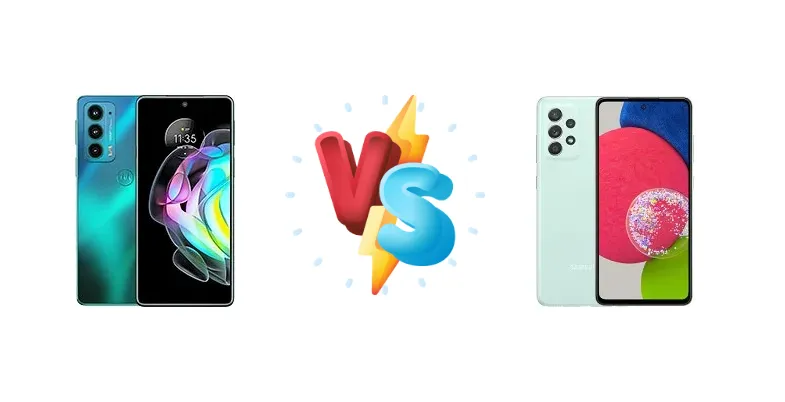
|
🏆 Quick Verdict
For the average user prioritizing longevity, the Samsung Galaxy A52s 5G is the clear winner. Its significantly superior endurance rating of 113 hours, compared to the Motorola Edge 20’s 86 hours, translates to a tangible difference in daily usage. While the Edge 20 offers a slightly brighter display, the A52s 5G’s battery advantage is more impactful for most.
| PHONES | ||
|---|---|---|
| Phone Names | Motorola Edge 20 | Samsung Galaxy A52s 5G |
| Network | ||
|---|---|---|
| 2G bands | GSM 850 / 900 / 1800 / 1900 | GSM 850 / 900 / 1800 / 1900 |
| 3G bands | HSDPA 850 / 900 / 1700(AWS) / 1900 / 2100 | HSDPA 850 / 900 / 1700(AWS) / 1900 / 2100 |
| 4G bands | 1, 2, 3, 4, 5, 7, 8, 12, 18, 19, 20, 26, 28, 32, 34, 38, 39, 40, 41, 42, 43, 66 | 1, 2, 3, 4, 5, 7, 8, 12, 17, 20, 26, 28, 32, 38, 40, 41, 66 |
| 5G bands | 1, 3, 5, 7, 8, 28, 38, 41, 66, 77, 78 SA/NSA/Sub6 | 1, 3, 5, 7, 8, 20, 28, 38, 40, 41, 66, 78 SA/NSA/Sub6 |
| Speed | HSPA 42.2/5.76 Mbps, LTE Cat18 1200/150 Mbps, 5G | HSPA 42.2/5.76 Mbps, LTE Cat18 1200/150 Mbps, 5G |
| Technology | GSM / HSPA / LTE / 5G | GSM / HSPA / LTE / 5G |
| Launch | ||
|---|---|---|
| Announced | 2021, July 29 | 2021, August 17 |
| Status | Available. Released 2021, August 16 | Available. Released 2021, September 01 |
| Body | ||
|---|---|---|
| Build | Glass front (Gorilla Glass 5), aluminum frame, glass back (Gorilla Glass 3) | Glass front (Gorilla Glass 5), plastic back |
| Dimensions | 163 x 76 x 7 mm (6.42 x 2.99 x 0.28 in) | 159.9 x 75.1 x 8.4 mm (6.30 x 2.96 x 0.33 in) |
| SIM | Nano-SIM + Nano-SIM | · Nano-SIM· Nano-SIM + Nano-SIM |
| Weight | 163 g (5.75 oz) | 189 g (6.67 oz) |
| Water-repellent design | IP67 dust/water resistant (up to 1m for 30 min) | |
| Display | ||
|---|---|---|
| Protection | Corning Gorilla Glass 5 | Corning Gorilla Glass 5 |
| Resolution | 1080 x 2400 pixels, 19.5:9 ratio (~385 ppi density) | 1080 x 2400 pixels, 20:9 ratio (~405 ppi density) |
| Size | 6.7 inches, 110.2 cm2 (~89.0% screen-to-body ratio) | 6.5 inches, 102.0 cm2 (~84.9% screen-to-body ratio) |
| Type | OLED, 1B colors, 144Hz, HDR10+ | Super AMOLED, 120Hz, 800 nits (HBM) |
| Platform | ||
|---|---|---|
| CPU | Octa-core (1x2.4 GHz Cortex-A78 & 3x2.2 GHz Cortex-A78 & 4x1.9 GHz Cortex-A55) | Octa-core (1x2.4 GHz Cortex-A78 & 3x2.2 GHz Cortex-A78 & 4x1.9 GHz Cortex-A55) |
| Chipset | Qualcomm SM7325 Snapdragon 778G 5G (6 nm) | Qualcomm SM7325 Snapdragon 778G 5G (6 nm) |
| GPU | Adreno 642L | Adreno 642L |
| OS | Android 11, upgradable to Android 13 | Android 11, upgradable to Android 14, One UI 6 |
| Memory | ||
|---|---|---|
| Card slot | No | microSDXC (uses shared SIM slot) |
| Internal | 128GB 6GB RAM, 128GB 8GB RAM, 256GB 8GB RAM | 128GB 4GB RAM, 128GB 6GB RAM, 128GB 8GB RAM, 256GB 6GB RAM, 256GB 8GB RAM |
| UFS | - | |
| Main Camera | ||
|---|---|---|
| Features | Dual-LED dual-tone flash, HDR, panorama | LED flash, panorama, HDR |
| Quad | - | 64 MP, f/1.8, 26mm (wide), 1/1.7", 0.8µm, PDAF, OIS 12 MP, f/2.2, 123˚ (ultrawide), 1.12µm 5 MP (macro) Auxiliary lens |
| Single | - | 32 MP, f/2.2, 26mm (wide), 1/2.8", 0.8µm |
| Triple | 108 MP, f/1.9, (wide), 1/1.52", 0.7µm, PDAF 8 MP, f/2.4, 79mm (telephoto), 1.0µm, 3x optical zoom, PDAF, OIS 16 MP, f/2.2, 17mm, 119˚ (ultrawide), 1/3.06", 1.0µm, AF | - |
| Video | 4K@30fps, 1080p@30/60/120/240fps, 720p@960fps, gyro-EIS | 4K@30fps, 1080p@30/60fps; gyro-EIS |
| Selfie camera | ||
|---|---|---|
| Features | HDR | HDR |
| Single | 32 MP, f/2.3, (wide), 0.7µm | 32 MP, f/2.2, 26mm (wide), 1/2.8", 0.8µm |
| Video | 1080p@30fps | 4K@30fps, 1080p@30/60fps |
| Sound | ||
|---|---|---|
| 3.5mm jack | No | Yes |
| 35mm jack | No | Yes |
| Loudspeaker | Yes | Yes, with stereo speakers |
| Comms | ||
|---|---|---|
| Bluetooth | 5.2, A2DP, LE, aptX HD, aptX Adaptive | 5.0, A2DP, LE |
| NFC | Yes | Yes (market/region dependent) |
| Positioning | GPS, GLONASS, BDS, GALILEO | GPS, GLONASS, GALILEO, BDS, QZSS |
| Radio | No | No |
| USB | USB Type-C 2.0 | USB Type-C 2.0, OTG |
| WLAN | Wi-Fi 802.11 a/b/g/n/ac/6e, dual-band, Wi-Fi Direct | Wi-Fi 802.11 a/b/g/n/ac/6, dual-band, Wi-Fi Direct |
| Features | ||
|---|---|---|
| Sensors | Fingerprint (side-mounted), accelerometer, gyro, proximity, compass | Fingerprint (under display, optical), accelerometer, gyro, compass |
| - | Virtual Proximity Sensing | |
| Battery | ||
|---|---|---|
| Charging | 30W wired | 25W wired |
| Type | Li-Po 4000 mAh | Li-Ion 4500 mAh |
| Misc | ||
|---|---|---|
| Colors | Frosted Grey, Frosted White, Frosted Emerald | Awesome Black, Awesome White, Awesome Purple, Awesome Mint |
| Models | XT2143-1 | SM-A528B, SM-A528B/DS, SM-A528N |
| Price | About 140 EUR | £ 112.98 / € 249.47 |
| SAR | - | 0.72 W/kg (head) |
| SAR EU | - | 0.88 W/kg (head) 0.84 W/kg (body) |
| Tests | ||
|---|---|---|
| Battery life | Endurance rating 86h | Endurance rating 113h |
| Camera | Photo / Video | Photo / Video |
| Display | Contrast ratio: Infinite (nominal) | Contrast ratio: Infinite (nominal) |
| Loudspeaker | -28.7 LUFS (Average) | -27.5 LUFS (Good) |
| Performance | AnTuTu: 424031 (v8), 488574 (v9) GeekBench: 2550 (v5.1) GFXBench: 29fps (ES 3.1 onscreen) | AnTuTu: 429675 (v8), 506432(v9) GeekBench: 11060 (v4.4), 2801 (v5.1) GFXBench: 28fps (ES 3.1 onscreen) |
Motorola Edge 20
- Slightly brighter display (650 nits)
- Faster wired charging (30W)
- Potentially sleeker design (unconfirmed)
- Significantly lower battery endurance (86h)
- Camera details are unknown, making a comparison impossible
Samsung Galaxy A52s 5G
- Superior battery endurance (113h)
- Brighter display for outdoor use (800 nits)
- Generally more readily available and often cheaper
- Slower wired charging (25W)
- Camera details are unknown, making a comparison impossible
Display Comparison
The Samsung Galaxy A52s 5G boasts a measured peak brightness of 800 nits, exceeding the Motorola Edge 20’s 650 nits. This 12.5% increase in brightness will be noticeable in direct sunlight, making the A52s 5G more readable outdoors. Both displays share an 'Infinite' (nominal) contrast ratio, suggesting similar black levels and overall image quality. However, without knowing the panel technology (OLED vs LCD) or refresh rate for either device, a definitive judgment on color accuracy and viewing angles is impossible. The Edge 20’s lower brightness may necessitate higher screen brightness settings, potentially impacting battery life.
Camera Comparison
Both devices are listed as having 'Photo / Video' capabilities, offering minimal insight into their camera systems. Without sensor size, aperture, or OIS details, a meaningful comparison is difficult. The presence of a 2MP macro camera on either device is unlikely to significantly impact image quality, serving primarily as a marketing feature. Image processing styles will likely differ, with Samsung typically favoring more saturated and vibrant colors, while Motorola often aims for a more natural look. Further analysis requires detailed camera specifications.
Performance
Both the Motorola Edge 20 and the Samsung Galaxy A52s 5G are powered by the Qualcomm SM7325 Snapdragon 778G 5G (6 nm) chipset, featuring an identical CPU configuration: an octa-core setup with 1x2.4 GHz Cortex-A78, 3x2.2 GHz Cortex-A78, and 4x1.9 GHz Cortex-A55 cores. This means raw processing power will be virtually indistinguishable between the two devices. Performance will be limited more by RAM and storage speeds, which are not specified in the provided data. Thermal management is also unknown, but the 6nm process node suggests both phones should handle sustained loads reasonably well without excessive throttling.
Battery Life
The most significant difference lies in battery endurance. The Samsung Galaxy A52s 5G achieves an impressive endurance rating of 113 hours, substantially outperforming the Motorola Edge 20’s 86 hours. This 31% increase in endurance translates to nearly a full day of additional usage. While the Edge 20 supports 30W wired charging, compared to the A52s 5G’s 25W, the larger battery capacity of the A52s 5G means it will still likely take a comparable amount of time to fully recharge, and the extra endurance will outweigh the slightly faster charging speed.
Buying Guide
Buy the Motorola Edge 20 if you prioritize a slightly brighter display for outdoor visibility and prefer a potentially sleeker design (though this isn't specified in the data). Buy the Samsung Galaxy A52s 5G if you value all-day battery life and want a phone that can reliably last through heavy usage without needing a midday charge. The A52s 5G is the better choice for travelers or those frequently away from power outlets.