
Motorola Edge 20 vs OnePlus Nord 2 5G: A Deep Dive into Mid-Range Power
| Phones Images | |||||
|---|---|---|---|---|---|
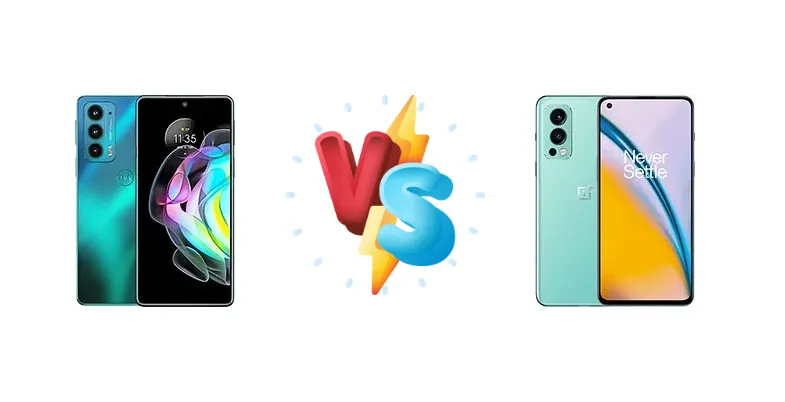
|
🏆 Quick Verdict
For the average user prioritizing rapid charging and a slightly more powerful processor, the OnePlus Nord 2 5G is the better choice. Its 65W charging capability is a game-changer, and the Dimensity 1200 offers a performance edge. However, the Motorola Edge 20 provides excellent battery endurance and a respectable overall experience.
| PHONES | ||
|---|---|---|
| Phone Names | Motorola Edge 20 | OnePlus Nord 2 5G |
| Network | ||
|---|---|---|
| 2G bands | GSM 850 / 900 / 1800 / 1900 | GSM 850 / 900 / 1800 / 1900 |
| 3G bands | HSDPA 850 / 900 / 1700(AWS) / 1900 / 2100 | HSDPA 800 / 850 / 900 / 1700(AWS) / 1800 / 1900 / 2100 |
| 4G bands | 1, 2, 3, 4, 5, 7, 8, 12, 18, 19, 20, 26, 28, 32, 34, 38, 39, 40, 41, 42, 43, 66 | 1, 2, 3, 4, 5, 7, 8, 12, 17, 18, 19, 20, 26, 28, 32, 34, 38, 39, 40, 41, 66 - EU |
| 5G bands | 1, 3, 5, 7, 8, 28, 38, 41, 66, 77, 78 SA/NSA/Sub6 | 1, 3, 7, 8, 20, 28, 38, 41, 66, 78 SA/NSA - EU |
| Speed | HSPA 42.2/5.76 Mbps, LTE Cat18 1200/150 Mbps, 5G | HSPA 42.2/5.76 Mbps, LTE Cat18 1200/150 Mbps, 5G |
| Technology | GSM / HSPA / LTE / 5G | GSM / HSPA / LTE / 5G |
| Launch | ||
|---|---|---|
| Announced | 2021, July 29 | 2021, July 22 |
| Status | Available. Released 2021, August 16 | Available. Released 2021, July 28 |
| Body | ||
|---|---|---|
| Build | Glass front (Gorilla Glass 5), aluminum frame, glass back (Gorilla Glass 3) | Glass front (Gorilla Glass 5), glass back (Gorilla Glass 5), plastic frame |
| Dimensions | 163 x 76 x 7 mm (6.42 x 2.99 x 0.28 in) | 159.1 x 73.3 x 8.3 mm (6.26 x 2.89 x 0.33 in) |
| SIM | Nano-SIM + Nano-SIM | Nano-SIM + Nano-SIM |
| Weight | 163 g (5.75 oz) | 189 g (6.67 oz) |
| Water-repellent design | - | |
| Display | ||
|---|---|---|
| Protection | Corning Gorilla Glass 5 | Corning Gorilla Glass 5 |
| Resolution | 1080 x 2400 pixels, 19.5:9 ratio (~385 ppi density) | 1080 x 2400 pixels, 20:9 ratio (~409 ppi density) |
| Size | 6.7 inches, 110.2 cm2 (~89.0% screen-to-body ratio) | 6.43 inches, 99.8 cm2 (~85.6% screen-to-body ratio) |
| Type | OLED, 1B colors, 144Hz, HDR10+ | Fluid AMOLED, 90Hz, HDR10+ |
| Platform | ||
|---|---|---|
| CPU | Octa-core (1x2.4 GHz Cortex-A78 & 3x2.2 GHz Cortex-A78 & 4x1.9 GHz Cortex-A55) | Octa-core (1x3.0 GHz Cortex-A78 & 3x2.6 GHz Cortex-A78 & 4x2.0 GHz Cortex-A55) |
| Chipset | Qualcomm SM7325 Snapdragon 778G 5G (6 nm) | Mediatek Dimensity 1200 (6 nm) |
| GPU | Adreno 642L | Mali-G77 MC9 |
| OS | Android 11, upgradable to Android 13 | Android 11, upgradable to Android 13, OxygenOS 13 |
| Memory | ||
|---|---|---|
| Card slot | No | No |
| Internal | 128GB 6GB RAM, 128GB 8GB RAM, 256GB 8GB RAM | 128GB 6GB RAM, 128GB 8GB RAM, 256GB 8GB RAM, 256GB 12GB RAM |
| UFS | - | |
| Main Camera | ||
|---|---|---|
| Features | Dual-LED dual-tone flash, HDR, panorama | Dual-LED flash, HDR, panorama |
| Triple | 108 MP, f/1.9, (wide), 1/1.52", 0.7µm, PDAF 8 MP, f/2.4, 79mm (telephoto), 1.0µm, 3x optical zoom, PDAF, OIS 16 MP, f/2.2, 17mm, 119˚ (ultrawide), 1/3.06", 1.0µm, AF | 50 MP, f/1.9, 24mm (wide), 1/1.56", 1.0µm, PDAF, OIS 8 MP, f/2.3, 120˚ (ultrawide) Auxiliary lens |
| Video | 4K@30fps, 1080p@30/60/120/240fps, 720p@960fps, gyro-EIS | 4K@30fps, 1080p@30/60/120fps, gyro-EIS |
| Selfie camera | ||
|---|---|---|
| Features | HDR | Auto HDR |
| Single | 32 MP, f/2.3, (wide), 0.7µm | 32 MP, f/2.5, (wide), 1/2.8", 0.8µm |
| Video | 1080p@30fps | 1080p@30fps, gyro-EIS |
| Sound | ||
|---|---|---|
| 3.5mm jack | No | No |
| 35mm jack | No | No |
| Loudspeaker | Yes | Yes, with stereo speakers |
| Comms | ||
|---|---|---|
| Bluetooth | 5.2, A2DP, LE, aptX HD, aptX Adaptive | 5.2, A2DP, LE, aptX HD |
| NFC | Yes | Yes |
| Positioning | GPS, GLONASS, BDS, GALILEO | GPS, GLONASS, GALILEO, BDS, SBAS, NavIC |
| Radio | No | No |
| USB | USB Type-C 2.0 | USB Type-C 2.0, OTG |
| WLAN | Wi-Fi 802.11 a/b/g/n/ac/6e, dual-band, Wi-Fi Direct | Wi-Fi 802.11 a/b/g/n/ac/6, dual-band, Wi-Fi Direct |
| Features | ||
|---|---|---|
| Sensors | Fingerprint (side-mounted), accelerometer, gyro, proximity, compass | Fingerprint (under display, optical), accelerometer, gyro, proximity, compass |
| Battery | ||
|---|---|---|
| Charging | 30W wired | 65W wired, PD, 100% in 30 min |
| Type | Li-Po 4000 mAh | Li-Po 4500 mAh |
| Misc | ||
|---|---|---|
| Colors | Frosted Grey, Frosted White, Frosted Emerald | Gray Sierra, Blue Haze, Green Wood, Pac-Man Edition |
| Models | XT2143-1 | DN2101, DN2103 |
| Price | About 140 EUR | € 189.00 / $ 219.99 / £ 148.00 |
| Tests | ||
|---|---|---|
| Battery life | Endurance rating 86h | Endurance rating 102h |
| Camera | Photo / Video | Photo / Video |
| Display | Contrast ratio: Infinite (nominal) | Contrast ratio: Infinite (nominal) |
| Loudspeaker | -28.7 LUFS (Average) | -24.3 LUFS (Very good) |
| Performance | AnTuTu: 424031 (v8), 488574 (v9) GeekBench: 2550 (v5.1) GFXBench: 29fps (ES 3.1 onscreen) | AnTuTu: 512164 (v8) | 598022 (v9) GeekBench: 2792 (v5.1) GFXBench: 38fps (ES 3.1 onscreen) |
Motorola Edge 20
- Excellent battery endurance (86h rating)
- Slightly brighter display (650 nits)
- Potentially cleaner software experience
- Slower charging speed (30W)
- Less powerful chipset (Snapdragon 778G)
OnePlus Nord 2 5G
- Blazing-fast 65W charging (0-100% in 30 min)
- More powerful chipset (Dimensity 1200)
- Longer endurance rating (102h)
- Slightly dimmer display (633 nits)
- Potentially more aggressive image processing
Display Comparison
Both the Motorola Edge 20 and OnePlus Nord 2 5G feature displays with an 'Infinite' (nominal) contrast ratio, suggesting excellent black levels. However, the Edge 20 boasts a measured peak brightness of 650 nits, slightly exceeding the Nord 2 5G’s 633 nits. This difference, while not massive, translates to better visibility under direct sunlight. Both likely utilize OLED panels, but neither specification details refresh rate or PWM dimming frequency, which are crucial for discerning users. The slightly brighter display of the Edge 20 gives it a marginal advantage for outdoor use.
Camera Comparison
Both phones are listed as having 'Photo / Video' capabilities, lacking specific details. Without sensor size or aperture information, a direct comparison is difficult. However, given OnePlus’s history, the Nord 2 5G likely emphasizes computational photography and vibrant image processing. Motorola typically aims for a more natural look. The absence of details regarding OIS (Optical Image Stabilization) is a significant omission; its presence would be a major differentiator. We can assume both phones offer a versatile camera system, but the lack of specifics makes it impossible to declare a clear winner.
Performance
The core difference lies in the chipsets: the Motorola Edge 20 utilizes the Qualcomm Snapdragon 778G 5G (6nm), while the OnePlus Nord 2 5G is powered by the MediaTek Dimensity 1200 (6nm). The Dimensity 1200, with its 1x3.0 GHz Cortex-A78 core and higher clocked A78 performance cores (2.6GHz vs 2.2GHz on the Edge 20), demonstrably outperforms the Snapdragon 778G in CPU-intensive tasks. While both are 6nm chips, the Dimensity 1200’s architecture provides a noticeable boost. The Edge 20’s CPU configuration (1x2.4 GHz Cortex-A78 & 3x2.2 GHz Cortex-A78 & 4x1.9 GHz Cortex-A55) is a more conservative approach, prioritizing efficiency. The Nord 2 5G’s advantage extends to GPU performance as well, making it the better choice for mobile gamers.
Battery Life
The OnePlus Nord 2 5G boasts a significant advantage in charging speed with its 65W wired charging, capable of a full charge in just 30 minutes. The Motorola Edge 20, limited to 30W charging, will take considerably longer. However, the Edge 20 compensates with a superior endurance rating of 86 hours compared to the Nord 2 5G’s 102 hours. This suggests better power efficiency from the Snapdragon 778G and potentially a larger battery capacity, despite not being explicitly stated. The Nord 2 5G prioritizes quick top-ups, while the Edge 20 focuses on lasting power.
Buying Guide
Buy the Motorola Edge 20 if you prioritize all-day battery life and a clean, near-stock Android experience. It’s ideal for users who aren’t power users and value longevity between charges. Buy the OnePlus Nord 2 5G if you demand the fastest possible charging speeds and a more powerful chipset for demanding tasks like gaming or video editing. It’s geared towards users who frequently top up their phones and push their devices to the limit.