
Motorola Edge 20 vs Edge 40: The Ultimate Showdown
| Phones Images | |||||
|---|---|---|---|---|---|
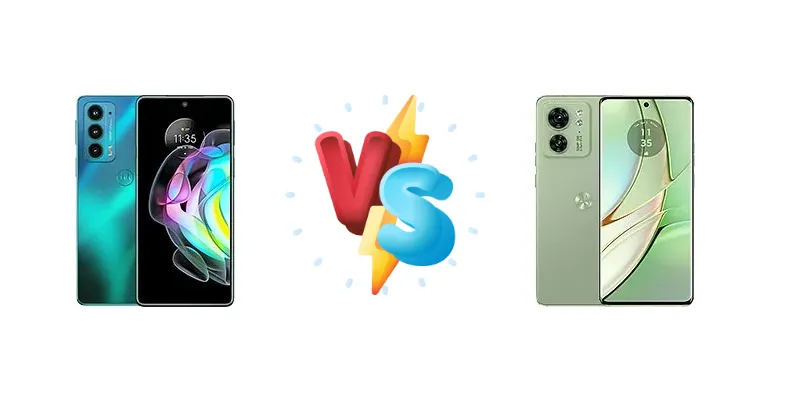
|
🏆 Quick Verdict
The Motorola Edge 40 is the clear winner, offering a brighter display, faster charging, and improved performance thanks to the Dimensity 8020. While the Edge 20 remains a capable device, the Edge 40's enhancements make it a worthwhile upgrade for most users.
| PHONES | ||
|---|---|---|
| Phone Names | Motorola Edge 20 | Motorola Edge 40 |
| Network | ||
|---|---|---|
| 2G bands | GSM 850 / 900 / 1800 / 1900 | GSM 850 / 900 / 1800 / 1900 |
| 3G bands | HSDPA 850 / 900 / 1700(AWS) / 1900 / 2100 | HSDPA 850 / 900 / 1700(AWS) / 1900 / 2100 |
| 4G bands | 1, 2, 3, 4, 5, 7, 8, 12, 18, 19, 20, 26, 28, 32, 34, 38, 39, 40, 41, 42, 43, 66 | 1, 2, 3, 4, 5, 7, 8, 12, 13, 17, 20, 26, 28, 32, 38, 39, 40, 41, 42, 43, 66 |
| 5G bands | 1, 3, 5, 7, 8, 28, 38, 41, 66, 77, 78 SA/NSA/Sub6 | 1, 2, 3, 5, 7, 8, 20, 28, 38, 40, 41, 66, 77, 78 SA/NSA/Sub6 |
| Speed | HSPA 42.2/5.76 Mbps, LTE Cat18 1200/150 Mbps, 5G | HSPA, LTE, 5G |
| Technology | GSM / HSPA / LTE / 5G | GSM / HSPA / LTE / 5G |
| Launch | ||
|---|---|---|
| Announced | 2021, July 29 | 2023, May 04 |
| Status | Available. Released 2021, August 16 | Available. Released 2023, May 04 |
| Body | ||
|---|---|---|
| Build | Glass front (Gorilla Glass 5), aluminum frame, glass back (Gorilla Glass 3) | Glass front, aluminum frame, plastic back or eco leather back |
| Dimensions | 163 x 76 x 7 mm (6.42 x 2.99 x 0.28 in) | 158.4 x 72 x 7.6 mm (6.24 x 2.83 x 0.30 in) |
| SIM | Nano-SIM + Nano-SIM | · Nano-SIM· Nano-SIM + eSIM· Nano-SIM + Nano-SIM |
| Weight | 163 g (5.75 oz) | 167 g or 171 g (5.89 oz) |
| Water-repellent design | IP68 dust/water resistant (up to 1.5m for 30 min) | |
| Display | ||
|---|---|---|
| Protection | Corning Gorilla Glass 5 | - |
| Resolution | 1080 x 2400 pixels, 19.5:9 ratio (~385 ppi density) | 1080 x 2400 pixels, 20:9 ratio (~402 ppi density) |
| Size | 6.7 inches, 110.2 cm2 (~89.0% screen-to-body ratio) | 6.55 inches, 103.6 cm2 (~90.8% screen-to-body ratio) |
| Type | OLED, 1B colors, 144Hz, HDR10+ | P-OLED, 144Hz, HDR10+, 1200 nits (peak) |
| Platform | ||
|---|---|---|
| CPU | Octa-core (1x2.4 GHz Cortex-A78 & 3x2.2 GHz Cortex-A78 & 4x1.9 GHz Cortex-A55) | Octa-core (4x2.6 GHz Cortex-A78 & 4x2.0 GHz Cortex-A55) |
| Chipset | Qualcomm SM7325 Snapdragon 778G 5G (6 nm) | Mediatek Dimensity 8020 (6 nm) |
| GPU | Adreno 642L | Mali-G77 MC9 |
| OS | Android 11, upgradable to Android 13 | Android 13, up to 2 major Android upgrades |
| Memory | ||
|---|---|---|
| Card slot | No | No |
| Internal | 128GB 6GB RAM, 128GB 8GB RAM, 256GB 8GB RAM | 128GB 8GB RAM, 256GB 8GB RAM |
| UFS | UFS 3.1 | |
| Main Camera | ||
|---|---|---|
| Dual | - | 50 MP, f/1.4, (wide), 1/1.55", 1.0µm, multi-directional PDAF, OIS 13 MP, f/2.2, 120˚ (ultrawide), 1/3.0", 1.12µm, AF |
| Features | Dual-LED dual-tone flash, HDR, panorama | Dual-LED flash, HDR, panorama |
| Triple | 108 MP, f/1.9, (wide), 1/1.52", 0.7µm, PDAF 8 MP, f/2.4, 79mm (telephoto), 1.0µm, 3x optical zoom, PDAF, OIS 16 MP, f/2.2, 17mm, 119˚ (ultrawide), 1/3.06", 1.0µm, AF | - |
| Video | 4K@30fps, 1080p@30/60/120/240fps, 720p@960fps, gyro-EIS | 4K@30fps, 1080p@30/60/120fps, 720p@960fps, HDR10, gyro-EIS |
| Selfie camera | ||
|---|---|---|
| Features | HDR | HDR |
| Single | 32 MP, f/2.3, (wide), 0.7µm | 32 MP, f/2.4, (wide), 1/3.0", 0.7µm |
| Video | 1080p@30fps | 4K@30fps, 1080p@30/120fps |
| Sound | ||
|---|---|---|
| 3.5mm jack | No | No |
| 35mm jack | No | No |
| Loudspeaker | Yes | Yes, with stereo speakers |
| Comms | ||
|---|---|---|
| Bluetooth | 5.2, A2DP, LE, aptX HD, aptX Adaptive | 5.2, A2DP, LE |
| NFC | Yes | Yes |
| Positioning | GPS, GLONASS, BDS, GALILEO | GPS, GLONASS, GALILEO, BDS |
| Radio | No | No |
| USB | USB Type-C 2.0 | USB Type-C 2.0, OTG |
| WLAN | Wi-Fi 802.11 a/b/g/n/ac/6e, dual-band, Wi-Fi Direct | Wi-Fi 802.11 a/b/g/n/ac/6e, tri-band, Wi-Fi Direct |
| Features | ||
|---|---|---|
| Sensors | Fingerprint (side-mounted), accelerometer, gyro, proximity, compass | Fingerprint (under display, optical), accelerometer, gyro, proximity, compass |
| - | Moto Ready For support | |
| Battery | ||
|---|---|---|
| Charging | 30W wired | 68W wired 15W wireless |
| Type | Li-Po 4000 mAh | Li-Po 4400 mAh |
| Misc | ||
|---|---|---|
| Colors | Frosted Grey, Frosted White, Frosted Emerald | Nebula Green, Lunar Blue, Eclipse Black, Viva Magenta |
| Models | XT2143-1 | XT2303-2 |
| Price | About 140 EUR | € 202.03 / $ 419.99 / £ 199.00 / ₹ 29,999 |
| Tests | ||
|---|---|---|
| Battery life | Endurance rating 86h | Endurance rating 98h |
| Camera | Photo / Video | Photo / Video |
| Display | Contrast ratio: Infinite (nominal) | Contrast ratio: Infinite (nominal) |
| Loudspeaker | -28.7 LUFS (Average) | -24.2 LUFS (Very good) |
| Performance | AnTuTu: 424031 (v8), 488574 (v9) GeekBench: 2550 (v5.1) GFXBench: 29fps (ES 3.1 onscreen) | AnTuTu: 688347 (v9) GeekBench: 3320 (v5.1), 3603 (v6) GFXBench: 33fps (ES 3.1 onscreen) |
Motorola Edge 20
- Excellent battery life
- Solid performance
- Good value for money
- Compact design
- Less bright display
- Slower charging
- Older chipset
- No wireless charging
Motorola Edge 40
- Brighter display
- Faster performance
- Faster charging (wired & wireless)
- Modern design
- Improved image processing
- Potentially higher price
- May not offer significantly better camera hardware
Display Comparison
The Edge 40 boasts a significantly brighter display at 1043 nits compared to the Edge 20's 650 nits. Both offer excellent contrast (infinite nominal), but the Edge 40's increased brightness makes it much more usable outdoors. The Edge 40 also likely has a higher refresh rate (typically 144Hz) compared to the Edge 20 (90Hz), resulting in smoother scrolling and animations.
Camera Comparison
While both phones offer capable camera systems, the Edge 40 likely has improvements in image processing and low-light performance. Specific camera specs (megapixels, aperture) are not provided, but the newer chipset often includes enhanced image signal processing (ISP) capabilities. Both phones likely offer similar video recording capabilities.
Performance
The Edge 40's Mediatek Dimensity 8020 chipset provides a noticeable performance boost over the Edge 20's Snapdragon 778G. Expect faster app loading times, smoother multitasking, and better gaming performance on the Edge 40. Both phones have ample RAM, but the newer chipset provides a more efficient and powerful experience.
Battery Life
The Edge 40 edges out the Edge 20 with an endurance rating of 98h versus 86h. While both offer excellent battery life, the Edge 40's slightly larger battery and more efficient chipset contribute to its longer runtime. The Edge 40 also features significantly faster 68W wired charging and 15W wireless charging, a major advantage over the Edge 20's 30W wired charging.
Buying Guide
Who should buy the Motorola Edge 20? Those on a tighter budget who prioritize excellent battery life and a solid overall experience. Who should buy the Motorola Edge 40? Users seeking a brighter, faster, and more feature-rich phone with faster charging and wireless charging capabilities.