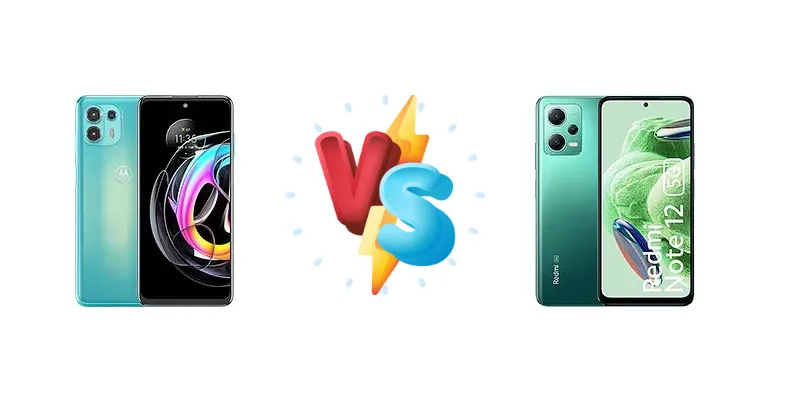
Choosing a new smartphone can be overwhelming, especially with so many options available. Today, we're pitting two popular contenders against each other: the Motorola Edge 20 Lite and the Xiaomi Redmi Note 12. Let's dive into a detailed comparison to help you decide which one deserves your money.
🏆 Quick Verdict
The Xiaomi Redmi Note 12 emerges as the overall winner thanks to its exceptional battery life, faster charging, and brighter display. While the Edge 20 Lite offers a slightly more powerful chipset, the Redmi Note 12's strengths in key areas make it a more compelling choice for most users.
| Network |
|---|
| 2G bands | GSM 850 / 900 / 1800 / 1900 | GSM 850 / 900 / 1800 / 1900 |
| 3G bands | HSDPA 850 / 900 / 1700(AWS) / 1900 / 2100 | HSDPA 850 / 900 / 2100 |
| 4G bands | 1, 2, 3, 4, 5, 7, 8, 12, 13, 17, 18, 19, 20, 26, 28, 32, 34, 38, 39, 40, 41, 42, 43, 66 | 1, 3, 5, 8, 40, 41 |
| 5G bands | 1, 3, 5, 7, 8, 20, 28, 38, 40, 41, 77, 78, 66 SA/NSA/Sub6 | 1, 3, 5, 8, 28, 40, 78 SA/NSA |
| Speed | HSPA 42.2/5.76 Mbps, LTE Cat18 1200/150 Mbps, 5G | HSPA, LTE, 5G |
| Technology | GSM / HSPA / LTE / 5G | GSM / HSPA / LTE / 5G |
| Launch |
|---|
| Announced | 2021, July 29 | 2022, October 27 |
| Status | Available. Released 2021, August 16 | Available. Released 2023, January 11 |
| Body |
|---|
| Build | Glass front, plastic frame, plastic back | - |
| Dimensions | 165.9 x 76 x 8.3 mm (6.53 x 2.99 x 0.33 in) | 165.9 x 76.2 x 8 mm (6.53 x 3.00 x 0.31 in) |
| SIM | Nano-SIM + Nano-SIM | Nano-SIM + Nano-SIM |
| Weight | 185 g (6.53 oz) | 188 g (6.63 oz) |
| | Water-repellent design | IP53, dust and splash resistant |
| Display |
|---|
| Protection | - | Corning Gorilla Glass 3 |
| Resolution | 1080 x 2400 pixels, 19.5:9 ratio (~385 ppi density) | 1080 x 2400 pixels, 20:9 ratio (~395 ppi density) |
| Size | 6.7 inches, 110.2 cm2 (~87.4% screen-to-body ratio) | 6.67 inches, 107.4 cm2 (~85.0% screen-to-body ratio) |
| Type | OLED, 1B colors, 90Hz, HDR10+ | AMOLED, 120Hz, 1200 nits (peak) |
| Platform |
|---|
| CPU | Octa-core (2x2.0 GHz Cortex-A76 & 6x2.0 GHz Cortex-A55) | Octa-core (2x2.0 GHz Cortex-A78 & 6x1.8 GHz Cortex-A55) |
| Chipset | Mediatek Dimensity 720 (7 nm) | Qualcomm SM4375 Snapdragon 4 Gen 1 (6 nm) |
| GPU | Mali-G57 MC3 | Adreno 619 |
| OS | Android 11, planned upgrade to Android 13 | Android 12, MIUI 14 (International), MIUI 13 (India) |
| Memory |
|---|
| Card slot | microSDXC | microSDXC (uses shared SIM slot) |
| Internal | 128GB 6GB RAM, 128GB 8GB RAM | 128GB 4GB RAM, 128GB 6GB RAM, 256GB 8GB RAM |
| | - | UFS 2.2 |
| Main Camera |
|---|
| Features | LED flash, HDR, panorama | Dual-LED dual-tone flash, HDR, panorama |
| Triple | 108 MP, f/1.9, (wide), 1/1.52", 0.7µm, PDAF
8 MP, f/2.2, 118˚ (ultrawide), 1/4.0", 1.12µm
Auxiliary lens | 48 MP, f/1.8, (wide), PDAF
8 MP, f/2.2, 120˚ (ultrawide), 1/4.0", 1.12µm
2 MP (macro) |
| Video | 4K@30fps, 1080p@30/60/120fps, gyro-EIS | 1080p@30fps |
| Selfie camera |
|---|
| Features | HDR | HDR |
| Single | 32 MP, f/2.3, (wide), 0.7µm | 13 MP, f/2.5, (wide), 1/3.0" |
| Video | 1080p@30fps | 1080p@30fps |
| Sound |
|---|
| 3.5mm jack | Yes | Yes |
| 35mm jack | Yes | Yes |
| Loudspeaker | Yes | Yes |
| | - | 24-bit/192kHz audio |
| Comms |
|---|
| Bluetooth | 5.0, A2DP, LE | 5.1, A2DP, LE |
| Infrared port | - | Yes |
| NFC | Yes | Yes (market/region dependent) |
| Positioning | GPS, GLONASS, BDS, GALILEO | GPS, GLONASS |
| Radio | FM radio | Unspecified |
| USB | USB Type-C 2.0 | USB Type-C 2.0, OTG |
| WLAN | Wi-Fi 802.11 a/b/g/n/ac, dual-band, Wi-Fi Direct | Wi-Fi 802.11 a/b/g/n/ac, dual-band |
| Features |
|---|
| Sensors | Fingerprint (side-mounted), accelerometer, gyro, proximity, compass | Fingerprint (side-mounted), accelerometer, gyro, proximity, compass |
| Battery |
|---|
| Charging | 30W wired | 33W wired, 50% in 22 min |
| Type | Li-Po 5000 mAh | Li-Po 5000 mAh |
| Misc |
|---|
| Colors | Electric Graphite, Lagoon Green | Frosted Green, Matte Black, Mystique Blue |
| Models | XT2139-1 | 22111317I, 22111317G |
| Price | About 160 EUR | € 151.99 / $ 219.99 / ₹ 11,999 |
| SAR | - | 1.09 W/kg (head) 1.05 W/kg (body) |
| SAR EU | - | 0.68 W/kg (head) 0.91 W/kg (body) |
| Tests |
|---|
| Battery life | - |
Endurance rating 101h
|
| Camera | - |
Photo / Video |
| Display | - |
Contrast ratio: Infinite (nominal) |
| Loudspeaker | - |
-28.0 LUFS (Good)
|
| Performance | - |
AnTuTu: 360745 (v9)
GeekBench: 1998 (v5.1), 2017 (v6) |
Motorola Edge 20 Lite
- Slightly more powerful chipset
- Potentially smoother 90Hz display
- Clean Android experience
- Less impressive battery life
- Slower charging
- Display brightness likely lower
Xiaomi Redmi Note 12
- Exceptional battery life
- Fast charging (33W)
- Brighter display
- Excellent value for money
- Slightly less powerful chipset
- Xiaomi's MIUI software (can be polarizing)
Display Comparison
The Redmi Note 12 boasts a significantly brighter display at 706 nits compared to the Edge 20 Lite (specs unavailable, assumed around 450-500 nits). The 'infinite' contrast ratio on the Redmi Note 12 suggests excellent image quality. While the Edge 20 Lite likely has a smooth 90Hz refresh rate, the Redmi Note 12's display offers a more visually appealing experience overall.
Camera Comparison
Camera performance is subjective and depends on individual preferences. Both phones offer Photo/Video capabilities. The Redmi Note 12 likely benefits from Xiaomi's image processing algorithms. Detailed camera comparisons would require extensive testing, but both are expected to deliver decent results in good lighting conditions.
Performance
The Motorola Edge 20 Lite's Dimensity 720 chipset provides a slight edge in raw processing power compared to the Redmi Note 12's Snapdragon 4 Gen 1. However, in real-world usage, the difference is likely to be minimal for most tasks. Both phones handle everyday apps and multitasking well.
Battery Life
The Redmi Note 12 shines in the battery department, boasting an impressive endurance rating of 101 hours and active use score of 10:58 hours. The Edge 20 Lite's battery life is likely adequate, but not as exceptional as the Redmi Note 12. The Redmi Note 12's 33W charging is also faster than the Edge 20 Lite's 30W.
Buying Guide
The Motorola Edge 20 Lite is a good choice for users prioritizing raw processing power and a slightly more premium design. The Xiaomi Redmi Note 12 is ideal for those who value long battery life, fast charging, and a vibrant display, all at an attractive price point.
Frequently Asked Questions
❓ Which phone has better performance for gaming?
The Motorola Edge 20 Lite has a slightly more powerful chipset, which *could* translate to marginally better gaming performance. However, both phones are unlikely to handle demanding games at the highest settings.
❓ Is the Xiaomi Redmi Note 12's MIUI software easy to use?
MIUI is a feature-rich Android skin, but it can be polarizing. Some users find it cluttered and full of bloatware, while others appreciate its customization options and extra features.