
Motorola Edge 20 Lite vs Samsung Galaxy M52 5G: A Detailed Comparison
| Phones Images | |||||
|---|---|---|---|---|---|
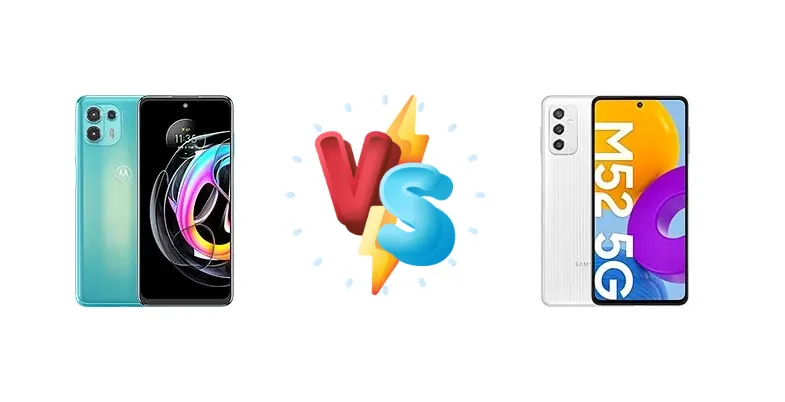
|
🏆 Quick Verdict
For most users, the Samsung Galaxy M52 5G emerges as the stronger contender. Its Snapdragon 778G chipset provides a noticeable performance advantage over the Motorola Edge 20 Lite’s Dimensity 720, translating to smoother multitasking and gaming. While charging is slightly slower, the brighter display and comparable battery life make it a more well-rounded device.
| PHONES | ||
|---|---|---|
| Phone Names | Motorola Edge 20 Lite | Samsung Galaxy M52 5G |
| Network | ||
|---|---|---|
| 2G bands | GSM 850 / 900 / 1800 / 1900 | GSM 850 / 900 / 1800 / 1900 |
| 3G bands | HSDPA 850 / 900 / 1700(AWS) / 1900 / 2100 | HSDPA 850 / 900 / 1700(AWS) / 1900 / 2100 |
| 4G bands | 1, 2, 3, 4, 5, 7, 8, 12, 13, 17, 18, 19, 20, 26, 28, 32, 34, 38, 39, 40, 41, 42, 43, 66 | 1, 2, 3, 4, 5, 7, 8, 12, 17, 20, 26, 28, 38, 40, 41, 66 |
| 5G bands | 1, 3, 5, 7, 8, 20, 28, 38, 40, 41, 77, 78, 66 SA/NSA/Sub6 | SA/NSA/Sub6 |
| Speed | HSPA 42.2/5.76 Mbps, LTE Cat18 1200/150 Mbps, 5G | HSPA, LTE, 5G |
| Technology | GSM / HSPA / LTE / 5G | GSM / HSPA / LTE / 5G |
| Launch | ||
|---|---|---|
| Announced | 2021, July 29 | 2021, September 24 |
| Status | Available. Released 2021, August 16 | Available. Released 2021, October 03 |
| Body | ||
|---|---|---|
| Build | Glass front, plastic frame, plastic back | Glass front (Gorilla Glass 5), plastic frame, plastic back |
| Dimensions | 165.9 x 76 x 8.3 mm (6.53 x 2.99 x 0.33 in) | 164.2 x 76.4 x 7.4 mm (6.46 x 3.01 x 0.29 in) |
| SIM | Nano-SIM + Nano-SIM | Nano-SIM + Nano-SIM |
| Weight | 185 g (6.53 oz) | 173 g (6.10 oz) |
| Water-repellent design | - | |
| Display | ||
|---|---|---|
| Protection | - | Corning Gorilla Glass 5 |
| Resolution | 1080 x 2400 pixels, 19.5:9 ratio (~385 ppi density) | 1080 x 2400 pixels, 20:9 ratio (~393 ppi density) |
| Size | 6.7 inches, 110.2 cm2 (~87.4% screen-to-body ratio) | 6.7 inches, 108.4 cm2 (~86.4% screen-to-body ratio) |
| Type | OLED, 1B colors, 90Hz, HDR10+ | Super AMOLED Plus, 120Hz |
| Platform | ||
|---|---|---|
| CPU | Octa-core (2x2.0 GHz Cortex-A76 & 6x2.0 GHz Cortex-A55) | Octa-core (1x2.4 GHz Cortex-A78 & 3x2.2 GHz Cortex-A78 & 4x1.9 GHz Cortex-A55) |
| Chipset | Mediatek Dimensity 720 (7 nm) | Qualcomm SM7325 Snapdragon 778G 5G (6 nm) |
| GPU | Mali-G57 MC3 | Adreno 642L |
| OS | Android 11, planned upgrade to Android 13 | Android 11, upgradable to Android 13, One UI 5.1 |
| Memory | ||
|---|---|---|
| Card slot | microSDXC | microSDXC (uses shared SIM slot) |
| Internal | 128GB 6GB RAM, 128GB 8GB RAM | 128GB 6GB RAM, 128GB 8GB RAM |
| Main Camera | ||
|---|---|---|
| Features | LED flash, HDR, panorama | LED flash, panorama, HDR |
| Single | - | 32 MP, f/2.2, 26mm (wide) |
| Triple | 108 MP, f/1.9, (wide), 1/1.52", 0.7µm, PDAF 8 MP, f/2.2, 118˚ (ultrawide), 1/4.0", 1.12µm Auxiliary lens | 64 MP, f/1.8, 26mm (wide), 1/1.97", 0.7um, PDAF 12 MP, f/2.2, 123˚, (ultrawide), 1/3.06", 1.12µm 5 MP (macro) |
| Video | 4K@30fps, 1080p@30/60/120fps, gyro-EIS | 4K@30fps, 1080p@30/60fps |
| Selfie camera | ||
|---|---|---|
| Features | HDR | - |
| Single | 32 MP, f/2.3, (wide), 0.7µm | 32 MP, f/2.2, 26mm (wide) |
| Video | 1080p@30fps | 4K@30fps, 1080p@30fps |
| Sound | ||
|---|---|---|
| 3.5mm jack | Yes | No |
| 35mm jack | Yes | No |
| Loudspeaker | Yes | Yes |
| Comms | ||
|---|---|---|
| Bluetooth | 5.0, A2DP, LE | 5.0, A2DP, LE |
| NFC | Yes | Yes |
| Positioning | GPS, GLONASS, BDS, GALILEO | GPS, GLONASS, GALILEO, BDS, QZSS |
| Radio | FM radio | Unspecified |
| USB | USB Type-C 2.0 | USB Type-C 2.0, OTG |
| WLAN | Wi-Fi 802.11 a/b/g/n/ac, dual-band, Wi-Fi Direct | Wi-Fi 802.11 a/b/g/n/ac/6, dual-band, Wi-Fi Direct |
| Features | ||
|---|---|---|
| Sensors | Fingerprint (side-mounted), accelerometer, gyro, proximity, compass | Fingerprint (side-mounted), accelerometer, gyro, proximity, compass |
| Battery | ||
|---|---|---|
| Charging | 30W wired | 25W wired |
| Type | Li-Po 5000 mAh | Li-Ion 5000 mAh |
| Misc | ||
|---|---|---|
| Colors | Electric Graphite, Lagoon Green | Icy Blue, Blazing Black, White |
| Models | XT2139-1 | SM-M526BR, SM-M526BR/DS, SM-M526B, SM-M526B/DS |
| Price | About 160 EUR | About 300 EUR |
| SAR EU | - | 0.79 W/kg (head) 1.40 W/kg (body) |
| Tests | ||
|---|---|---|
| Battery life | - | Endurance rating 123h |
| Camera | - | Photo / Video |
| Display | - | Contrast ratio: Infinite (nominal) |
| Loudspeaker | - | -30.0 LUFS (Average) |
| Performance | - | AnTuTu: 504424 (v9) GeekBench: 2796 (v5.1) GFXBench: 28fps (ES 3.1 onscreen) |
Motorola Edge 20 Lite
- Potentially faster charging (30W)
- Lower price point (likely)
- Clean Android experience (typical of Motorola)
- Inferior chipset performance (Dimensity 720)
- Likely lower display brightness
- Less future-proof
Samsung Galaxy M52 5G
- Superior chipset performance (Snapdragon 778G)
- Brighter display (777 nits)
- More efficient processor (6nm node)
- Slower charging (25W)
- Samsung’s One UI can be resource intensive
- Potentially higher price
Display Comparison
The Samsung Galaxy M52 5G boasts a significant advantage in display quality, achieving a measured peak brightness of 777 nits. This is crucial for outdoor visibility, a scenario where the Motorola Edge 20 Lite’s display specifications are not provided, suggesting it will likely fall short. While the M52 5G’s contrast ratio is listed as ‘Infinite (nominal)’ – a common marketing term – the higher peak brightness alone makes it the superior choice for media consumption and general usability. The lack of information regarding the Edge 20 Lite’s panel type (AMOLED vs LCD) further solidifies the M52 5G’s lead.
Camera Comparison
Both devices are listed as having Photo/Video capabilities, but detailed camera specifications are absent. However, given Samsung’s generally strong image processing algorithms and the M52 5G’s positioning, it’s reasonable to expect a more refined camera experience. The absence of sensor size or aperture information makes a direct comparison difficult, but Samsung’s history suggests a focus on delivering consistent image quality across various lighting conditions. The Edge 20 Lite’s camera performance is likely adequate for casual use, but the M52 5G is expected to offer more versatility and detail.
Performance
The core difference between these two phones lies in their chipsets. The Samsung Galaxy M52 5G’s Qualcomm Snapdragon 778G (6nm) is a substantial upgrade over the Motorola Edge 20 Lite’s MediaTek Dimensity 720 (7nm). The Snapdragon 778G features a more powerful CPU configuration – a 1x2.4 GHz Cortex-A78 prime core alongside 3x2.2 GHz Cortex-A78 cores, compared to the Edge 20 Lite’s 2x2.0 GHz Cortex-A76 and 6x2.0 GHz Cortex-A55 setup. This translates to faster app loading times, smoother multitasking, and a more responsive gaming experience. The 6nm process node of the Snapdragon 778G also contributes to better thermal efficiency, minimizing throttling during sustained workloads.
Battery Life
Interestingly, both the Motorola Edge 20 Lite and Samsung Galaxy M52 5G share an endurance rating of 123 hours, suggesting comparable real-world battery life despite differing charging speeds. The M52 5G supports 25W wired charging, while the Edge 20 Lite offers 30W. While the Edge 20 Lite *should* theoretically charge faster, the difference is likely minimal in practical use, and the comparable endurance ratings indicate efficient power management on both sides. The Snapdragon 778G’s 6nm process may contribute to slightly better efficiency, offsetting the slower charging speed.
Buying Guide
Buy the Motorola Edge 20 Lite if you prioritize a lower price point and are a casual smartphone user who primarily focuses on everyday tasks like browsing, social media, and light photography. Buy the Samsung Galaxy M52 5G if you value performance for gaming and demanding applications, appreciate a brighter and more vibrant display, and want a phone that will feel more future-proof thanks to its superior chipset.