
Motorola Edge 20 Fusion vs Samsung Galaxy A53 5G: The Ultimate Showdown
| Phones Images | |||||
|---|---|---|---|---|---|
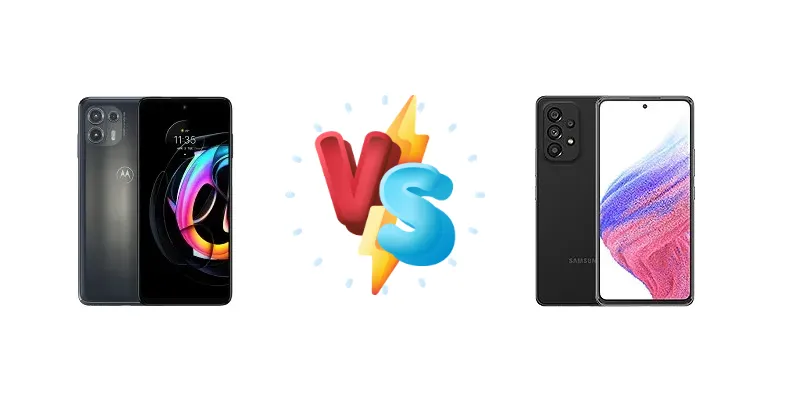
|
🏆 Quick Verdict
The Samsung Galaxy A53 5G edges out the Motorola Edge 20 Fusion thanks to its brighter display, longer software support, and generally more polished software experience. While the Edge 20 Fusion offers a slightly faster chipset, the A53's overall package is more appealing for most users.
| PHONES | ||
|---|---|---|
| Phone Names | Motorola Edge 20 Fusion | Samsung Galaxy A53 5G |
| Network | ||
|---|---|---|
| 2G bands | GSM 850 / 900 / 1800 / 1900 | GSM 850 / 900 / 1800 / 1900 |
| 3G bands | HSDPA 850 / 900 / 1700(AWS) / 1900 / 2100 | HSDPA 850 / 900 / 1700(AWS) / 1900 / 2100 |
| 4G bands | 1, 2, 3, 4, 5, 7, 8, 12, 13, 17, 18, 19, 20, 26, 28, 32, 34, 38, 39, 40, 41, 42, 43, 66 | 1, 2, 3, 4, 5, 7, 12, 14, 20, 29, 30, 38, 39, 40, 41, 46, 48, 66 - SM-A536U |
| 5G bands | 1, 3, 5, 7, 8, 20, 28, 38, 40, 41, 77, 78, 66 SA/NSA/Sub6 | 2, 5, 41, 66, 77, 78 SA/NSA/Sub6/mmWave - SM-A536U |
| Speed | HSPA 42.2/5.76 Mbps, LTE Cat18 1200/150 Mbps, 5G | HSPA, LTE, 5G |
| Technology | GSM / HSPA / LTE / 5G | GSM / HSPA / LTE / 5G |
| - | 2, 5, 48, 66, 77, 78, 260, 261 SA/NSA/Sub6/mmWave - SM-A536V | |
| Launch | ||
|---|---|---|
| Announced | 2021, August 17 | 2022, March 17 |
| Status | Available. Released 2021, August 27 | Available. Released 2022, March 24 |
| Body | ||
|---|---|---|
| Build | Glass front | Glass front (Gorilla Glass 5), plastic frame, plastic back |
| Dimensions | 166 x 76 x 8.3 mm (6.54 x 2.99 x 0.33 in) | 159.6 x 74.8 x 8.1 mm (6.28 x 2.94 x 0.32 in) |
| SIM | Nano-SIM + Nano-SIM | · Nano-SIM· Nano-SIM + Nano-SIM |
| Weight | 185 g (6.53 oz) | 189 g (6.67 oz) |
| Water-repellent design | IP67 dust/water resistant (up to 1m for 30 min) | |
| Display | ||
|---|---|---|
| Protection | - | Corning Gorilla Glass 5 |
| Resolution | 1080 x 2400 pixels, 20:9 ratio (~393 ppi density) | 1080 x 2400 pixels, 20:9 ratio (~405 ppi density) |
| Size | 6.7 inches, 108.4 cm2 (~85.9% screen-to-body ratio) | 6.5 inches, 102.0 cm2 (~85.4% screen-to-body ratio) |
| Type | OLED, 1B colors, 90Hz, HDR10+ | Super AMOLED, 120Hz, 800 nits (HBM) |
| Platform | ||
|---|---|---|
| CPU | Octa-core (2x2.4 GHz Cortex-A76 & 6x2.0 GHz Cortex-A55) | Octa-core (2x2.4 GHz Cortex-A78 & 6x2.0 GHz Cortex-A55) |
| Chipset | Mediatek Dimensity 800U (7 nm) | Exynos 1280 (5 nm) |
| GPU | Mali-G57 MC3 | Mali-G68 |
| OS | Android 11 | Android 12, up to 4 major Android upgrades, One UI 8 |
| Memory | ||
|---|---|---|
| Card slot | microSDXC | microSDXC (uses shared SIM slot) |
| Internal | 128GB 6GB RAM, 128GB 8GB RAM | 128GB 4GB RAM, 128GB 6GB RAM, 128GB 8GB RAM, 256GB 6GB RAM, 256GB 8GB RAM |
| Main Camera | ||
|---|---|---|
| Features | LED flash, HDR, panorama | LED flash, panorama, HDR |
| Quad | - | 64 MP, f/1.8, 26mm (wide), 1/1.7X", 0.8µm, PDAF, OIS 12 MP, f/2.2, 123˚ (ultrawide), 1.12µm 5 MP (macro) Auxiliary lens |
| Single | - | 32 MP, f/2.2, 26mm (wide), 1/2.8", 0.8µm |
| Triple | 108 MP, f/1.9, (wide), 1/1.52", 0.7µm, PDAF 8 MP, f/2.2, 118˚ (ultrawide) Auxiliary lens | - |
| Video | 4K@30fps, 1080p@30/60/120fps, gyro-EIS | 4K@30fps, 1080p@30/60fps; gyro-EIS |
| Selfie camera | ||
|---|---|---|
| Features | HDR | HDR |
| Single | 32 MP, f/2.3, (wide), 0.7µm | 32 MP, f/2.2, 26mm (wide), 1/2.8", 0.8µm |
| Video | 1080p@30fps | 4K@30fps, 1080p@30fps |
| Sound | ||
|---|---|---|
| 3.5mm jack | Yes | No |
| 35mm jack | Yes | No |
| Loudspeaker | Yes | Yes, with stereo speakers |
| Comms | ||
|---|---|---|
| Bluetooth | 5.0, A2DP, LE | 5.1, A2DP, LE |
| NFC | Yes | Yes (market/region dependent) |
| Positioning | GPS, GLONASS, GALILEO | GPS, GLONASS, GALILEO, BDS |
| Radio | FM radio | No |
| USB | USB Type-C 2.0 | USB Type-C 2.0, OTG |
| WLAN | Wi-Fi 802.11 a/b/g/n/ac, dual-band, Wi-Fi Direct | Wi-Fi 802.11 a/b/g/n/ac, dual-band, Wi-Fi Direct |
| Features | ||
|---|---|---|
| Sensors | Fingerprint (side-mounted), accelerometer, gyro, proximity, compass | Fingerprint (under display, optical), accelerometer, gyro, compass, barometer (market/region dependent) |
| - | Virtual proximity sensing | |
| Battery | ||
|---|---|---|
| Charging | 30W wired | 25W wired |
| Type | Li-Po 5000 mAh | Li-Po 5000 mAh |
| Misc | ||
|---|---|---|
| Colors | Electric Graphite, Cyber Teal | Black, White, Blue, Peach |
| Models | - | SM-A536B, SM-A536B/DS, SM-A536U, SM-A536U1, SM-A5360, SM-A536E, SM-A536E/DS, SM-A536V, SM-A536W, SM-A536N, SM-S536DL |
| Price | About 250 EUR | $ 151.42 / £ 185.00 / € 169.14 |
| SAR | - | 0.75 W/kg (head) 1.58 W/kg (body) |
| SAR EU | - | 0.89 W/kg (head) 1.60 W/kg (body) |
| Tests | ||
|---|---|---|
| Battery life | - | Endurance rating 113h |
| Camera | - | Photo / Video |
| Display | - | Contrast ratio: Infinite (nominal) |
| Loudspeaker | - | -26.5 LUFS (Good) |
| Performance | - | AnTuTu: 329802 (v8), 379313 (v9) GeekBench: 1891 (v5.1) GFXBench: 19fps (ES 3.1 onscreen) |
Motorola Edge 20 Fusion
- Slightly faster chipset
- More compact design
- Clean Android experience
- Lower brightness display
- Less impressive camera
- Shorter software support
Samsung Galaxy A53 5G
- Brighter display
- Excellent battery life
- Longer software support
- Reputable brand
- Slightly slower chipset
- 25W charging
- One UI can be bloated for some
Display Comparison
The Samsung Galaxy A53 5G boasts a significant advantage with its 830 nits max brightness, making it much easier to view outdoors. Its 'Infinite' contrast ratio (nominal) suggests excellent image quality. The Edge 20 Fusion's display is good, but lacks the A53's punch and outdoor visibility. Both feature OLED panels, offering vibrant colors and deep blacks.
Camera Comparison
Both phones offer capable camera systems. The Galaxy A53 5G likely has a more versatile setup with its multiple lenses and Samsung's image processing expertise. The Edge 20 Fusion's camera is decent, but may not match the A53's overall image quality, especially in challenging lighting conditions. Video recording capabilities are comparable.
Performance
The Motorola Edge 20 Fusion's Mediatek Dimensity 800U chipset provides a slight edge in raw processing power compared to the Exynos 1280. However, in real-world usage, the difference is often negligible. The A53's Exynos 1280 is efficient and handles everyday tasks and moderate gaming with ease. Software optimization plays a crucial role here, and Samsung's One UI is generally well-optimized.
Battery Life
The Samsung Galaxy A53 5G shines with its exceptional endurance rating of 113 hours. This translates to excellent real-world battery life, easily lasting a full day or more. The Edge 20 Fusion's battery life is respectable, but falls short of the A53's longevity. Both support 30W/25W wired charging, respectively, but charging speeds are not a major differentiator.
Buying Guide
The Motorola Edge 20 Fusion is ideal for users prioritizing raw performance and a more compact design. The Samsung Galaxy A53 5G is a better choice for those who value a vibrant display, long-term software updates, and a more established brand reputation.