
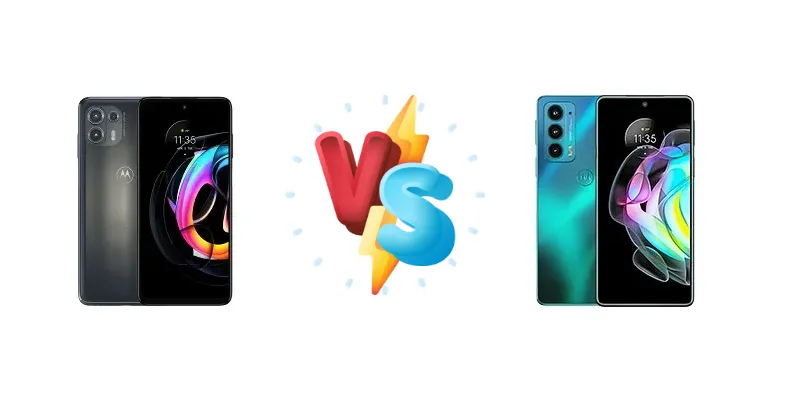
Motorola Edge 20 Fusion vs. Edge 20: A Head-to-Head Showdown
| Phones Images | |||||
|---|---|---|---|---|---|
|
🏆 Quick Verdict
The Motorola Edge 20 edges out the Fusion thanks to its superior Snapdragon 778G chipset, brighter display, and generally more refined experience. While the Fusion offers decent value, the Edge 20 provides a noticeable performance and display upgrade.
| PHONES | ||
|---|---|---|
| Phone Names | Motorola Edge 20 Fusion | Motorola Edge 20 |
| Network | ||
|---|---|---|
| 2G bands | GSM 850 / 900 / 1800 / 1900 | GSM 850 / 900 / 1800 / 1900 |
| 3G bands | HSDPA 850 / 900 / 1700(AWS) / 1900 / 2100 | HSDPA 850 / 900 / 1700(AWS) / 1900 / 2100 |
| 4G bands | 1, 2, 3, 4, 5, 7, 8, 12, 13, 17, 18, 19, 20, 26, 28, 32, 34, 38, 39, 40, 41, 42, 43, 66 | 1, 2, 3, 4, 5, 7, 8, 12, 18, 19, 20, 26, 28, 32, 34, 38, 39, 40, 41, 42, 43, 66 |
| 5G bands | 1, 3, 5, 7, 8, 20, 28, 38, 40, 41, 77, 78, 66 SA/NSA/Sub6 | 1, 3, 5, 7, 8, 28, 38, 41, 66, 77, 78 SA/NSA/Sub6 |
| Speed | HSPA 42.2/5.76 Mbps, LTE Cat18 1200/150 Mbps, 5G | HSPA 42.2/5.76 Mbps, LTE Cat18 1200/150 Mbps, 5G |
| Technology | GSM / HSPA / LTE / 5G | GSM / HSPA / LTE / 5G |
| Launch | ||
|---|---|---|
| Announced | 2021, August 17 | 2021, July 29 |
| Status | Available. Released 2021, August 27 | Available. Released 2021, August 16 |
| Body | ||
|---|---|---|
| Build | Glass front | Glass front (Gorilla Glass 5), aluminum frame, glass back (Gorilla Glass 3) |
| Dimensions | 166 x 76 x 8.3 mm (6.54 x 2.99 x 0.33 in) | 163 x 76 x 7 mm (6.42 x 2.99 x 0.28 in) |
| SIM | Nano-SIM + Nano-SIM | Nano-SIM + Nano-SIM |
| Weight | 185 g (6.53 oz) | 163 g (5.75 oz) |
| Water-repellent design | Water-repellent design | |
| Display | ||
|---|---|---|
| Protection | - | Corning Gorilla Glass 5 |
| Resolution | 1080 x 2400 pixels, 20:9 ratio (~393 ppi density) | 1080 x 2400 pixels, 19.5:9 ratio (~385 ppi density) |
| Size | 6.7 inches, 108.4 cm2 (~85.9% screen-to-body ratio) | 6.7 inches, 110.2 cm2 (~89.0% screen-to-body ratio) |
| Type | OLED, 1B colors, 90Hz, HDR10+ | OLED, 1B colors, 144Hz, HDR10+ |
| Platform | ||
|---|---|---|
| CPU | Octa-core (2x2.4 GHz Cortex-A76 & 6x2.0 GHz Cortex-A55) | Octa-core (1x2.4 GHz Cortex-A78 & 3x2.2 GHz Cortex-A78 & 4x1.9 GHz Cortex-A55) |
| Chipset | Mediatek Dimensity 800U (7 nm) | Qualcomm SM7325 Snapdragon 778G 5G (6 nm) |
| GPU | Mali-G57 MC3 | Adreno 642L |
| OS | Android 11 | Android 11, upgradable to Android 13 |
| Memory | ||
|---|---|---|
| Card slot | microSDXC | No |
| Internal | 128GB 6GB RAM, 128GB 8GB RAM | 128GB 6GB RAM, 128GB 8GB RAM, 256GB 8GB RAM |
| - | UFS | |
| Main Camera | ||
|---|---|---|
| Features | LED flash, HDR, panorama | Dual-LED dual-tone flash, HDR, panorama |
| Triple | 108 MP, f/1.9, (wide), 1/1.52", 0.7µm, PDAF 8 MP, f/2.2, 118˚ (ultrawide) Auxiliary lens | 108 MP, f/1.9, (wide), 1/1.52", 0.7µm, PDAF 8 MP, f/2.4, 79mm (telephoto), 1.0µm, 3x optical zoom, PDAF, OIS 16 MP, f/2.2, 17mm, 119˚ (ultrawide), 1/3.06", 1.0µm, AF |
| Video | 4K@30fps, 1080p@30/60/120fps, gyro-EIS | 4K@30fps, 1080p@30/60/120/240fps, 720p@960fps, gyro-EIS |
| Selfie camera | ||
|---|---|---|
| Features | HDR | HDR |
| Single | 32 MP, f/2.3, (wide), 0.7µm | 32 MP, f/2.3, (wide), 0.7µm |
| Video | 1080p@30fps | 1080p@30fps |
| Sound | ||
|---|---|---|
| 3.5mm jack | Yes | No |
| 35mm jack | Yes | No |
| Loudspeaker | Yes | Yes |
| Comms | ||
|---|---|---|
| Bluetooth | 5.0, A2DP, LE | 5.2, A2DP, LE, aptX HD, aptX Adaptive |
| NFC | Yes | Yes |
| Positioning | GPS, GLONASS, GALILEO | GPS, GLONASS, BDS, GALILEO |
| Radio | FM radio | No |
| USB | USB Type-C 2.0 | USB Type-C 2.0 |
| WLAN | Wi-Fi 802.11 a/b/g/n/ac, dual-band, Wi-Fi Direct | Wi-Fi 802.11 a/b/g/n/ac/6e, dual-band, Wi-Fi Direct |
| Features | ||
|---|---|---|
| Sensors | Fingerprint (side-mounted), accelerometer, gyro, proximity, compass | Fingerprint (side-mounted), accelerometer, gyro, proximity, compass |
| Battery | ||
|---|---|---|
| Charging | 30W wired | 30W wired |
| Type | Li-Po 5000 mAh | Li-Po 4000 mAh |
| Misc | ||
|---|---|---|
| Colors | Electric Graphite, Cyber Teal | Frosted Grey, Frosted White, Frosted Emerald |
| Models | - | XT2143-1 |
| Price | About 250 EUR | About 140 EUR |
| Tests | ||
|---|---|---|
| Battery life | - | Endurance rating 86h |
| Camera | - | Photo / Video |
| Display | - | Contrast ratio: Infinite (nominal) |
| Loudspeaker | - | -28.7 LUFS (Average) |
| Performance | - | AnTuTu: 424031 (v8), 488574 (v9) GeekBench: 2550 (v5.1) GFXBench: 29fps (ES 3.1 onscreen) |
Motorola Edge 20 Fusion
- More affordable
- Decent all-around performance
- Solid build quality
- Clean Android experience
- Less powerful chipset
- Dimmer display
- Potentially lower camera quality
Motorola Edge 20
- Superior performance (Snapdragon 778G)
- Brighter and more vibrant display
- Likely better camera quality
- More efficient power consumption
- Higher price
- Similar charging speed
Display Comparison
The Motorola Edge 20 boasts a significant advantage with its measured 650 nits max brightness, offering better visibility in sunlight. While the Edge 20 Fusion's display is perfectly adequate, it lacks the punch and clarity of its sibling. The Edge 20's 'Infinite' contrast ratio (nominal) suggests excellent blacks and vibrant colors, further enhancing the viewing experience.
Camera Comparison
Both phones offer capable camera systems, but the Edge 20 likely has a slight edge in image quality, particularly in challenging lighting conditions, due to the superior image signal processor (ISP) within the Snapdragon 778G. Details and color accuracy are generally better on the Edge 20. Specific camera specs (megapixels, aperture) would need further investigation for a definitive conclusion.
Performance
The Snapdragon 778G 5G in the Edge 20 is a clear winner over the Dimensity 800U in the Fusion. The 778G offers noticeably faster processing speeds, smoother multitasking, and better gaming performance. The Edge 20's CPU architecture (Cortex-A78 cores) is also more modern and efficient than the Fusion's (Cortex-A76 cores).
Battery Life
Both phones share a similar battery capacity (around 4000mAh, estimated for Fusion), but the Edge 20 achieves an impressive endurance rating of 86 hours. This suggests better power efficiency and optimization, likely due to the more efficient Snapdragon 778G chipset.
Buying Guide
Who should buy the Motorola Edge 20 Fusion? Users prioritizing affordability and a solid all-around experience on a budget. Who should buy the Motorola Edge 20? Those seeking better performance, a brighter display, and a slightly more premium feel, even if it means spending a bit more.