
Motorola Edge 20 Fusion vs Google Pixel 6a: The Ultimate Showdown
| Phones Images | |||||
|---|---|---|---|---|---|
|
🏆 Quick Verdict
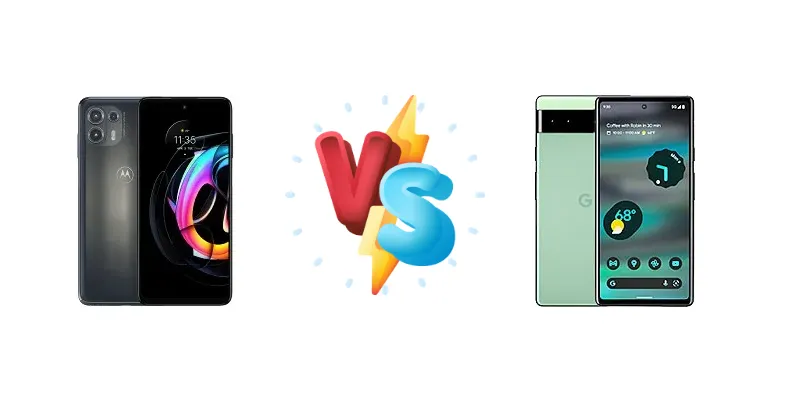
The Google Pixel 6a emerges as the overall winner thanks to its superior chipset, exceptional camera capabilities powered by Google's software, and vibrant display. While the Edge 20 Fusion offers a faster charging speed, the Pixel 6a's performance and camera quality justify its price.
| PHONES | ||
|---|---|---|
| Phone Names | Motorola Edge 20 Fusion | Google Pixel 6a |
| Network | ||
|---|---|---|
| 2G bands | GSM 850 / 900 / 1800 / 1900 | GSM 850 / 900 / 1800 / 1900 |
| 3G bands | HSDPA 850 / 900 / 1700(AWS) / 1900 / 2100 | HSDPA 800 / 850 / 900 / 1700(AWS) / 1900 / 2100 |
| 4G bands | 1, 2, 3, 4, 5, 7, 8, 12, 13, 17, 18, 19, 20, 26, 28, 32, 34, 38, 39, 40, 41, 42, 43, 66 | 1, 2, 3, 4, 5, 7, 8, 12, 13, 14, 17, 18, 19, 20, 25, 26, 28, 29, 30, 38, 39, 40, 41, 42, 48, 66, 71 - GX7AS, GB62Z (USA/Canada) |
| 5G bands | 1, 3, 5, 7, 8, 20, 28, 38, 40, 41, 77, 78, 66 SA/NSA/Sub6 | 1, 2, 3, 5, 7, 8, 12, 20, 25, 28, 30, 38, 40, 41, 48, 66, 71, 77, 78 SA/NSA/Sub6 - GX7AS (USA/Canada) |
| Speed | HSPA 42.2/5.76 Mbps, LTE Cat18 1200/150 Mbps, 5G | HSPA, LTE, 5G |
| Technology | GSM / HSPA / LTE / 5G | GSM / HSPA / LTE / 5G |
| - | 1, 2, 3, 5, 7, 8, 12, 20, 25, 28, 30, 40, 48, 66, 71, 77, 78 SA/NSA/Sub6 - G1AZG (International) | |
| Launch | ||
|---|---|---|
| Announced | 2021, August 17 | 2022, May 11 |
| Status | Available. Released 2021, August 27 | Available. Released 2022, July 21 |
| Body | ||
|---|---|---|
| Build | Glass front | Glass front (Gorilla Glass 3), aluminum frame, plastic back |
| Dimensions | 166 x 76 x 8.3 mm (6.54 x 2.99 x 0.33 in) | 152.2 x 71.8 x 8.9 mm (5.99 x 2.83 x 0.35 in) |
| SIM | Nano-SIM + Nano-SIM | Nano-SIM + eSIM |
| Weight | 185 g (6.53 oz) | 178 g (6.28 oz) |
| Water-repellent design | IP67 dust/water resistant (up to 1m for 30 min) | |
| Display | ||
|---|---|---|
| Protection | - | Corning Gorilla Glass 3 |
| Resolution | 1080 x 2400 pixels, 20:9 ratio (~393 ppi density) | 1080 x 2400 pixels, 20:9 ratio (~429 ppi density) |
| Size | 6.7 inches, 108.4 cm2 (~85.9% screen-to-body ratio) | 6.1 inches, 90.7 cm2 (~83.0% screen-to-body ratio) |
| Type | OLED, 1B colors, 90Hz, HDR10+ | OLED, HDR |
| - | Always-on display | |
| Platform | ||
|---|---|---|
| CPU | Octa-core (2x2.4 GHz Cortex-A76 & 6x2.0 GHz Cortex-A55) | Octa-core (2x2.80 GHz Cortex-X1 & 2x2.25 GHz Cortex-A76 & 4x1.80 GHz Cortex-A55) |
| Chipset | Mediatek Dimensity 800U (7 nm) | Google Tensor (5 nm) |
| GPU | Mali-G57 MC3 | Mali-G78 MP20 |
| OS | Android 11 | Android 12, upgradable to Android 15, up to 5 major Android upgrades |
| Memory | ||
|---|---|---|
| Card slot | microSDXC | No |
| Internal | 128GB 6GB RAM, 128GB 8GB RAM | 128GB 6GB RAM |
| - | UFS 3.1 | |
| Main Camera | ||
|---|---|---|
| Dual | - | 12.2 MP, f/1.7, 27mm, (wide), 1/2.55", 1.4µm, dual pixel PDAF, OIS 12 MP, f/2.2, 17mm, 114˚ (ultrawide), 1.25µm |
| Features | LED flash, HDR, panorama | Dual-LED flash, Pixel Shift, Auto-HDR, panorama |
| Single | - | 8 MP, f/2.0, 24mm (wide), 1.12µm |
| Triple | 108 MP, f/1.9, (wide), 1/1.52", 0.7µm, PDAF 8 MP, f/2.2, 118˚ (ultrawide) Auxiliary lens | - |
| Video | 4K@30fps, 1080p@30/60/120fps, gyro-EIS | 4K@30/60fps, 1080p@30/60/120/240fps; gyro-EIS, OIS |
| Selfie camera | ||
|---|---|---|
| Features | HDR | HDR, panorama |
| Single | 32 MP, f/2.3, (wide), 0.7µm | 8 MP, f/2.0, 24mm (wide), 1.12µm |
| Video | 1080p@30fps | 1080p@30fps |
| Sound | ||
|---|---|---|
| 3.5mm jack | Yes | No |
| 35mm jack | Yes | No |
| Loudspeaker | Yes | Yes, with stereo speakers |
| Comms | ||
|---|---|---|
| Bluetooth | 5.0, A2DP, LE | 5.2, A2DP, LE |
| NFC | Yes | Yes |
| Positioning | GPS, GLONASS, GALILEO | GPS, GLONASS, GALILEO, QZSS |
| Radio | FM radio | No |
| USB | USB Type-C 2.0 | USB Type-C 3.1 |
| WLAN | Wi-Fi 802.11 a/b/g/n/ac, dual-band, Wi-Fi Direct | Wi-Fi 802.11 a/b/g/n/ac/6e, dual-band, Wi-Fi Direct |
| Features | ||
|---|---|---|
| Sensors | Fingerprint (side-mounted), accelerometer, gyro, proximity, compass | Fingerprint (under display, optical), accelerometer, gyro, proximity, compass, barometer |
| Battery | ||
|---|---|---|
| Charging | 30W wired | 18W wired, PD3.0 |
| Type | Li-Po 5000 mAh | Li-Po 4410 mAh |
| Misc | ||
|---|---|---|
| Colors | Electric Graphite, Cyber Teal | Chalk, Charcoal, Sage |
| Models | - | GX7AS, GB62Z, G1AZG, GB17L |
| Price | About 250 EUR | $ 138.99 / C$ 228.74 / ₹ 23,999 |
| Tests | ||
|---|---|---|
| Battery life | - | Endurance rating 94h |
| Display | - | Contrast ratio: Infinite (nominal) |
Motorola Edge 20 Fusion
- Faster Charging (30W)
- Slightly More Affordable
- Good Color Accuracy (OLED)
- Weaker Processor
- Less Impressive Camera
- No Official IP Rating
Google Pixel 6a
- Superior Performance (Google Tensor)
- Exceptional Camera Quality
- Guaranteed Software Updates
- Brighter Display
- Slower Charging (18W)
- Higher Price
- Design can be polarizing
Display Comparison
The Pixel 6a boasts a significantly brighter display (876 nits vs. Edge 20 Fusion's estimated 450-500 nits) making it easier to view outdoors. The Pixel 6a's infinite contrast ratio suggests excellent black levels and vibrant colors, while the Edge 20 Fusion's OLED panel offers good color accuracy. Both have FHD+ resolution, ensuring sharp visuals.
Camera Comparison
The Pixel 6a's camera is a major selling point. Google's computational photography expertise delivers stunning images with excellent dynamic range and accurate colors. The Edge 20 Fusion has a decent camera system, but it can't match the Pixel 6a's image quality, especially in low light. Pixel 6a's software processing is a key differentiator.
Performance
Here, the Pixel 6a takes a commanding lead. The Google Tensor chipset is considerably more powerful than the Mediatek Dimensity 800U. Expect smoother multitasking, faster app loading times, and better gaming performance on the Pixel 6a. The Edge 20 Fusion is still capable for everyday tasks, but struggles with demanding applications.
Battery Life
Both phones offer impressive battery life, with an endurance rating of 94 hours. While the Edge 20 Fusion charges faster (30W vs 18W), the Pixel 6a's efficient Tensor chip contributes to its longevity. Real-world usage will likely see similar battery performance from both devices.
Buying Guide
The Motorola Edge 20 Fusion is ideal for users prioritizing fast charging and a slightly more affordable price point. The Google Pixel 6a is the better choice for those who value a top-tier camera experience, smooth performance, and guaranteed software updates.