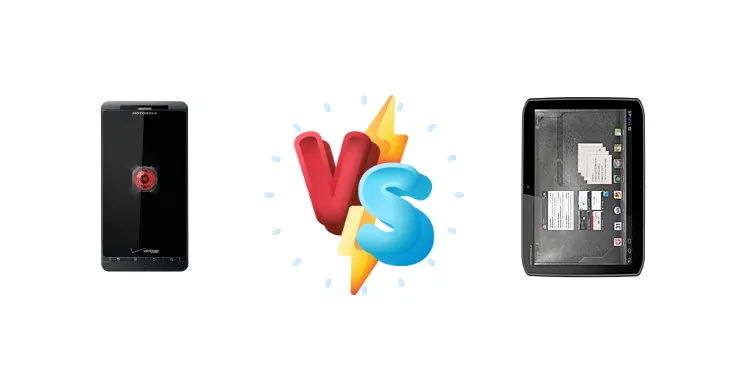
The Motorola DROID X2 and XYBOARD 10.1 were popular Android devices of their time, offering distinct form factors and features. But which one holds up better today? This comprehensive comparison dives deep into their specs, performance, and overall value to help you decide.
🏆 Quick Verdict
The DROID XYBOARD 10.1 edges out the DROID X2 thanks to its larger screen, slightly faster processor, and generally more versatile tablet experience. However, the X2's smaller size and potential for better call quality (being a phone) might appeal to some.
| Network |
|---|
| 2G bands | CDMA 800 / 1900 | GSM 850 / 900 / 1800 / 1900 |
| 3G bands | CDMA2000 1xEV-DO | HSDPA 850 / 900 / 1900 / 2100 |
| 4G bands | - | 13 - Verizon |
| Speed | EV-DO Rev.A 3.1 Mbps | HSPA, LTE, EV-DO Rev.B |
| Technology | CDMA / EVDO | GSM / CDMA / HSPA / EVDO / LTE |
| | - | CDMA2000 1xEV-DO |
| Launch |
|---|
| Announced | 2011, May. Released 2011, May | 2011, December. Released 2011, December |
| Status | Discontinued | Discontinued |
| Body |
|---|
| Dimensions | 127.5 x 65.5 x 9.9 mm (5.02 x 2.58 x 0.39 in) | 259.9 x 173.6 x 8.8 mm (10.23 x 6.83 x 0.35 in) |
| SIM | Mini-SIM | Mini-SIM |
| Weight | 155 g (5.47 oz) | 599 g (1.32 lb) |
| | - | Splash resistant |
| Display |
|---|
| Protection | Corning Gorilla Glass | Corning Gorilla Glass |
| Resolution | 540 x 960 pixels, 16:9 ratio (~256 ppi density) | 800 x 1280 pixels, 16:10 ratio (~149 ppi density) |
| Size | 4.3 inches, 51.0 cm2 (~61.0% screen-to-body ratio) | 10.1 inches, 295.8 cm2 (~65.6% screen-to-body ratio) |
| Type | TFT | HD-IPS LCD |
| Platform |
|---|
| CPU | Dual-core 1.0 GHz Cortex-A9 | Dual-core 1.2 GHz Cortex-A9 |
| Chipset | Nvidia Tegra 2 AP20H | TI OMAP 4430 |
| GPU | ULP GeForce | PowerVR SGX540 |
| OS | Android 2.3 (Gingerbread), not upgradable to 4.1 (Jelly Bean) | Android 3.2 (Honeycomb), upgradable to 4.0 (Ice Cream Sandwich) |
| Memory |
|---|
| Card slot | microSDHC (dedicated slot), 8 GB included | No |
| Internal | 8GB 512MB RAM | 16GB 1GB RAM, 32GB 1GB RAM, 64GB 1GB RAM |
| Main Camera |
|---|
| Features | Dual-LED flash | LED flash |
| Single | 8 MP, AF | 5 MP, AF |
| Video | 720p@30fps | 720p@30fps |
| Selfie camera |
|---|
| Single | - | 1.3 MP |
| | No | - |
| Sound |
|---|
| 3.5mm jack | Yes | Yes |
| 35mm jack | Yes | Yes |
| Loudspeaker | Yes | Yes, with stereo speakers |
| | - | 3D virtual surround sound |
| Comms |
|---|
| Bluetooth | 2.1, A2DP | 2.1, A2DP, EDR |
| Infrared port | - | Yes |
| Positioning | GPS, A-GPS | GPS, A-GPS |
| Radio | Stereo FM radio, RDS | No |
| USB | microUSB 2.0 | microUSB 2.0 |
| WLAN | Wi-Fi 802.11 b/g/n, DLNA, hotspot | Wi-Fi 802.11 a/b/g/n, dual-band, hotspot |
| Features |
|---|
| Browser | HTML, Adobe Flash | - |
| Sensors | Accelerometer, proximity, compass | Accelerometer, gyro, compass, barometer |
| | MP3/WAV/WMA/AAC+ player
MP4/WMV/H.264 player
HDMI port
Document viewer
Photo viewer/editor
Organizer
Voice memo/dial/commands
Predictive text input | HDMI port
MP3/WAV/WMA/AAC+ player
MP4/WMV/H.264 player
Document viewer
Photo viewer/editor
Organizer
Voice memo
Predictive text input |
| Battery |
|---|
| Talk time | - | Up to 10 h |
| Type | Removable Li-Ion 1540 mAh battery | Non-removable Li-Ion 7000 mAh battery |
| Misc |
|---|
| Colors | Black | Black |
| Price | About 230 EUR | About 260 EUR |
| SAR | 0.74 W/kg (head) 1.50 W/kg (body) | - |
Motorola DROID X2
- Pocketable size
- Potentially better call quality
- Decent performance for everyday tasks
- More compact form factor
- Smaller screen
- Older processor
- Lower resolution display
- Limited multitasking capabilities
Motorola DROID XYBOARD 10.1 MZ617
- Larger screen for media consumption
- Slightly faster processor
- More versatile tablet experience
- Better for web browsing
- Larger size, less portable
- Older processor, struggles with modern apps
- Battery life can be shorter
- Lack of front-facing camera in some models
Display Comparison
The XYBOARD 10.1 boasts a significantly larger 10.1-inch display compared to the X2's 4.3-inch screen. While both utilize LCD technology, the XYBOARD's larger size provides a more immersive viewing experience for videos and games. Resolution is also higher on the XYBOARD, contributing to sharper visuals.
Camera Comparison
The DROID X2 typically featured an 8MP rear camera and a front-facing camera. The XYBOARD 10.1 also had an 8MP rear camera, but often lacked a front-facing camera or had a lower resolution one. Image quality on both devices is adequate for casual snapshots but lacks the detail and dynamic range of modern smartphone cameras.
Performance
While both devices feature dual-core Cortex-A9 processors, the XYBOARD's TI OMAP 4430 has a slightly higher clock speed (1.2 GHz vs 1.0 GHz). This translates to marginally better performance in demanding applications and smoother multitasking on the XYBOARD. Both will show their age by modern standards.
Battery Life
Battery life is a tricky comparison. The X2, being a phone, likely had a smaller battery capacity. However, its smaller screen and less demanding usage patterns could have resulted in comparable or even slightly better real-world battery life. The XYBOARD's larger screen and more intensive tasks would generally drain the battery faster.
Buying Guide
The Motorola DROID X2 is best suited for users who prioritize a pocketable phone with decent performance for everyday tasks. The DROID XYBOARD 10.1 is ideal for those seeking a larger screen for media consumption, web browsing, and light productivity on the go.
Frequently Asked Questions
❓ Are these devices still worth buying?
Given their age, finding these devices in good condition can be challenging. While they can still perform basic tasks, they are significantly outdated compared to modern smartphones and tablets. Consider them only if you're looking for a retro device or have a very limited budget.
❓ What operating system do these devices run?
Both devices originally shipped with Android 2.2 (Froyo) and 3.2 (Honeycomb) respectively. While custom ROMs might exist, official software updates are no longer available.