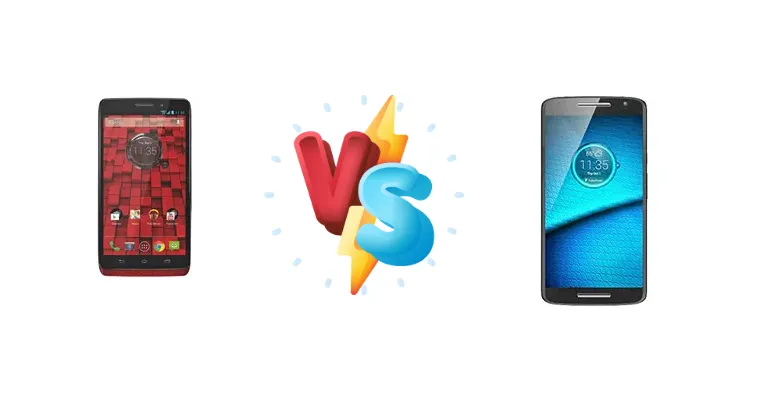
The Motorola DROID Ultra and Droid Maxx 2 represent different approaches to the smartphone experience. The Ultra prioritized sleek design and a premium feel, while the Maxx 2 focused on exceptional battery life. But which phone truly delivers the better overall experience? Let's dive into a comprehensive comparison.
🏆 Quick Verdict
The Droid Maxx 2 is the clear winner for most users. Its significantly longer battery life, octa-core processor, and improved display outweigh the Ultra's slimmer design. While the Ultra was a flagship at its time, the Maxx 2 offers better value and longevity.
| Network |
|---|
| 2G bands | CDMA 800 / 1900 | GSM 850 / 900 / 1800 / 1900 |
| 3G bands | CDMA2000 1xEV-DO | HSDPA 850 / 900 / 1900 / 2100 |
| 4G bands | 4, 13 | 2, 3, 4, 5, 7, 13, 20 |
| EDGE | - | No |
| GPRS | - | No |
| Speed | HSPA 42.2/5.76 Mbps, LTE Cat3 100/50 Mbps, EV-DO Rev.A 3.1 Mbps | HSPA, LTE Cat4 150/50 Mbps, EV-DO Rev.A 3.1 Mbps |
| Technology | GSM / CDMA / HSPA / EVDO / LTE | GSM / CDMA / HSPA / EVDO / LTE |
| | HSDPA 850 / 900 / 1900 / 2100 | CDMA2000 1xEV-DO |
| Launch |
|---|
| Announced | 2013, July. Released 2013, August | 2015, October. Released 2015, October |
| Status | Discontinued | Discontinued |
| Body |
|---|
| Dimensions | 137.5 x 71.2 x 7.2 mm (5.41 x 2.80 x 0.28 in) | 148 x 75 x 10.9 mm (5.83 x 2.95 x 0.43 in) |
| SIM | Nano-SIM | Nano-SIM |
| Weight | 137 g (4.83 oz) | 169 g (5.96 oz) |
| | Splash resistant | Splash and dust resistant |
| Display |
|---|
| Protection | Corning Gorilla Glass | Corning Gorilla Glass 3 |
| Resolution | 720 x 1280 pixels, 16:9 ratio (~294 ppi density) | 1080 x 1920 pixels, 16:9 ratio (~403 ppi density) |
| Size | 5.0 inches, 68.9 cm2 (~70.4% screen-to-body ratio) | 5.5 inches, 82.6 cm2 (~74.4% screen-to-body ratio) |
| Type | Super AMOLED | IPS LCD |
| Platform |
|---|
| CPU | Dual-core 1.7 GHz Krait | Octa-core (4x1.7 GHz Cortex-A53 & 4x1.0 GHz Cortex-A53) |
| Chipset | Qualcomm Snapdragon S4 Pro | Qualcomm MSM8939 Snapdragon 615 (28 nm) |
| GPU | Adreno 320 | Adreno 405 |
| OS | Android 4.2.2 (Jelly Bean) | Android 5.1.1 (Lollipop), upgradable to 7.0 (Nougat) |
| Memory |
|---|
| Card slot | No | microSDXC (dedicated slot) |
| Internal | 16GB 2GB RAM | 16GB 2GB RAM |
| | - | eMMC 4.5 |
| Main Camera |
|---|
| Features | LED flash | Dual-LED dual-tone flash, panorama |
| Single | 10 MP, AF | 21 MP, f/2.0, PDAF |
| Video | 1080p@30fps | 1080p@30fps |
| Selfie camera |
|---|
| Single | 2 MP | 5 MP, f/2.0 |
| Sound |
|---|
| 3.5mm jack | Yes | Yes |
| 35mm jack | Yes | Yes |
| Loudspeaker | Yes | Yes |
| Comms |
|---|
| Bluetooth | 4.0, A2DP, EDR, LE, aptX | 4.0, A2DP, LE, aptX |
| NFC | Yes | Yes |
| Positioning | GPS, GLONASS | GPS |
| Radio | No | FM radio |
| USB | microUSB 2.0 | microUSB 2.0 |
| WLAN | Wi-Fi 802.11 a/b/g/n/ac, dual-band, hotspot, DLNA | Wi-Fi 802.11 a/b/g/n, dual-band, hotspot |
| Features |
|---|
| Sensors | Accelerometer, gyro, proximity, compass, barometer | Yes |
| Battery |
|---|
| Charging | - | 15W wired |
| Stand-by | Up to 312 h | Up to 576 h (3G) |
| Talk time | Up to 28 h | Up to 48 h (3G) |
| Type | Li-Ion 2130 mAh, non-removable | Li-Ion 3630 mAh, non-removable |
| Misc |
|---|
| Colors | Black, Red, White | Deep Sea Blue, White |
| Models | XT1080 | XT1565B, XT1565 |
| Price | About 250 EUR | About 300 EUR |
| SAR | 1.54 W/kg (head) 0.32 W/kg (body) | 1.14 W/kg (head) 1.38 W/kg (body) |
| Tests |
|---|
| Audio quality | - |
Noise -82.7dB / Crosstalk -82.9dB |
| Battery life | - | Endurance rating 56h |
| Display | - |
Contrast ratio: 1256:1 (nominal) / 911:1 (docking station) |
| Loudspeaker | - |
Voice 57dB / Noise 66dB / Ring 77dB |
Motorola DROID Ultra
- Slim and lightweight design
- Compact form factor
- Premium build quality
- Outdated processor
- Short battery life
- Lower display quality compared to Maxx 2
Motorola Droid Maxx 2
- Exceptional battery life
- Faster octa-core processor
- Larger and better display
- Improved multitasking
- Larger and heavier than the Ultra
- Design less premium than Ultra
Display Comparison
The Droid Maxx 2 boasts a larger 5.5-inch display compared to the Ultra's 5-inch screen. While both are LCD panels, the Maxx 2's contrast ratio (1256:1) suggests better image quality and deeper blacks. The Ultra's display is adequate, but the Maxx 2 offers a more immersive viewing experience.
Camera Comparison
Camera specs are similar, both featuring 10MP rear cameras. However, the Maxx 2's newer processor and potentially improved image processing algorithms likely result in slightly better image quality, especially in low-light conditions. The Ultra's camera is decent but lacks the refinement of the Maxx 2.
Performance
The Droid Maxx 2's octa-core Snapdragon 615 processor provides a noticeable performance boost over the Ultra's dual-core Snapdragon S4 Pro. The Maxx 2 handles multitasking and demanding apps with greater ease, resulting in a smoother and more responsive user experience. The Ultra can feel sluggish by today's standards.
Battery Life
This is where the Droid Maxx 2 truly shines. Its massive battery delivers an endurance rating of 56 hours, far surpassing the Ultra's considerably shorter battery life. The Maxx 2 is a champion for users who need a phone that can last through multiple days of moderate use.
Buying Guide
Who should buy the Motorola DROID Ultra? Users prioritizing a slim, premium design and a slightly more compact form factor might still appreciate the Ultra. Who should buy the Motorola Droid Maxx 2? Anyone needing exceptional battery life, a smoother multitasking experience, and a larger display will find the Maxx 2 a compelling choice.
Frequently Asked Questions
❓ Is the DROID Ultra still usable in 2024?
While technically usable, the DROID Ultra's outdated hardware means it will struggle with modern apps and software updates. Performance will be noticeably slower than newer devices.
❓ What was the main selling point of the Droid Maxx 2?
The Droid Maxx 2's primary selling point was its exceptional battery life, capable of lasting up to 56 hours on a single charge.