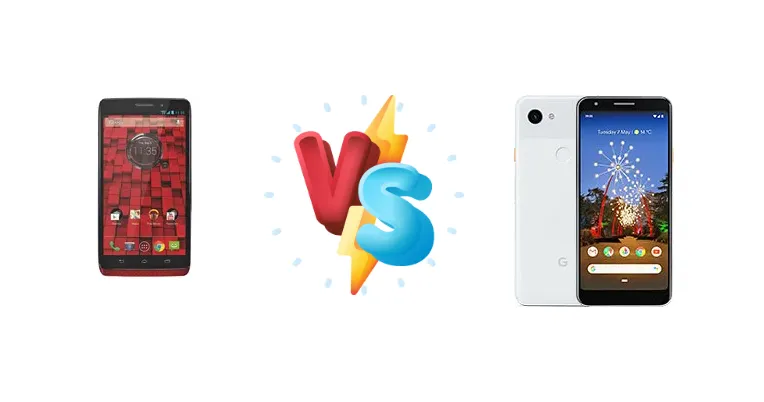
The Motorola DROID Ultra, a flagship from its time, and the Google Pixel 3a XL, known for its exceptional camera and value, represent different eras of Android. Both offer compelling features, but which one holds up best today? Let's dive into a comprehensive comparison to help you decide.
🏆 Quick Verdict
The Google Pixel 3a XL is the clear winner. While the DROID Ultra boasts a slightly faster CPU, the Pixel 3a XL’s superior camera, modern chipset, longer software support, and excellent battery life make it a more compelling choice for most users in 2024.
| Network |
|---|
| 2G bands | CDMA 800 / 1900 | GSM 850 / 900 / 1800 / 1900 |
| 3G bands | CDMA2000 1xEV-DO | HSDPA 850 / 900 / 1700(AWS) / 1900 / 2100 |
| 4G bands | 4, 13 | 1, 2, 3, 4, 5, 7, 8, 12, 13, 14, 17, 20, 25, 26, 28, 29, 30, 38, 40, 41, 66, 71 |
| Speed | HSPA 42.2/5.76 Mbps, LTE Cat3 100/50 Mbps, EV-DO Rev.A 3.1 Mbps | HSPA 42.2/5.76 Mbps, LTE (3CA) Cat11 600/75 Mbps |
| Technology | GSM / CDMA / HSPA / EVDO / LTE | GSM / CDMA / HSPA / EVDO / LTE |
| | HSDPA 850 / 900 / 1900 / 2100 | CDMA2000 1xEV-DO |
| Launch |
|---|
| Announced | 2013, July. Released 2013, August | 2019, May 07. Released 2019, May 15 |
| Status | Discontinued | Discontinued |
| Body |
|---|
| Build | - | Glass front (Asahi Dragontrail), plastic back, plastic frame |
| Dimensions | 137.5 x 71.2 x 7.2 mm (5.41 x 2.80 x 0.28 in) | 160.1 x 76.1 x 8.2 mm (6.30 x 3.00 x 0.32 in) |
| SIM | Nano-SIM | Nano-SIM + eSIM |
| Weight | 137 g (4.83 oz) | 167 g (5.89 oz) |
| | Splash resistant | - |
| Display |
|---|
| Protection | Corning Gorilla Glass | Asahi Dragontrail Glass |
| Resolution | 720 x 1280 pixels, 16:9 ratio (~294 ppi density) | 1080 x 2160 pixels, 18:9 ratio (~402 ppi density) |
| Size | 5.0 inches, 68.9 cm2 (~70.4% screen-to-body ratio) | 6.0 inches, 92.9 cm2 (~76.3% screen-to-body ratio) |
| Type | Super AMOLED | OLED |
| | - | Always-on display |
| Platform |
|---|
| CPU | Dual-core 1.7 GHz Krait | Octa-core (2x2.0 GHz 360 Gold & 6x1.7 GHz Kryo 360 Silver) |
| Chipset | Qualcomm Snapdragon S4 Pro | Qualcomm SDM670 Snapdragon 670 (10 nm) |
| GPU | Adreno 320 | Adreno 615 |
| OS | Android 4.2.2 (Jelly Bean) | Android 9.0 (Pie), upgradable to Android 12 |
| Memory |
|---|
| Card slot | No | No |
| Internal | 16GB 2GB RAM | 64GB 4GB RAM |
| | - | eMMC 5.1 |
| Main Camera |
|---|
| Features | LED flash | Dual-LED flash, Pixel Shift, HDR, panorama |
| Single | 10 MP, AF | 12.2 MP, f/1.8, 28mm (wide), 1/2.55", 1.4µm, dual pixel PDAF, OIS |
| Video | 1080p@30fps | 4K@30fps, 1080p@30/60/120fps |
| Selfie camera |
|---|
| Features | - | HDR |
| Single | 2 MP | 8 MP, f/2.0, 24mm (wide), 1/4.0", 1.12µm |
| Video | - | 1080p@30fps |
| Sound |
|---|
| 3.5mm jack | Yes | Yes |
| 35mm jack | Yes | Yes |
| Loudspeaker | Yes | Yes, with stereo speakers |
| Comms |
|---|
| Bluetooth | 4.0, A2DP, EDR, LE, aptX | 5.0, A2DP, LE, aptX HD |
| NFC | Yes | Yes |
| Positioning | GPS, GLONASS | GPS, GLONASS, GALILEO |
| Radio | No | No |
| USB | microUSB 2.0 | USB Type-C 2.0 |
| WLAN | Wi-Fi 802.11 a/b/g/n/ac, dual-band, hotspot, DLNA | Wi-Fi 802.11 a/b/g/n/ac, dual-band, Wi-Fi Direct |
| Features |
|---|
| Sensors | Accelerometer, gyro, proximity, compass, barometer | Fingerprint (rear-mounted), accelerometer, gyro, proximity, compass, barometer |
| Battery |
|---|
| Charging | - | 18W wired, PD2.0 |
| Stand-by | Up to 312 h | - |
| Talk time | Up to 28 h | - |
| Type | Li-Ion 2130 mAh, non-removable | Li-Po 3700 mAh, non-removable |
| Misc |
|---|
| Colors | Black, Red, White | Just Black, Clearly White, Purple-ish |
| Models | XT1080 | G020C, G020G, G020F, G020A, G020B, G020D |
| Price | About 250 EUR | About 290 EUR |
| SAR | 1.54 W/kg (head) 0.32 W/kg (body) | - |
| Tests |
|---|
| Audio quality | - |
Noise -90.8dB / Crosstalk -94.8dB |
| Battery life | - |
Endurance rating 98h
|
| Display | - |
Contrast ratio: infinite |
| Loudspeaker | - |
Voice 79dB / Noise 77dB / Ring 91dB
|
| Performance | - |
AnTuTu: 159110 (v7), 176612 (v8)
GeekBench: 5176 (v4.4), 1307 (v5.1)
GFXBench: 11fps (ES 3.1 onscreen) |
Motorola DROID Ultra
- Compact design (for its time)
- Potentially more durable build
- Nostalgic Android experience
- Outdated chipset
- Dim display
- Poor camera quality
- No fast charging
- Limited software updates
Google Pixel 3a XL
- Excellent camera
- Clean Android experience
- Long software support (historically)
- Good battery life
- Fast charging
- Modern chipset
- Plastic build
- Older model (limited parts availability)
- Screen could be brighter
Display Comparison
The Pixel 3a XL's 6.6-inch display offers a larger viewing area and a measured 451 nits of brightness, making it easier to see outdoors. The DROID Ultra's display is smaller and likely dimmer, potentially impacting outdoor visibility. The Pixel 3a XL's infinite contrast ratio suggests deeper blacks and better overall image quality.
Camera Comparison
This is where the Pixel 3a XL truly shines. Google's computational photography is legendary, and the Pixel 3a XL delivers exceptional image quality, especially in low light. The DROID Ultra's camera was decent for its era, but it simply can't compete with the Pixel's capabilities.
Performance
The DROID Ultra's dual-core 1.7 GHz Krait CPU was powerful for its time, but the Pixel 3a XL's octa-core Snapdragon 670, built on a more efficient 10nm process, provides significantly better performance and power efficiency. The Pixel 3a XL handles multitasking and demanding apps with greater ease.
Battery Life
Both phones boast impressive endurance ratings (98h), but the Pixel 3a XL's more efficient chipset likely contributes to slightly better real-world battery life. The Pixel 3a XL also supports 18W fast charging (PD2.0), a feature absent in the DROID Ultra.
Buying Guide
The Motorola DROID Ultra might appeal to enthusiasts seeking a vintage flagship experience or those needing a very compact phone (though it's still relatively large). The Google Pixel 3a XL is ideal for budget-conscious users who prioritize camera quality, reliable performance, and a clean Android experience.
Frequently Asked Questions
❓ Is the DROID Ultra still usable in 2024?
Yes, but it will feel dated. Performance will be noticeably slower than modern phones, and software updates are long gone. It's best suited for basic tasks.
❓ Which phone has better software support?
The Google Pixel 3a XL historically received more timely Android updates and security patches, although support has ended. The DROID Ultra has no active software support.
❓ Can I find replacement parts for the DROID Ultra?
Finding replacement parts for the DROID Ultra is becoming increasingly difficult due to its age.