
Motorola DROID RAZR XT912 vs Samsung Galaxy S23 Ultra: A Generational Leap?
| Phones Images | |||||
|---|---|---|---|---|---|
|
🏆 Quick Verdict
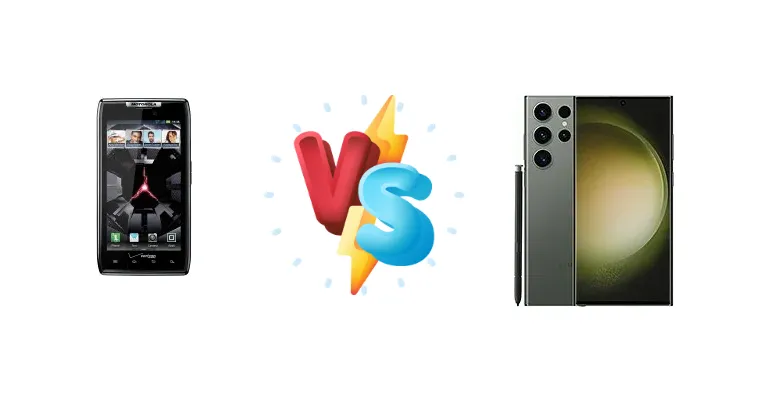
The Samsung Galaxy S23 Ultra utterly dominates this comparison. While the DROID RAZR was impressive for its era, the S23 Ultra's superior performance, camera, display, and battery life make it the clear winner for anyone seeking a top-tier Android experience. It's a generational upgrade.
| PHONES | ||
|---|---|---|
| Phone Names | Motorola DROID RAZR XT912 | Samsung Galaxy S23 Ultra |
| Network | ||
|---|---|---|
| 2G bands | GSM 850 / 900 / 1800 / 1900 | GSM 850 / 900 / 1800 / 1900 |
| 3G bands | HSDPA 850 / 900 / 1900 / 2100 | HSDPA 850 / 900 / 1700(AWS) / 1900 / 2100 |
| 4G bands | 13 - Verizon | 1, 2, 3, 4, 5, 7, 8, 12, 13, 17, 18, 19, 20, 25, 26, 28, 32, 38, 39, 40, 41, 66 - International |
| 5G bands | - | 1, 2, 3, 5, 7, 8, 12, 20, 25, 28, 38, 40, 41, 66, 75, 77, 78 SA/NSA/Sub6 - International |
| Speed | EV-DO Rev.A 3.1 Mbps, LTE, HSPA | HSPA, LTE (up to 7CA), 5G |
| Technology | GSM / CDMA / HSPA / EVDO / LTE | GSM / CDMA / HSPA / EVDO / LTE / 5G |
| CDMA2000 1xEV-DO | 1, 7, 28, 41, 66, 71, 78, 258, 260, 261 SA/NSA/Sub6/mmWave - USA | |
| Launch | ||
|---|---|---|
| Announced | 2011, October. Released 2011, November | 2023, February 01 |
| Status | Discontinued | Available. Released 2023, February 17 |
| Body | ||
|---|---|---|
| Build | - | Glass front (Gorilla Glass Victus 2), glass back (Gorilla Glass Victus 2), aluminum frame |
| Dimensions | 130.7 x 68.9 x 7.1 mm (5.15 x 2.71 x 0.28 in) | 163.4 x 78.1 x 8.9 mm (6.43 x 3.07 x 0.35 in) |
| SIM | Micro-SIM | · Nano-SIM + eSIM· Nano-SIM + Nano-SIM + eSIM (max 2 at a time) |
| Weight | 127 g (4.48 oz) | 234 g (8.25 oz) |
| Splash resistant | IP68 dust/water resistant (up to 1.5m for 30 min) Armor aluminum frame with tougher drop and scratch resistance (advertised) Stylus (Bluetooth integration, accelerometer, gyro) | |
| Display | ||
|---|---|---|
| Protection | Corning Gorilla Glass | Corning Gorilla Glass Victus 2 |
| Resolution | 540 x 960 pixels, 16:9 ratio (~256 ppi density) | 1440 x 3088 pixels, 19.3:9 ratio (~500 ppi density) |
| Size | 4.3 inches, 51.0 cm2 (~56.6% screen-to-body ratio) | 6.8 inches, 114.7 cm2 (~89.9% screen-to-body ratio) |
| Type | Super AMOLED | Dynamic AMOLED 2X, 120Hz, HDR10+, 1200 nits (HBM), 1750 nits (peak) |
| - | Always-on display | |
| Platform | ||
|---|---|---|
| CPU | Dual-core 1.2 GHz Cortex-A9 | Octa-core (1x3.36 GHz Cortex-X3 & 2x2.8 GHz Cortex-A715 & 2x2.8 GHz Cortex-A710 & 3x2.0 GHz Cortex-A510) |
| Chipset | TI OMAP 4430 | Qualcomm SM8550-AC Snapdragon 8 Gen 2 (4 nm) |
| GPU | PowerVR SGX540 | Adreno 740 |
| OS | Android 2.3.5 (Gingerbread), upgradable to 4.1 (Jelly Bean) | Android 13, up to 4 major Android upgrades, One UI 8 |
| Memory | ||
|---|---|---|
| Card slot | microSDHC (dedicated slot), 16 GB included | No |
| Internal | 16GB 1GB RAM | 256GB 8GB RAM, 256GB 12GB RAM, 512GB 12GB RAM, 1TB 12GB RAM |
| - | UFS 4.0 | |
| Main Camera | ||
|---|---|---|
| Features | LED flash | Laser AF, LED flash, auto-HDR, panorama |
| Quad | - | 200 MP, f/1.7, 24mm (wide), 1/1.3", 0.6µm, multi-directional PDAF, OIS 10 MP, f/2.4, 70mm (telephoto), 1/3.52", 1.12µm, PDAF, OIS, 3x optical zoom 10 MP, f/4.9, 230mm (periscope telephoto), 1/3.52", 1.12µm, PDAF, OIS, 10x optical zoom 12 MP, f/2.2, 13mm, 120˚ (ultrawide), 1/2.55", 1.4µm, dual pixel PDAF, Super Steady video |
| Single | 8 MP, AF | 12 MP, f/2.2, 26mm (wide), Dual Pixel PDAF |
| Video | 1080p@30fps, 480p@120fps | 8K@24/30fps, 4K@30/60fps, 1080p@30/60/120/240fps, HDR10+, stereo sound rec., gyro-EIS |
| Selfie camera | ||
|---|---|---|
| Features | - | HDR, HDR10+ |
| Single | 2 MP | 12 MP, f/2.2, 26mm (wide), 1/3.2", 1.12µm, dual pixel PDAF |
| Video | 720p | 4K@30/60fps, 1080p@30fps |
| Sound | ||
|---|---|---|
| 3.5mm jack | Yes | No |
| 35mm jack | Yes | No |
| Loudspeaker | Yes | Yes, with stereo speakers |
| - | 32-bit/384kHz audio Tuned by AKG | |
| Comms | ||
|---|---|---|
| Bluetooth | 4.0, EDR, LE | 5.3, A2DP, LE |
| NFC | - | Yes |
| Positioning | GPS, A-GPS | GPS, GALILEO, GLONASS, BDS, QZSS |
| Radio | No | No |
| USB | microUSB 2.0 | USB Type-C 3.2, OTG |
| WLAN | Wi-Fi 802.11 b/g/n, DLNA, hotspot | Wi-Fi 802.11 a/b/g/n/ac/6e, tri-band, Wi-Fi Direct |
| Features | ||
|---|---|---|
| Sensors | Accelerometer, proximity, compass | Fingerprint (under display, ultrasonic), accelerometer, gyro, proximity, compass, barometer |
| HDMI port MP3/AAC+/WAV/WMA player MP4/H.264/WMV player Organizer Document viewer/editor Voice memo/dial/commands Predictive text input | Samsung DeX, Samsung Wireless DeX (desktop experience support) Bixby natural language commands and dictation Samsung Pay (Visa, MasterCard certified) Ultra Wideband (UWB) support | |
| Battery | ||
|---|---|---|
| Charging | - | 45W wired, PD3.0, 65% in 30 min 15W wireless (Qi) 4.5W reverse wireless |
| Stand-by | Up to 204 h | - |
| Talk time | Up to 12 h 30 min | - |
| Type | Non-removable Li-Ion 1780 mAh battery | Li-Ion 5000 mAh |
| Misc | ||
|---|---|---|
| Colors | Black, White, Purple | Phantom Black, Green, Cream, Lavender, Graphite, Sky Blue, Lime, Red, BMW M Edition |
| Models | - | SM-S918B, SM-S918B/DS, SM-S918U, SM-S918U1, SM-S918W, SM-S918N, SM-S9180, SM-S918E, SM-S918E/DS |
| Price | About 220 EUR | € 549.90 / $ 454.99 / £ 433.00 |
| SAR | 1.45 W/kg (head) 0.71 W/kg (body) | 1.12 W/kg (head) 0.92 W/kg (body) |
| SAR EU | - | 0.96 W/kg (head) 1.40 W/kg (body) |
| Tests | ||
|---|---|---|
| Battery life | - | Endurance rating 126h |
| Camera | - | Photo / Video |
| Display | - | Contrast ratio: Infinite (nominal) |
| Loudspeaker | - | -25.6 LUFS (Very good) |
| Performance | - | AnTuTu: 1241531 (v9) GeekBench: 4927 (v5.1) GFXBench: 67fps (ES 3.1 onscreen) |
Motorola DROID RAZR XT912
- Innovative folding design (for its time)
- Relatively affordable (used)
- Compact form factor
- Outdated chipset
- Low resolution display
- Poor battery life
- Slow charging
- Limited app compatibility
Samsung Galaxy S23 Ultra
- Exceptional performance
- Stunning display
- Versatile and high-quality camera
- Long battery life
- Fast charging
- Premium design and build quality
- Expensive
- Large size may not suit everyone
Display Comparison
The Galaxy S23 Ultra boasts a stunning Dynamic AMOLED 2X display with a peak brightness of 1274 nits and an infinite contrast ratio. Its resolution and color accuracy far surpass the RAZR's older LCD panel. The RAZR's display, while innovative for its time, suffers from lower resolution and brightness.
Camera Comparison
The Galaxy S23 Ultra's camera system is a significant upgrade. It features a high-resolution sensor and advanced image processing capabilities, delivering exceptional photo and video quality. The RAZR's camera, while decent for its time, cannot compete with the S23 Ultra's versatility and image quality.
Performance
The Snapdragon 8 Gen 2 in the S23 Ultra provides a massive performance advantage over the TI OMAP 4430 in the RAZR. The S23 Ultra handles demanding games and multitasking with ease, while the RAZR struggles with modern apps and experiences. The octa-core CPU and advanced architecture of the S23 Ultra are simply in a different league.
Battery Life
The S23 Ultra offers significantly better battery life, with an endurance rating of 126 hours and fast charging capabilities (45W wired, 15W wireless). The RAZR's battery life is considerably shorter, and charging speeds are much slower.
Buying Guide
The Motorola DROID RAZR XT912 might appeal to nostalgic users or those seeking a very affordable, albeit dated, folding phone. The Samsung Galaxy S23 Ultra is for users who demand the best possible performance, camera capabilities, and a premium experience, regardless of price.