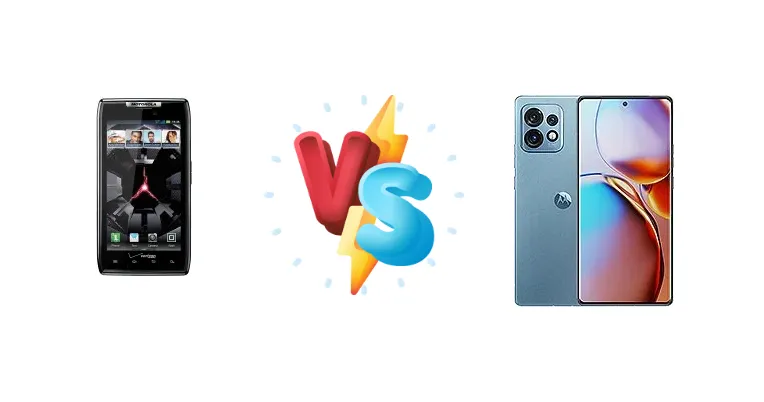
The Motorola DROID RAZR XT912 was a flagship in its time, known for its sleek design and innovative features. Now, the Moto X40 represents Motorola's cutting-edge technology. Let's dive into a head-to-head comparison to see how these two phones stack up.
🏆 Quick Verdict
The Moto X40 utterly dominates the DROID RAZR in almost every category. Its modern chipset, superior display, advanced camera, and blazing-fast charging make it the clear winner. The RAZR's historical significance and unique design are its only remaining strengths.
| Network |
|---|
| 2G bands | GSM 850 / 900 / 1800 / 1900 | GSM 850 / 900 / 1800 / 1900 |
| 3G bands | HSDPA 850 / 900 / 1900 / 2100 | HSDPA 850 / 900 / 1700(AWS) / 1900 / 2100 |
| 4G bands | 13 - Verizon | 1, 2, 3, 4, 5, 7, 8, 12, 13, 17, 18, 19, 20, 25, 26, 28, 32, 38, 39, 40, 41, 42, 43, 48, 66 |
| 5G bands | - | 1, 2, 3, 5, 7, 8, 20, 28, 38, 40, 41, 66, 77, 78 SA/NSA/Sub6 |
| Speed | EV-DO Rev.A 3.1 Mbps, LTE, HSPA | HSPA, LTE, 5G |
| Technology | GSM / CDMA / HSPA / EVDO / LTE | GSM / CDMA / HSPA / LTE / 5G |
| | CDMA2000 1xEV-DO | CDMA 800 |
| Launch |
|---|
| Announced | 2011, October. Released 2011, November | 2022, December 15 |
| Status | Discontinued | Available. Released 2022, December 22 |
| Body |
|---|
| Build | - | Glass front, glass back (Gorilla Glass Victus), aluminum frame |
| Dimensions | 130.7 x 68.9 x 7.1 mm (5.15 x 2.71 x 0.28 in) | 161.2 x 74 x 8.6 mm (6.35 x 2.91 x 0.34 in) |
| SIM | Micro-SIM | Nano-SIM + Nano-SIM |
| Weight | 127 g (4.48 oz) | 199 g (7.02 oz) |
| | Splash resistant | IP68 dust/water resistant (up to 1.5m for 30 min) |
| Display |
|---|
| Protection | Corning Gorilla Glass | - |
| Resolution | 540 x 960 pixels, 16:9 ratio (~256 ppi density) | 1080 x 2400 pixels, 20:9 ratio (~393 ppi density) |
| Size | 4.3 inches, 51.0 cm2 (~56.6% screen-to-body ratio) | 6.7 inches, 108.4 cm2 (~90.9% screen-to-body ratio) |
| Type | Super AMOLED | OLED, 1B colors, 165Hz, HDR10+ |
| Platform |
|---|
| CPU | Dual-core 1.2 GHz Cortex-A9 | Octa-core (1x3.2 GHz Cortex-X3 & 2x2.8 GHz Cortex-A715 & 2x2.8 GHz Cortex-A710 & 3x2.0 GHz Cortex-A510) |
| Chipset | TI OMAP 4430 | Qualcomm SM8550-AB Snapdragon 8 Gen 2 (4 nm) |
| GPU | PowerVR SGX540 | Adreno 740 |
| OS | Android 2.3.5 (Gingerbread), upgradable to 4.1 (Jelly Bean) | Android 13, upgradable to Android 14, MYUI 6.0 |
| Memory |
|---|
| Card slot | microSDHC (dedicated slot), 16 GB included | No |
| Internal | 16GB 1GB RAM | 128GB 8GB RAM, 256GB 12GB RAM, 512GB 12GB RAM |
| | - | UFS 3.1 - 128GB
UFS 4.0 - 256GB/512GB |
| Main Camera |
|---|
| Features | LED flash | Dual-LED flash, panorama, HDR |
| Single | 8 MP, AF | - |
| Triple | - | 50 MP, f/1.9, (wide), 1/1.55", 1.0µm, dual pixel PDAF, OIS
12 MP, f/1.6, (telephoto), 1/2.93", 1.22µm, PDAF, 2x optical zoom
50 MP, f/2.2, 117˚ (ultrawide), 1/2.76", 0.64µm, AF |
| Video | 1080p@30fps, 480p@120fps | 8K@30fps, 4K@30/60fps, 1080p@30/60/120/240/960fps, 10-bit HDR10+, gyro-EIS |
| Selfie camera |
|---|
| Features | - | HDR |
| Single | 2 MP | 60 MP, f/2.2, (wide), 1/2.8", 0.61µm |
| Video | 720p | 4K@30fps, 1080p@30/60fps |
| Sound |
|---|
| 3.5mm jack | Yes | No |
| 35mm jack | Yes | No |
| Loudspeaker | Yes | Yes, with stereo speakers |
| Comms |
|---|
| Bluetooth | 4.0, EDR, LE | 5.3, A2DP, LE, aptX HD, aptX Adaptive |
| NFC | - | Yes |
| Positioning | GPS, A-GPS | GPS (L1+L5), GLONASS (L1), BDS (B1I+B1c+B2a), GALILEO (E1+E5a), QZSS (L1+L5) |
| Radio | No | No |
| USB | microUSB 2.0 | USB Type-C, OTG |
| WLAN | Wi-Fi 802.11 b/g/n, DLNA, hotspot | Wi-Fi 802.11 a/b/g/n/ac/6e, dual-band, Wi-Fi Direct |
| Features |
|---|
| Sensors | Accelerometer, proximity, compass | Fingerprint (under display, optical), accelerometer, gyro, proximity, compass |
| | HDMI port
MP3/AAC+/WAV/WMA player
MP4/H.264/WMV player
Organizer
Document viewer/editor
Voice memo/dial/commands
Predictive text input | Ready For 3.5 support |
| Battery |
|---|
| Charging | - | 125W wired, PD3.0, QC5, 50% in 7 min
15W wireless
5W reverse wired |
| Stand-by | Up to 204 h | - |
| Talk time | Up to 12 h 30 min | - |
| Type | Non-removable Li-Ion 1780 mAh battery | Li-Po 4600 mAh |
| Misc |
|---|
| Colors | Black, White, Purple | Black, Blue |
| Models | - | XT2301-5 |
| Price | About 220 EUR | About 540 EUR |
| SAR | 1.45 W/kg (head) 0.71 W/kg (body) | - |
Motorola DROID RAZR XT912
- Iconic design
- Compact form factor
- Nostalgic Android experience
- Outdated chipset
- Poor performance
- Low-resolution display
- Short battery life
- Limited app compatibility
Motorola Moto X40
- Blazing-fast performance
- Stunning display
- Excellent camera
- Long battery life
- Fast charging
- Modern features
- Design may not appeal to all
- Price point is higher than older devices
Display Comparison
The Moto X40 boasts a 6.67-inch OLED display with a 144Hz refresh rate and HDR10+ support, offering vibrant colors and smooth visuals. The DROID RAZR XT912 has a 4.3-inch external display and a 3.9-inch internal display, both LCD, with a standard 60Hz refresh rate. The X40's larger, higher-quality display is a significant advantage.
Camera Comparison
The Moto X40 features a 50MP main camera with OIS and a 12MP ultrawide lens, delivering excellent image quality. The DROID RAZR XT912 has an 8MP main camera. The X40's superior hardware and image processing algorithms result in significantly better photos and videos.
Performance
The Snapdragon 8 Gen 2 in the Moto X40 provides a massive performance leap over the TI OMAP 4430 in the DROID RAZR. The X40 handles demanding games and multitasking with ease, while the RAZR struggles with modern apps. The X40's octa-core processor and modern architecture are simply in a different league.
Battery Life
The Moto X40 packs a 4600mAh battery with 125W wired charging, 15W wireless charging, and 5W reverse wired charging. The DROID RAZR XT912 has a 2500mAh battery with slower charging speeds. The X40's larger battery and faster charging provide a much better user experience.
Buying Guide
The DROID RAZR XT912 is best suited for nostalgic users seeking a classic Android experience or collectors. The Moto X40 is ideal for anyone wanting a high-performance, feature-rich smartphone with a stunning display and exceptional camera capabilities.
Frequently Asked Questions
❓ Is the DROID RAZR XT912 still usable in 2024?
While technically usable, the DROID RAZR XT912's outdated hardware makes it difficult to run modern apps and games smoothly. Software updates are no longer available, posing security risks.
❓ What is the biggest difference between the DROID RAZR and the Moto X40?
The biggest difference is the chipset. The Moto X40's Snapdragon 8 Gen 2 offers significantly better performance than the DROID RAZR's TI OMAP 4430, impacting every aspect of the user experience.