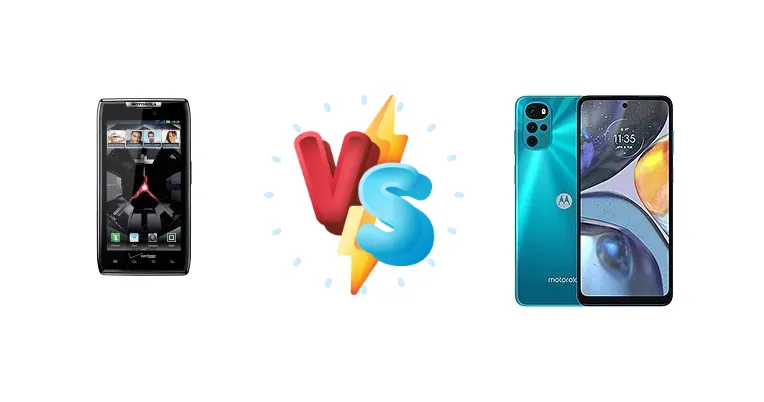
Nostalgia meets modern budget – that's the essence of comparing the Motorola DROID RAZR XT912, a classic from 2011, against the more recent Moto G22. Both offer a Motorola experience, but their capabilities differ significantly. This review breaks down the key differences to help you decide which phone is right for you.
🏆 Quick Verdict
The Moto G22 is the clear winner. While the DROID RAZR holds a certain nostalgic appeal, the G22's modern chipset, improved camera, and longer software support make it a far more practical choice for everyday use. The RAZR's age shows in its performance and features.
| Network |
|---|
| 2G bands | GSM 850 / 900 / 1800 / 1900 | GSM 850 / 900 / 1800 / 1900 |
| 3G bands | HSDPA 850 / 900 / 1900 / 2100 | HSDPA 850 / 900 / 1900 / 2100 |
| 4G bands | 13 - Verizon | 1, 3, 5, 7, 8, 20, 38, 40, 41 |
| Speed | EV-DO Rev.A 3.1 Mbps, LTE, HSPA | HSPA 42.2/5.76 Mbps, LTE Cat4 150/50 Mbps |
| Technology | GSM / CDMA / HSPA / EVDO / LTE | GSM / HSPA / LTE |
| | CDMA2000 1xEV-DO | - |
| Launch |
|---|
| Announced | 2011, October. Released 2011, November | 2022, March 04 |
| Status | Discontinued | Available. Released 2022, March 04 |
| Body |
|---|
| Build | - | Glass front, plastic frame, plastic back |
| Dimensions | 130.7 x 68.9 x 7.1 mm (5.15 x 2.71 x 0.28 in) | 164 x 75 x 8.5 mm (6.46 x 2.95 x 0.33 in) |
| SIM | Micro-SIM | · Nano-SIM· Nano-SIM + Nano-SIM |
| Weight | 127 g (4.48 oz) | 185 g (6.53 oz) |
| | Splash resistant | Water-repellent design |
| Display |
|---|
| Protection | Corning Gorilla Glass | - |
| Resolution | 540 x 960 pixels, 16:9 ratio (~256 ppi density) | 720 x 1600 pixels, 20:9 ratio (~268 ppi density) |
| Size | 4.3 inches, 51.0 cm2 (~56.6% screen-to-body ratio) | 6.5 inches, 103.5 cm2 (~84.2% screen-to-body ratio) |
| Type | Super AMOLED | IPS LCD, 90Hz |
| Platform |
|---|
| CPU | Dual-core 1.2 GHz Cortex-A9 | Octa-core (4x2.3 GHz Cortex-A53 & 4x1.8 GHz Cortex-A53) |
| Chipset | TI OMAP 4430 | Mediatek MT6765V/CB Helio G37 (12 nm) |
| GPU | PowerVR SGX540 | PowerVR GE8320 |
| OS | Android 2.3.5 (Gingerbread), upgradable to 4.1 (Jelly Bean) | Android 12 |
| Memory |
|---|
| Card slot | microSDHC (dedicated slot), 16 GB included | microSDXC (dedicated slot) |
| Internal | 16GB 1GB RAM | 64GB 4GB RAM, 128GB 4GB RAM |
| Main Camera |
|---|
| Features | LED flash | LED flash, HDR, panorama |
| Quad | - | 50 MP, f/1.8, (wide), 0.64µm, PDAF
8 MP, f/2.2, 118˚ (ultrawide), 1/4.0", 1.12µm
2 MP (macro)
Auxiliary lens |
| Single | 8 MP, AF | - |
| Video | 1080p@30fps, 480p@120fps | 1080p@30fps |
| Selfie camera |
|---|
| Features | - | HDR |
| Single | 2 MP | 16 MP, f/2.5, (wide), 1.0µm |
| Video | 720p | 1080p@30fps |
| Sound |
|---|
| 3.5mm jack | Yes | Yes |
| 35mm jack | Yes | Yes |
| Loudspeaker | Yes | Yes |
| Comms |
|---|
| Bluetooth | 4.0, EDR, LE | 5.0, A2DP, LE |
| NFC | - | Yes (market/region dependent) |
| Positioning | GPS, A-GPS | GPS, GLONASS, GALILEO |
| Radio | No | Unspecified |
| USB | microUSB 2.0 | USB Type-C 2.0 |
| WLAN | Wi-Fi 802.11 b/g/n, DLNA, hotspot | Wi-Fi 802.11 a/b/g/n/ac, dual-band, Wi-Fi Direct |
| Features |
|---|
| Sensors | Accelerometer, proximity, compass | Fingerprint (side-mounted), accelerometer, gyro, proximity, compass |
| | HDMI port
MP3/AAC+/WAV/WMA player
MP4/H.264/WMV player
Organizer
Document viewer/editor
Voice memo/dial/commands
Predictive text input | - |
| Battery |
|---|
| Charging | - | 20W wired (India)
15W wired (Global) |
| Stand-by | Up to 204 h | - |
| Talk time | Up to 12 h 30 min | - |
| Type | Non-removable Li-Ion 1780 mAh battery | Li-Po 5000 mAh |
| Misc |
|---|
| Colors | Black, White, Purple | Pearl White, Iceberg Blue, Cosmic Black, Mint Green |
| Models | - | XT2231-1, XT2231-2, XT2231-5 |
| Price | About 220 EUR | About 120 EUR |
| SAR | 1.45 W/kg (head) 0.71 W/kg (body) | - |
Motorola DROID RAZR XT912
- Unique dual-screen design
- Nostalgic appeal
- Compact size
- Outdated processor
- Poor performance
- Limited storage
- Short battery life
- No software updates
Motorola Moto G22
- Modern chipset
- Good value for money
- Decent camera
- Longer battery life
- More storage options
- Plastic build
- Basic design
- Not a flagship device
Display Comparison
The Moto G22 boasts a larger 6.5-inch display with a higher resolution (1080 x 2400) and a more modern panel, likely offering better color accuracy and viewing angles compared to the RAZR's smaller, older display (3.7-inch external and 4.3-inch internal). The RAZR's dual-screen design is unique, but the G22's single, larger screen is more practical for most users.
Camera Comparison
The Moto G22's camera system is a substantial upgrade. It likely features a higher-resolution main sensor and improved image processing capabilities compared to the RAZR's dated camera. Expect better low-light performance and more detailed photos from the G22.
Performance
The Moto G22's octa-core Helio G37 chipset significantly outperforms the DROID RAZR's dual-core OMAP 4430. The G22 offers smoother multitasking, faster app loading times, and better overall responsiveness. The RAZR struggles with modern apps and demanding tasks.
Battery Life
The Moto G22 generally has a larger battery capacity and more efficient processor, resulting in significantly longer battery life than the DROID RAZR. The G22's 20W (or 15W) charging is also faster than the RAZR's charging capabilities.
Buying Guide
The DROID RAZR XT912 is best suited for collectors or those seeking a retro Android experience. The Moto G22 is ideal for budget-conscious users who want a reliable smartphone with decent performance and a good camera for the price.
Frequently Asked Questions
❓ Is the DROID RAZR XT912 still usable in 2024?
While technically usable, the DROID RAZR's age severely limits its functionality. It struggles with modern apps and lacks essential features found in contemporary smartphones. It's best suited for novelty or retro enthusiasts.
❓ What operating system do these phones run?
The DROID RAZR originally shipped with Android 2.3 (Gingerbread) and received updates to Android 4.0 (Ice Cream Sandwich). The Moto G22 runs Android 12 (upgradeable to Android 13) with Motorola's My UX overlay.