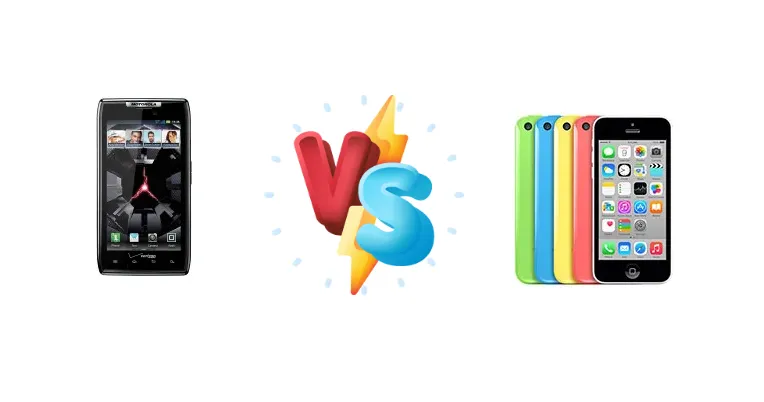
The DROID RAZR and iPhone 5c represent a fascinating era in smartphone history. Both devices, released in 2012 and 2013 respectively, offered distinct design philosophies and features. Let's revisit these iconic phones and see how they stack up against each other today.
🏆 Quick Verdict
The iPhone 5c ultimately edges out the DROID RAZR due to its generally smoother iOS experience, slightly better performance thanks to the A6 chip, and broader app ecosystem. However, the RAZR's unique design and thin profile remain appealing to some.
| Network |
|---|
| 2G bands | GSM 850 / 900 / 1800 / 1900 | GSM 850 / 900 / 1800 / 1900 - all versions |
| 3G bands | HSDPA 850 / 900 / 1900 / 2100 | HSDPA 850 / 900 / 1700 / 1900 / 2100 - A1532 (GSM), A1532 (CDMA), A1456 |
| 4G bands | 13 - Verizon | 1, 2, 3, 4, 5, 8, 13, 17, 19, 20, 25 - A1532 GSM, A1532 CDMA |
| Speed | EV-DO Rev.A 3.1 Mbps, LTE, HSPA | HSPA 42.2/5.76 Mbps, LTE Cat3 100/50 Mbps, EV-DO Rev.A 3.1 Mbps |
| Technology | GSM / CDMA / HSPA / EVDO / LTE | GSM / CDMA / HSPA / LTE |
| | CDMA2000 1xEV-DO | 1, 2, 3, 5, 7, 8, 20, 38, 39, 40 - A1529 |
| Launch |
|---|
| Announced | 2011, October. Released 2011, November | 2013, September 10. Released 2013, September 20 |
| Status | Discontinued | Discontinued |
| Body |
|---|
| Build | - | Glass front, plastic back, plastic frame |
| Dimensions | 130.7 x 68.9 x 7.1 mm (5.15 x 2.71 x 0.28 in) | 124.4 x 59.2 x 9 mm (4.90 x 2.33 x 0.35 in) |
| SIM | Micro-SIM | Nano-SIM |
| Weight | 127 g (4.48 oz) | 132 g (4.66 oz) |
| | Splash resistant | - |
| Display |
|---|
| Protection | Corning Gorilla Glass | - |
| Resolution | 540 x 960 pixels, 16:9 ratio (~256 ppi density) | 640 x 1136 pixels, 16:9 ratio (~326 ppi density) |
| Size | 4.3 inches, 51.0 cm2 (~56.6% screen-to-body ratio) | 4.0 inches, 44.1 cm2 (~59.9% screen-to-body ratio) |
| Type | Super AMOLED | IPS LCD |
| Platform |
|---|
| CPU | Dual-core 1.2 GHz Cortex-A9 | Dual-core 1.3 GHz Swift (ARM v7-based) |
| Chipset | TI OMAP 4430 | Apple A6 (32 nm) |
| GPU | PowerVR SGX540 | PowerVR SGX 543MP3 (triple-core graphics) |
| OS | Android 2.3.5 (Gingerbread), upgradable to 4.1 (Jelly Bean) | iOS 7, upgradable to iOS 10.3.3 |
| Memory |
|---|
| Card slot | microSDHC (dedicated slot), 16 GB included | No |
| Internal | 16GB 1GB RAM | 8GB 1GB RAM, 16GB 1GB RAM, 32GB 1GB RAM |
| Main Camera |
|---|
| Features | LED flash | LED flash, panorama, HDR |
| Single | 8 MP, AF | 8 MP, f/2.4, 33mm (standard), 1/3.2", 1.4µm, AF |
| Video | 1080p@30fps, 480p@120fps | 1080p@30fps |
| Selfie camera |
|---|
| Features | - | face detection, FaceTime over Wi-Fi or Cellular |
| Single | 2 MP | 1.2 MP |
| Video | 720p | 720p@30fps |
| Sound |
|---|
| 3.5mm jack | Yes | Yes |
| 35mm jack | Yes | Yes |
| Loudspeaker | Yes | Yes |
| | - | 16-bit/44.1kHz audio
|
| Comms |
|---|
| Bluetooth | 4.0, EDR, LE | 4.0, A2DP, LE |
| NFC | - | No |
| Positioning | GPS, A-GPS | GPS, GLONASS |
| Radio | No | No |
| USB | microUSB 2.0 | Lightning, USB 2.0 |
| WLAN | Wi-Fi 802.11 b/g/n, DLNA, hotspot | Wi-Fi 802.11 a/b/g/n, dual-band |
| Features |
|---|
| Sensors | Accelerometer, proximity, compass | Accelerometer, gyro, proximity, compass |
| | HDMI port
MP3/AAC+/WAV/WMA player
MP4/H.264/WMV player
Organizer
Document viewer/editor
Voice memo/dial/commands
Predictive text input | - |
| Battery |
|---|
| Stand-by | Up to 204 h | Up to 250 h (3G) |
| Talk time | Up to 12 h 30 min | Up to 10 h (3G) |
| Type | Non-removable Li-Ion 1780 mAh battery | Li-Po 1510 mAh, non-removable (5.73 Wh) |
| Misc |
|---|
| Colors | Black, White, Purple | White, Blue, Green, Yellow, Pink |
| Models | - | A1456, A1507, A1516, A1529, A1532, iPhone5,3, iPhone5,4 |
| Price | About 220 EUR | About 300 EUR |
| SAR | 1.45 W/kg (head) 0.71 W/kg (body) | 1.15 W/kg (head) 1.17 W/kg (body) |
| SAR EU | - | 1.00 W/kg (head) 0.96 W/kg (body) |
| Tests |
|---|
| Audio quality | - |
Noise -93.9dB / Crosstalk -80.3dB |
| Battery life | - |
Endurance rating 52h
|
| Camera | - |
Photo / Video |
| Display | - |
Contrast ratio: 1233:1 (nominal) / 3.512:1 (sunlight) |
| Loudspeaker | - |
Voice 66dB / Noise 65dB / Ring 66dB
|
| Performance | - |
Basemark X: 2225 |
Motorola DROID RAZR XT912
- Ultra-thin and sleek design
- Durable build quality
- Expandable storage via microSD
- Classic Android experience (at the time)
- Outdated processor and performance
- Lower screen resolution compared to modern phones
- Limited app support due to age
- Camera quality is average
Apple iPhone 5c
- Smoother iOS experience
- Better performance thanks to A6 chip
- Access to the App Store
- Slightly better camera quality
- More modern software support (historically)
- Plastic build feels less premium than some competitors
- Limited storage options
- Outdated by today's standards
- Battery life is adequate, but not exceptional
Display Comparison
Both phones feature 4-inch displays with a 1233:1 contrast ratio and 3.512:1 sunlight readability. The iPhone 5c's display is generally considered slightly more vibrant and accurate in color reproduction, though the RAZR's screen is perfectly serviceable. Resolution is similar, with neither excelling in sharpness by today's standards.
Camera Comparison
Camera quality is a mixed bag. Both phones offer Photo/Video capabilities. The iPhone 5c generally produces slightly better image quality, with more accurate colors and better low-light performance. However, the RAZR's camera is adequate for casual snapshots. Video recording quality is comparable.
Performance
The iPhone 5c's Apple A6 chip (1.3 GHz Dual-core Swift) provides a noticeable performance advantage over the DROID RAZR's TI OMAP 4430 (1.2 GHz Dual-core Cortex-A9). iOS is generally more optimized for Apple's hardware, resulting in smoother multitasking and app loading times on the iPhone 5c. The RAZR can feel sluggish at times, especially with demanding apps.
Battery Life
Both devices boast an endurance rating of 52 hours, suggesting similar battery life in typical usage. However, real-world performance can vary depending on usage patterns. The iPhone 5c's power efficiency is slightly better due to iOS optimization.
Buying Guide
The Motorola DROID RAZR XT912 is for those who appreciate a sleek, minimalist design and a durable build. It's a good choice for collectors or those seeking a simple, functional phone. The Apple iPhone 5c is better suited for users who prefer iOS, value a more modern software experience, and want access to a vast app library.
Frequently Asked Questions
❓ Are these phones still usable in 2024?
Yes, but with limitations. Network compatibility and app support are the biggest concerns. Check with your carrier to ensure compatibility. Many modern apps may not be optimized or even available for these older operating systems.
❓ Which phone is easier to find and repair?
The iPhone 5c is generally easier to find parts and repair due to Apple's larger user base and established repair ecosystem. Finding parts for the DROID RAZR can be more challenging.