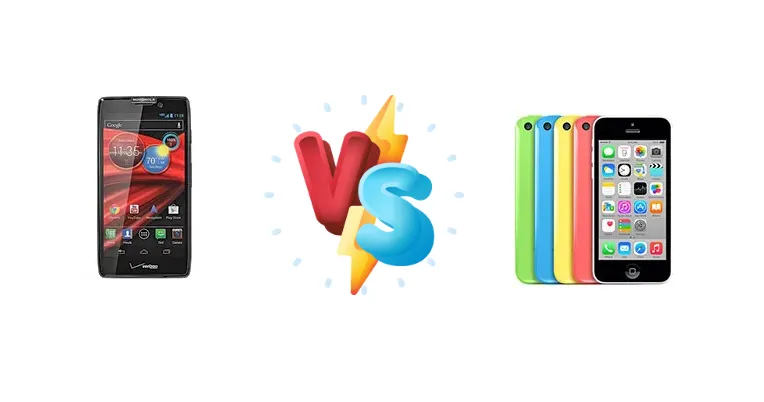
Reliving the early smartphone era, we pit two iconic devices against each other: the Motorola DROID RAZR MAXX HD and the Apple iPhone 5c. Both represent distinct design philosophies and eras of mobile technology. Let's see how these vintage powerhouses stack up in a head-to-head comparison.
🏆 Quick Verdict
The RAZR MAXX HD wins on battery life and charging speed, offering a significantly longer runtime and faster top-ups. However, the iPhone 5c boasts a more polished iOS experience and arguably a slightly better camera, making the choice dependent on your priorities.
| Network |
|---|
| 2G bands | CDMA 800 / 1900 | GSM 850 / 900 / 1800 / 1900 - all versions |
| 3G bands | CDMA2000 1xEV-DO | HSDPA 850 / 900 / 1700 / 1900 / 2100 - A1532 (GSM), A1532 (CDMA), A1456 |
| 4G bands | 13 | 1, 2, 3, 4, 5, 8, 13, 17, 19, 20, 25 - A1532 GSM, A1532 CDMA |
| 5G bands | 1, 3, 5, 7, 8, 20, 28, 38, 40, 41, 77, 78 SA/NSA | - |
| Speed | HSPA 21.1/5.76 Mbps, LTE, EV-DO Rev.A 3.1 Mbps | HSPA 42.2/5.76 Mbps, LTE Cat3 100/50 Mbps, EV-DO Rev.A 3.1 Mbps |
| Technology | GSM / CDMA / HSPA / EVDO / LTE | GSM / CDMA / HSPA / LTE |
| | HSDPA 850 / 900 / 1900 / 2100 | 1, 2, 3, 5, 7, 8, 20, 38, 39, 40 - A1529 |
| Launch |
|---|
| Announced | 2012, September. Released 2012, November | 2013, September 10. Released 2013, September 20 |
| Status | Discontinued | Discontinued |
| Body |
|---|
| Build | - | Glass front, plastic back, plastic frame |
| Dimensions | 131.9 x 67.9 x 9.3 mm (5.19 x 2.67 x 0.37 in) | 124.4 x 59.2 x 9 mm (4.90 x 2.33 x 0.35 in) |
| SIM | Micro-SIM | Nano-SIM |
| Weight | 157 g (5.54 oz) | 132 g (4.66 oz) |
| | Splash resistant | - |
| Display |
|---|
| Protection | Corning Gorilla Glass | - |
| Resolution | 720 x 1280 pixels, 16:9 ratio (~312 ppi density) | 640 x 1136 pixels, 16:9 ratio (~326 ppi density) |
| Size | 4.7 inches, 60.9 cm2 (~68.0% screen-to-body ratio) | 4.0 inches, 44.1 cm2 (~59.9% screen-to-body ratio) |
| Type | Super AMOLED | IPS LCD |
| Platform |
|---|
| CPU | Dual-core 1.5 GHz Krait | Dual-core 1.3 GHz Swift (ARM v7-based) |
| Chipset | Qualcomm MSM8960 Snapdragon S4 Plus | Apple A6 (32 nm) |
| GPU | Adreno 225 | PowerVR SGX 543MP3 (triple-core graphics) |
| OS | Android 4.0.4 (Ice Cream Sandwich), upgradable to 4.4 (KitKat) | iOS 7, upgradable to iOS 10.3.3 |
| Memory |
|---|
| Card slot | microSDHC (dedicated slot) | No |
| Internal | 16/32GB (26GB user available), 1GB RAM | 8GB 1GB RAM, 16GB 1GB RAM, 32GB 1GB RAM |
| Main Camera |
|---|
| Features | LED flash | LED flash, panorama, HDR |
| Quad | 48 MP, f/1.8, 25mm (wide), 1/2.0", 0.8µm, PDAF
8 MP, f/2.3, 16mm (ultrawide), 1/4.0", 1.12µm
2 MP, f/2.4, (macro)
2 MP, f/2.4, (depth) | - |
| Single | 8 MP, AF | 8 MP, f/2.4, 33mm (standard), 1/3.2", 1.4µm, AF |
| Video | 1080p@30fps | 1080p@30fps |
| Selfie camera |
|---|
| Dual | 16 MP, f/2.0, 26mm (wide), 1/3.06", 1.0µm
2 MP, f/2.4, (depth) | - |
| Features | HDR | face detection, FaceTime over Wi-Fi or Cellular |
| Single | 1.3 MP | 1.2 MP |
| Video | 720p@30fps | 720p@30fps |
| Sound |
|---|
| 3.5mm jack | Yes | Yes |
| 35mm jack | Yes | Yes |
| Loudspeaker | Yes | Yes |
| | - | 16-bit/44.1kHz audio
|
| Comms |
|---|
| Bluetooth | 4.0, EDR, LE, aptX | 4.0, A2DP, LE |
| NFC | Yes | No |
| Positioning | GPS, A-GPS, S-GPS, GLONASS | GPS, GLONASS |
| Radio | No | No |
| USB | microUSB 2.0 | Lightning, USB 2.0 |
| WLAN | Wi-Fi 802.11 a/b/g/n, dual-band, DLNA, hotspot | Wi-Fi 802.11 a/b/g/n, dual-band |
| Features |
|---|
| Sensors | Accelerometer, proximity, compass, barometer | Accelerometer, gyro, proximity, compass |
| | HDMI port
MP3/AAC+/WAV/WMA player
MP4/H.264/WMV player
Organizer
Document viewer/editor
Voice memo/dial/commands
Predictive text input (Swype) | - |
| Battery |
|---|
| Charging | 30W wired, 70% in 30 min (advertised) | - |
| Stand-by | Up to 372 h | Up to 250 h (3G) |
| Talk time | Up to 32 h | Up to 10 h (3G) |
| Type | Non-removable Li-Ion 3300 mAh battery | Li-Po 1510 mAh, non-removable (5.73 Wh) |
| Misc |
|---|
| Colors | Black, White | White, Blue, Green, Yellow, Pink |
| Models | RMX2144 | A1456, A1507, A1516, A1529, A1532, iPhone5,3, iPhone5,4 |
| Price | About 270 EUR | About 300 EUR |
| SAR | 1.56 W/kg (head) 0.46 W/kg (body) | 1.15 W/kg (head) 1.17 W/kg (body) |
| SAR EU | - | 1.00 W/kg (head) 0.96 W/kg (body) |
| Tests |
|---|
| Audio quality | - |
Noise -93.9dB / Crosstalk -80.3dB |
| Battery life | - |
Endurance rating 52h
|
| Camera | - |
Photo / Video |
| Display | - |
Contrast ratio: 1233:1 (nominal) / 3.512:1 (sunlight) |
| Loudspeaker | - |
Voice 66dB / Noise 65dB / Ring 66dB
|
| Performance | - |
Basemark X: 2225 |
Motorola DROID RAZR MAXX HD
- Exceptional battery life
- Fast charging (30W)
- Durable design
- Vibrant Super AMOLED display
- Rugged build quality
- Outdated processor
- Less refined iOS experience
- Camera not as good as iPhone 5c
- Larger and heavier than iPhone 5c
Apple iPhone 5c
- Smoother iOS experience
- More compact design
- Slightly better camera
- Good sunlight visibility
- Familiar Apple ecosystem
- Weaker battery life compared to RAZR MAXX HD
- Slower charging
- Outdated hardware
- Less durable than RAZR MAXX HD
Display Comparison
Both phones feature a 4.3-inch display with a respectable contrast ratio of 1233:1 (nominal) and 3.512:1 in sunlight. However, the RAZR MAXX HD's Super AMOLED display generally offers more vibrant colors and deeper blacks compared to the iPhone 5c's IPS LCD. The iPhone 5c's display is known for its accuracy, while the RAZR MAXX HD's can sometimes be oversaturated.
Camera Comparison
The iPhone 5c's camera, while basic by today's standards, was considered quite good for its time, delivering consistent image quality. The RAZR MAXX HD's camera is adequate but lacks the iPhone's refinement and image processing capabilities. Both offer photo and video recording, but the iPhone 5c's video quality is generally superior.
Performance
The RAZR MAXX HD's Qualcomm Snapdragon S4 Plus with a 1.5 GHz Krait dual-core processor provides decent performance for its time. The iPhone 5c, powered by Apple's A6 chip, generally offers a smoother and more responsive user experience due to iOS's optimization. While both are dual-core, the A6's architecture and Apple's software integration give it an edge.
Battery Life
This is where the RAZR MAXX HD truly shines. Its massive 3300 mAh battery provides exceptional endurance, achieving an endurance rating of 52 hours. The iPhone 5c's battery, while also rated at 52 hours, typically delivers less real-world usage due to iOS overhead and the slightly less efficient display. The RAZR MAXX HD also boasts 30W wired charging, capable of reaching 70% charge in just 30 minutes – a significant advantage over the iPhone 5c's slower charging.
Buying Guide
The Motorola DROID RAZR MAXX HD is ideal for users prioritizing exceptional battery life and a durable, rugged design. The Apple iPhone 5c is a better choice for those seeking a familiar iOS experience, a more compact form factor, and a slightly more refined camera, assuming they can tolerate its age.
Frequently Asked Questions
❓ Is the Motorola DROID RAZR MAXX HD still worth buying?
If you prioritize battery life and durability above all else, and don't need the latest features, it can be a surprisingly good option. However, be aware of its age and limitations.
❓ Which phone has better software support?
The Apple iPhone 5c, despite its age, may still receive occasional security updates, though support is dwindling. The Motorola DROID RAZR MAXX HD has long since ceased receiving updates.