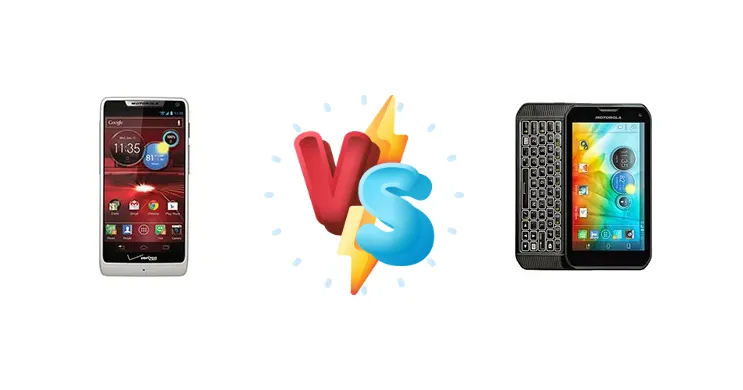
Remember the days of slim Android phones and fierce competition? The Motorola DROID RAZR M and Photon Q 4G LTE were both contenders, offering distinct features and designs. But which one holds up better today? Let's dive into a detailed comparison to see which phone reigns supreme.
🏆 Quick Verdict
The DROID RAZR M edges out the Photon Q primarily due to its significantly better battery life and generally more refined user experience. While both are aging devices, the RAZR M's endurance makes it the more practical choice for occasional use or as a backup phone.
| Network |
|---|
| 2G bands | CDMA 800 / 1900 | CDMA 800 / 1900 |
| 3G bands | CDMA2000 1xEV-DO | CDMA2000 1xEV-DO |
| 4G bands | 13 | 25 |
| Speed | HSPA 21.1/5.76 Mbps, LTE, EV-DO Rev.A 3.1 Mbps | HSPA 21.1/5.76 Mbps, LTE, EV-DO Rev.A 3.1 Mbps |
| Technology | GSM / CDMA / HSPA / EVDO / LTE | GSM / CDMA / HSPA / EVDO / LTE |
| | HSDPA 850 / 900 / 1900 / 2100 | HSDPA 850 / 1900 / 2100 |
| Launch |
|---|
| Announced | 2012, September. Released 2012, September | 2012, July. Released 2012, August |
| Status | Discontinued | Discontinued |
| Body |
|---|
| Dimensions | 122.5 x 60.9 x 8.3 mm (4.82 x 2.40 x 0.33 in) | 126.5 x 66 x 13.7 mm (4.98 x 2.60 x 0.54 in) |
| Keyboard | - | QWERTY |
| SIM | Micro-SIM | Non-removable |
| Weight | 126 g (4.44 oz) | 170.1 g (6.00 oz) |
| | Splash resistant | - |
| Display |
|---|
| Protection | Corning Gorilla Glass | Scratch-resistant glass |
| Resolution | 540 x 960 pixels, 16:9 ratio (~256 ppi density) | 540 x 960 pixels, 16:9 ratio (~256 ppi density) |
| Size | 4.3 inches, 51.0 cm2 (~68.3% screen-to-body ratio) | 4.3 inches, 51.0 cm2 (~61.1% screen-to-body ratio) |
| Type | Super AMOLED | TFT |
| | - | ColorBoost technology |
| Platform |
|---|
| CPU | Dual-core 1.5 GHz Krait | Dual-core 1.5 GHz |
| Chipset | Qualcomm MSM8960 Snapdragon S4 Plus | - |
| GPU | Adreno 225 | - |
| OS | Android 4.0.4 (Ice Cream Sandwich), upgradable to 4.4 (KitKat) | Android 4.0.4 (Ice Cream Sandwich) |
| Memory |
|---|
| Card slot | microSDHC (dedicated slot) | microSDHC (dedicated slot) |
| Internal | 8GB 1GB RAM | 8GB 1GB RAM |
| Main Camera |
|---|
| Features | LED flash | LED flash |
| Single | 8 MP, AF | 8 MP, AF |
| Video | 1080p@30fps | 1080p@30fps |
| Selfie camera |
|---|
| Single | VGA | Yes |
| Video | 720p | - |
| Sound |
|---|
| 3.5mm jack | Yes | Yes |
| 35mm jack | Yes | Yes |
| Loudspeaker | Yes | Yes |
| Comms |
|---|
| Bluetooth | 4.0, EDR, LE | 4.0, A2DP, EDR, LE |
| NFC | Yes | Yes |
| Positioning | GPS, A-GPS, GLONASS | GPS, A-GPS |
| Radio | No | No |
| USB | microUSB 2.0 | microUSB 2.0 |
| WLAN | Wi-Fi 802.11 a/b/g/n, dual-band, hotspot, DLNA | Wi-Fi 802.11 b/g/n, DLNA, hotspot |
| Features |
|---|
| Sensors | Accelerometer, proximity, compass | Accelerometer, proximity, compass |
| | MP3/AAC+/WAV/WMA player
MP4/H.264/WMV player
Organizer
Document viewer/editor
Voice memo/dial/commands
Predictive text input | HDMI port
MP3/WAV/WMA/AAC+ player
MP4/WMV/H.264 player
Document viewer
Photo viewer/editor
Organizer
Voice memo/dial/commands
Predictive text input (Swype) |
| Battery |
|---|
| Stand-by | Up to 408 h | Up to 220 h (3G) |
| Talk time | Up to 20 h | Up to 7 h 30 min (3G) |
| Type | Non-removable Li-Ion 2000 mAh battery | Non-removable Li-Ion 1785 mAh battery |
| Misc |
|---|
| Colors | Black, White | Black |
| Models | XT907 | - |
| Price | About 250 EUR | About 220 EUR |
| SAR | 0.63 W/kg (head) 1.30 W/kg (body) | 0.89 W/kg (head) 0.77 W/kg (body) |
| Tests |
|---|
| Audio quality |
Noise -82.9dB / Crosstalk -81.6dB | - |
| Battery life |
Endurance rating 55h
| - |
Motorola DROID RAZR M
- Excellent battery life (55h)
- Slim and lightweight design
- AMOLED display with vibrant colors
- Slightly better performance due to Snapdragon S4 Plus
- Older hardware, limited app compatibility
- No front-facing camera
- May struggle with demanding apps
Motorola Photon Q 4G LTE XT897
- QWERTY keyboard
- Slightly larger screen
- 4G LTE connectivity (if supported by carrier)
- Poor battery life
- Lower camera quality
- Older hardware, limited app compatibility
- Less refined user experience
Display Comparison
The Photon Q 4G LTE boasts a 4.3-inch qHD display (960 x 540), offering a slightly sharper image than the RAZR M's 4.3-inch Super AMOLED display (960 x 540). However, the RAZR M's AMOLED technology provides richer colors and deeper blacks, potentially making it more visually appealing.
Camera Comparison
The DROID RAZR M features an 8MP rear camera, while the Photon Q 4G LTE has a 5MP rear camera. The RAZR M's camera is expected to produce better image quality, especially in low-light conditions. Both lack front-facing cameras.
Performance
Both phones feature dual-core 1.5 GHz processors, but the RAZR M utilizes a Qualcomm MSM8960 Snapdragon S4 Plus chipset with Krait cores, generally offering a slight performance advantage over the Photon Q's unspecified chipset. Real-world performance will be similar, adequate for basic apps and web browsing, but struggling with modern, demanding games.
Battery Life
This is where the RAZR M truly shines. Its endurance rating of 55 hours significantly surpasses the Photon Q's likely shorter battery life (estimated around 20-25 hours based on typical usage for similar devices of the era). This difference makes a huge impact on usability.
Buying Guide
The Motorola DROID RAZR M is ideal for users seeking a compact, lightweight phone with decent battery life for basic tasks. The Photon Q 4G LTE might appeal to those prioritizing a QWERTY keyboard and a slightly larger screen, but its battery performance is a significant drawback.
Frequently Asked Questions
❓ Are these phones still receiving software updates?
No, both phones have long ceased receiving official software updates. They are running outdated versions of Android.
❓ Can I use these phones with a modern 4G LTE network?
It depends on your carrier. While both were marketed as 4G LTE devices, compatibility with current networks is unlikely without significant carrier support, which is highly improbable.