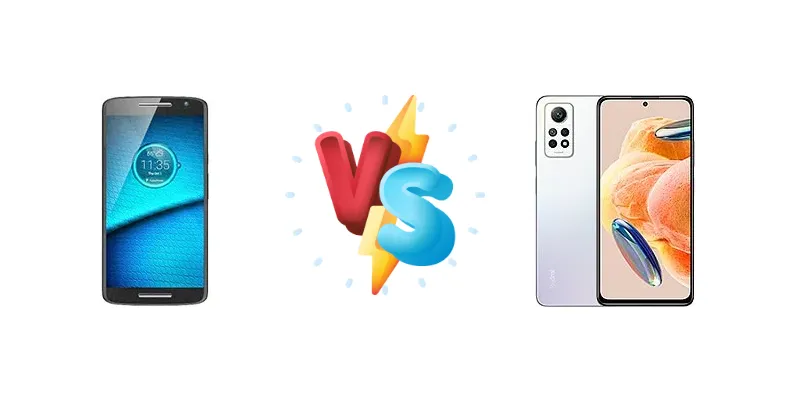
Choosing a new smartphone can be overwhelming. Today, we're pitting two contenders against each other: the Motorola Droid Maxx 2, known for its exceptional battery life, and the Xiaomi Redmi Note 12 Pro 4G, boasting fast charging and a modern chipset. Let's dive into a detailed comparison to help you decide which one reigns supreme.
🏆 Quick Verdict
The Xiaomi Redmi Note 12 Pro 4G takes the win overall. While the Droid Maxx 2 offers incredible battery endurance, the Redmi Note 12 Pro's superior performance, faster charging, and likely better camera capabilities make it the more compelling choice for most users.
| Network |
|---|
| 2G bands | GSM 850 / 900 / 1800 / 1900 | GSM 850 / 900 / 1800 / 1900 |
| 3G bands | HSDPA 850 / 900 / 1900 / 2100 | HSDPA 850 / 900 / 1700(AWS) / 1900 / 2100 |
| 4G bands | 2, 3, 4, 5, 7, 13, 20 | 1, 2, 3, 4, 5, 7, 8, 20, 28, 38, 40, 41, 66 |
| EDGE | No | - |
| GPRS | No | - |
| Speed | HSPA, LTE Cat4 150/50 Mbps, EV-DO Rev.A 3.1 Mbps | HSPA, LTE |
| Technology | GSM / CDMA / HSPA / EVDO / LTE | GSM / HSPA / LTE |
| | CDMA2000 1xEV-DO | - |
| Launch |
|---|
| Announced | 2015, October. Released 2015, October | 2023, March 03 |
| Status | Discontinued | Available. Released 2023, April 11 |
| Body |
|---|
| Dimensions | 148 x 75 x 10.9 mm (5.83 x 2.95 x 0.43 in) | 164.2 x 76.1 x 8.1 mm (6.46 x 3.00 x 0.32 in) |
| SIM | Nano-SIM | Nano-SIM + Nano-SIM |
| Weight | 169 g (5.96 oz) | 201.8 g (7.13 oz) |
| | Splash and dust resistant | - |
| Display |
|---|
| Protection | Corning Gorilla Glass 3 | - |
| Resolution | 1080 x 1920 pixels, 16:9 ratio (~403 ppi density) | 1080 x 2400 pixels, 20:9 ratio (~395 ppi density) |
| Size | 5.5 inches, 82.6 cm2 (~74.4% screen-to-body ratio) | 6.67 inches, 107.4 cm2 (~86.0% screen-to-body ratio) |
| Type | IPS LCD | AMOLED, 120Hz, Dolby Vision, 700 nits (HBM), 1100 nits (peak) |
| Platform |
|---|
| CPU | Octa-core (4x1.7 GHz Cortex-A53 & 4x1.0 GHz Cortex-A53) | Octa-core (2x2.2 GHz Kryo 470 Gold & 6x1.8 GHz Kryo 470 Silver) |
| Chipset | Qualcomm MSM8939 Snapdragon 615 (28 nm) | Qualcomm SM7150 Snapdragon 732G (8 nm) |
| GPU | Adreno 405 | Adreno 618 |
| OS | Android 5.1.1 (Lollipop), upgradable to 7.0 (Nougat) | Android 11, MIUI 13 |
| Memory |
|---|
| Card slot | microSDXC (dedicated slot) | microSDXC (uses shared SIM slot) |
| Internal | 16GB 2GB RAM | 128GB 6GB RAM, 128GB 8GB RAM, 256GB 8GB RAM |
| | eMMC 4.5 | UFS 2.2 |
| Main Camera |
|---|
| Features | Dual-LED dual-tone flash, panorama | LED flash, HDR, panorama |
| Quad | - | 108 MP, f/1.9, (wide), 1/1.52", 0.7µm, PDAF
8 MP, 120˚, (ultrawide)
2 MP (macro)
Auxiliary lens |
| Single | 21 MP, f/2.0, PDAF | - |
| Video | 1080p@30fps | 4K@30fps, 1080p@30/60fps |
| Selfie camera |
|---|
| Single | 5 MP, f/2.0 | 16 MP, f/2.4, (wide) |
| Video | - | 1080p@30fps |
| Sound |
|---|
| 3.5mm jack | Yes | Yes |
| 35mm jack | Yes | Yes |
| Loudspeaker | Yes | Yes, with stereo speakers |
| Comms |
|---|
| Bluetooth | 4.0, A2DP, LE, aptX | 5.0, A2DP, LE |
| Infrared port | - | Yes |
| NFC | Yes | Yes (market/region dependent) |
| Positioning | GPS | GPS, GLONASS, GALILEO, BDS |
| Radio | FM radio | Unspecified |
| USB | microUSB 2.0 | USB Type-C 2.0, OTG |
| WLAN | Wi-Fi 802.11 a/b/g/n, dual-band, hotspot | Wi-Fi 802.11 a/b/g/n/ac, dual-band |
| Features |
|---|
| Sensors | Yes | Fingerprint (side-mounted), accelerometer, gyro, compass |
| Battery |
|---|
| Charging | 15W wired | 67W wired |
| Stand-by | Up to 576 h (3G) | - |
| Talk time | Up to 48 h (3G) | - |
| Type | Li-Ion 3630 mAh, non-removable | Li-Po 5000 mAh |
| Misc |
|---|
| Colors | Deep Sea Blue, White | Star Blue, Graphite Gray, Polar White, Ice blue |
| Models | XT1565B, XT1565 | 2209116AG, 2209116AG |
| Price | About 300 EUR | About 150 EUR |
| SAR | 1.14 W/kg (head) 1.38 W/kg (body) | - |
| Tests |
|---|
| Audio quality |
Noise -82.7dB / Crosstalk -82.9dB | - |
| Battery life | Endurance rating 56h | - |
| Display |
Contrast ratio: 1256:1 (nominal) / 911:1 (docking station) | - |
| Loudspeaker |
Voice 57dB / Noise 66dB / Ring 77dB | - |
Motorola Droid Maxx 2
- Exceptional battery life
- High contrast ratio display
- Durable build quality (typical of Motorola)
- Outdated chipset
- Lower performance
- Likely inferior camera
- Slower charging
Xiaomi Redmi Note 12 Pro 4G
- Powerful Snapdragon 732G chipset
- Fast 67W charging
- Likely better camera
- Modern display technology (likely AMOLED)
- Battery life not as exceptional as Droid Maxx 2
- Xiaomi's MIUI software can be polarizing
Display Comparison
The Redmi Note 12 Pro 4G likely features a more modern display with better color accuracy and potentially a higher resolution than the Droid Maxx 2. While the Droid Maxx 2 boasts a high contrast ratio, the Redmi Note 12 Pro's display technology (likely AMOLED) will offer a more vibrant and immersive viewing experience. Expect better brightness and outdoor visibility on the Redmi.
Camera Comparison
While specific camera specs are limited for the Droid Maxx 2, the Redmi Note 12 Pro 4G is expected to have a more advanced camera system with higher resolution sensors and improved image processing. Expect better low-light performance and more detailed photos from the Redmi.
Performance
The Snapdragon 732G in the Redmi Note 12 Pro 4G is significantly more powerful than the Snapdragon 615 in the Droid Maxx 2. This translates to smoother multitasking, faster app loading times, and better gaming performance. The Redmi's CPU architecture is also more efficient, contributing to better overall performance.
Battery Life
The Droid Maxx 2's standout feature is its exceptional battery life, boasting an endurance rating of 56 hours. However, the Redmi Note 12 Pro 4G compensates with its 67W fast charging, allowing it to quickly replenish its battery when needed. While the Droid Maxx 2 lasts longer, the Redmi charges much faster.
Buying Guide
The Motorola Droid Maxx 2 is ideal for users prioritizing battery life above all else – those who need a phone that can easily last for multiple days on a single charge. The Xiaomi Redmi Note 12 Pro 4G is perfect for users who want a balance of performance, camera quality, and fast charging, without breaking the bank.
Frequently Asked Questions
❓ Is the Motorola Droid Maxx 2 still a good phone in 2024?
It's a niche choice. If battery life is your absolute top priority and you don't need the latest features, it can still suffice. However, its age means it's significantly slower than modern phones.
❓ How does the Redmi Note 12 Pro 4G's charging speed compare to other phones?
67W charging is very fast. It can typically charge the phone from 0% to 100% in around 45 minutes, which is competitive with many flagship devices.