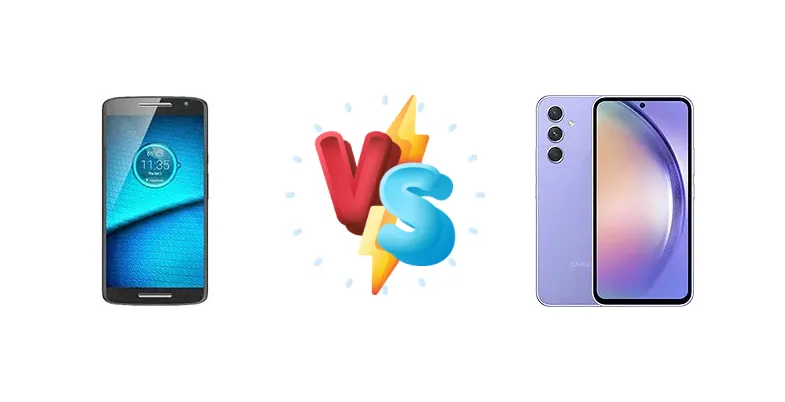
Choosing a new smartphone can be overwhelming. The Motorola Droid Maxx 2, a legacy device known for its incredible battery life, faces off against the modern Samsung Galaxy A54, packed with features and a sleek design. Let's dive into a comprehensive comparison to see which phone emerges as the winner.
🏆 Quick Verdict
The Samsung Galaxy A54 is the clear winner overall. While the Droid Maxx 2 boasts exceptional battery life, the A54’s superior performance, camera, display, and modern features make it a more compelling choice for most users. It's a modern all-rounder.
| Network |
|---|
| 2G bands | GSM 850 / 900 / 1800 / 1900 | GSM 850 / 900 / 1800 / 1900 |
| 3G bands | HSDPA 850 / 900 / 1900 / 2100 | HSDPA 850 / 900 / 1700(AWS) / 1900 / 2100 |
| 4G bands | 2, 3, 4, 5, 7, 13, 20 | 1, 2, 3, 4, 5, 7, 8, 12, 17, 20, 26, 28, 32, 38, 40, 41, 66 - International |
| 5G bands | - | 1, 3, 7, 8, 20, 28, 38, 40, 41, 77, 78 SA/NSA/Sub6 - International |
| EDGE | No | - |
| GPRS | No | - |
| Speed | HSPA, LTE Cat4 150/50 Mbps, EV-DO Rev.A 3.1 Mbps | HSPA, LTE, 5G |
| Technology | GSM / CDMA / HSPA / EVDO / LTE | GSM / HSPA / LTE / 5G |
| | CDMA2000 1xEV-DO | 25, 41, 66, 71 SA/NSA/Sub6/mmWave - USA |
| Launch |
|---|
| Announced | 2015, October. Released 2015, October | 2023, March 15 |
| Status | Discontinued | Available. Released 2023, March 24 |
| Body |
|---|
| Build | - | Glass front (Gorilla Glass 5), glass back (Gorilla Glass 5), plastic frame |
| Dimensions | 148 x 75 x 10.9 mm (5.83 x 2.95 x 0.43 in) | 158.2 x 76.7 x 8.2 mm (6.23 x 3.02 x 0.32 in) |
| SIM | Nano-SIM | · Nano-SIM + eSIM· Nano-SIM + Nano-SIM |
| Weight | 169 g (5.96 oz) | 202 g (7.13 oz) |
| | Splash and dust resistant | IP67 dust/water resistant (up to 1m for 30 min) |
| Display |
|---|
| Protection | Corning Gorilla Glass 3 | Corning Gorilla Glass 5 |
| Resolution | 1080 x 1920 pixels, 16:9 ratio (~403 ppi density) | 1080 x 2340 pixels, 19.5:9 ratio (~403 ppi density) |
| Size | 5.5 inches, 82.6 cm2 (~74.4% screen-to-body ratio) | 6.4 inches, 100.5 cm2 (~82.9% screen-to-body ratio) |
| Type | IPS LCD | Super AMOLED, 120Hz, HDR10+, 1000 nits (HBM) |
| Platform |
|---|
| CPU | Octa-core (4x1.7 GHz Cortex-A53 & 4x1.0 GHz Cortex-A53) | Octa-core (4x2.4 GHz Cortex-A78 & 4x2.0 GHz Cortex-A55) |
| Chipset | Qualcomm MSM8939 Snapdragon 615 (28 nm) | Exynos 1380 (5 nm) |
| GPU | Adreno 405 | Mali-G68 MP5 |
| OS | Android 5.1.1 (Lollipop), upgradable to 7.0 (Nougat) | Android 13, up to 4 major Android upgrades, One UI 7 |
| Memory |
|---|
| Card slot | microSDXC (dedicated slot) | microSDXC (uses shared SIM slot) |
| Internal | 16GB 2GB RAM | 128GB 4GB RAM, 128GB 6GB RAM, 128GB 8GB RAM, 256GB 6GB RAM, 256GB 8GB RAM |
| | eMMC 4.5 | - |
| Main Camera |
|---|
| Features | Dual-LED dual-tone flash, panorama | LED flash, panorama, HDR |
| Single | 21 MP, f/2.0, PDAF | 32 MP, f/2.2, 26mm (wide), 1/2.8", 0.8µm |
| Triple | - | 50 MP, f/1.8, 23mm (wide), 1/1.56", 1.0µm, PDAF, OIS
12 MP, f/2.2, 13mm, 123˚ (ultrawide), 1/3.X", 1.12µm
5 MP (macro) |
| Video | 1080p@30fps | 4K@30fps, 1080p@30/60fps, 720p@480fps, gyro-EIS |
| Selfie camera |
|---|
| Single | 5 MP, f/2.0 | 32 MP, f/2.2, 26mm (wide), 1/2.8", 0.8µm |
| Video | - | 4K@30fps, 1080p@30/60fps |
| Sound |
|---|
| 3.5mm jack | Yes | No |
| 35mm jack | Yes | No |
| Loudspeaker | Yes | Yes, with stereo speakers |
| Comms |
|---|
| Bluetooth | 4.0, A2DP, LE, aptX | 5.3, A2DP, LE |
| NFC | Yes | Yes (market/region dependent) |
| Positioning | GPS | GPS, GLONASS, GALILEO, BDS |
| Radio | FM radio | No |
| USB | microUSB 2.0 | USB Type-C 2.0, OTG |
| WLAN | Wi-Fi 802.11 a/b/g/n, dual-band, hotspot | Wi-Fi 802.11 a/b/g/n/ac/6, dual-band, Wi-Fi Direct |
| Features |
|---|
| Sensors | Yes | Fingerprint (under display, optical), accelerometer, gyro, compass, barometer (USA only) |
| | - | Virtual proximity sensing |
| Battery |
|---|
| Charging | 15W wired | 25W wired |
| Stand-by | Up to 576 h (3G) | - |
| Talk time | Up to 48 h (3G) | - |
| Type | Li-Ion 3630 mAh, non-removable | 5000 mAh |
| Misc |
|---|
| Colors | Deep Sea Blue, White | Lime, Graphite, Violet, White |
| Models | XT1565B, XT1565 | SM-A546V, SM-A546U, SM-A546U1, SM-A546B, SM-A546B/DS, SM-A546E, SM-A546E/DS, SM-A5460, SM-A546M, SM-A546M/DS, SM-A546W |
| Price | About 300 EUR | € 210.00 / $ 119.11 / £ 169.95 / ₹ 28,999 |
| SAR | 1.14 W/kg (head) 1.38 W/kg (body) | 0.81 W/kg (head) 0.67 W/kg (body) |
| SAR EU | - | 0.69 W/kg (head) 1.34 W/kg (body) |
| Tests |
|---|
| Audio quality |
Noise -82.7dB / Crosstalk -82.9dB | - |
| Battery life | Endurance rating 56h |
Endurance rating 119h
|
| Camera | - |
Photo / Video |
| Display |
Contrast ratio: 1256:1 (nominal) / 911:1 (docking station) |
Contrast ratio: Infinite (nominal) |
| Loudspeaker |
Voice 57dB / Noise 66dB / Ring 77dB |
-26.6 LUFS (Good)
|
| Performance | - |
AnTuTu: 506678 (v9)
GeekBench: 2703 (v5.1), 2797 (v6)
GFXBench: 25fps (ES 3.1 onscreen) |
Motorola Droid Maxx 2
- Exceptional battery life
- Budget-friendly
- Durable build (typical of Motorola)
- Outdated chipset
- Lower resolution display
- Basic camera
- Slow charging
Samsung Galaxy A54
- Modern chipset and performance
- Vibrant and bright display
- Excellent camera system
- Fast charging
- Sleek design
- Battery life not as extreme as Droid Maxx 2
- Can be pricier than Droid Maxx 2
Display Comparison
The Samsung Galaxy A54’s display is significantly better. Its 980 nits max brightness ensures excellent visibility even in direct sunlight, a feature the Droid Maxx 2 lacks. The A54’s 'Infinite' contrast ratio suggests superior color accuracy and deeper blacks compared to the Droid Maxx 2's 1256:1 ratio. The A54 also likely has a higher resolution and more modern display technology (e.g., AMOLED).
Camera Comparison
The Samsung Galaxy A54’s camera system is a clear winner. While the Droid Maxx 2 has a camera, the A54 offers a more advanced setup with likely better image quality, features, and video recording capabilities. Expect improved low-light performance, more detailed photos, and potentially optical image stabilization on the A54.
Performance
The Galaxy A54’s Exynos 1380 chipset, built on a 5nm process, offers a substantial performance advantage over the Droid Maxx 2’s Snapdragon 615 (28nm). The A54’s Cortex-A78 cores provide significantly faster processing speeds, resulting in smoother multitasking, faster app loading, and better gaming performance. The Droid Maxx 2's CPU is showing its age.
Battery Life
The Droid Maxx 2’s endurance rating of 56h is impressive, but the Galaxy A54’s active use score of 11:15h and endurance rating of 119h are still very competitive, especially considering its more powerful components. While the Droid Maxx 2 *might* edge out the A54 in pure endurance, the A54 offers a better balance of battery life and performance.
Buying Guide
Who should buy the Motorola Droid Maxx 2? Users prioritizing extreme battery life above all else and those seeking a budget-friendly option. Who should buy the Samsung Galaxy A54? Anyone wanting a modern smartphone with a great camera, vibrant display, and solid performance for everyday tasks and light gaming.
Frequently Asked Questions
❓ Is the Motorola Droid Maxx 2 still worth buying in 2024?
Only if battery life is your absolute top priority and you're on a very tight budget. Otherwise, the Galaxy A54 offers a much better overall experience.
❓ How does the Samsung Galaxy A54 compare to other phones in its price range?
The Galaxy A54 is a strong contender, offering a competitive camera, display, and performance for its price point. It's a well-rounded option compared to many alternatives.