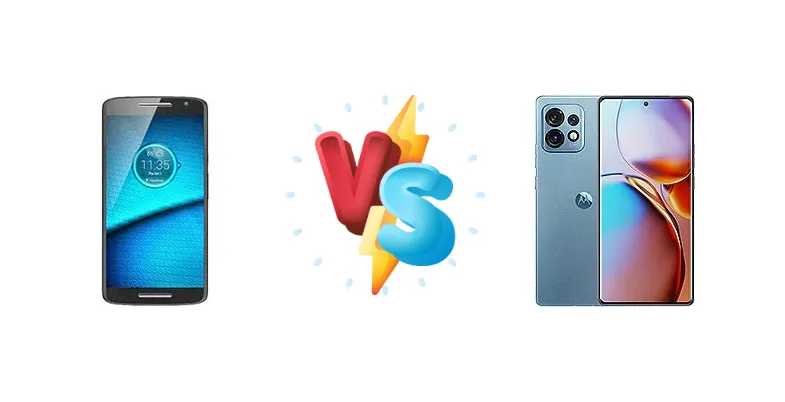
The Motorola Droid Maxx 2 was a battery champion in its time, but the Moto X40 represents a modern flagship. Can a focus on endurance compete with cutting-edge technology? This comparison dives deep into the specs and features of these two Motorola phones to help you choose the right one.
🏆 Quick Verdict
The Moto X40 utterly dominates the Droid Maxx 2 in almost every category – performance, camera, display, and charging. While the Maxx 2's legendary battery life remains a strong point, the X40's sheer power and modern features make it the clear winner for most users.
| Network |
|---|
| 2G bands | GSM 850 / 900 / 1800 / 1900 | GSM 850 / 900 / 1800 / 1900 |
| 3G bands | HSDPA 850 / 900 / 1900 / 2100 | HSDPA 850 / 900 / 1700(AWS) / 1900 / 2100 |
| 4G bands | 2, 3, 4, 5, 7, 13, 20 | 1, 2, 3, 4, 5, 7, 8, 12, 13, 17, 18, 19, 20, 25, 26, 28, 32, 38, 39, 40, 41, 42, 43, 48, 66 |
| 5G bands | - | 1, 2, 3, 5, 7, 8, 20, 28, 38, 40, 41, 66, 77, 78 SA/NSA/Sub6 |
| EDGE | No | - |
| GPRS | No | - |
| Speed | HSPA, LTE Cat4 150/50 Mbps, EV-DO Rev.A 3.1 Mbps | HSPA, LTE, 5G |
| Technology | GSM / CDMA / HSPA / EVDO / LTE | GSM / CDMA / HSPA / LTE / 5G |
| | CDMA2000 1xEV-DO | CDMA 800 |
| Launch |
|---|
| Announced | 2015, October. Released 2015, October | 2022, December 15 |
| Status | Discontinued | Available. Released 2022, December 22 |
| Body |
|---|
| Build | - | Glass front, glass back (Gorilla Glass Victus), aluminum frame |
| Dimensions | 148 x 75 x 10.9 mm (5.83 x 2.95 x 0.43 in) | 161.2 x 74 x 8.6 mm (6.35 x 2.91 x 0.34 in) |
| SIM | Nano-SIM | Nano-SIM + Nano-SIM |
| Weight | 169 g (5.96 oz) | 199 g (7.02 oz) |
| | Splash and dust resistant | IP68 dust/water resistant (up to 1.5m for 30 min) |
| Display |
|---|
| Protection | Corning Gorilla Glass 3 | - |
| Resolution | 1080 x 1920 pixels, 16:9 ratio (~403 ppi density) | 1080 x 2400 pixels, 20:9 ratio (~393 ppi density) |
| Size | 5.5 inches, 82.6 cm2 (~74.4% screen-to-body ratio) | 6.7 inches, 108.4 cm2 (~90.9% screen-to-body ratio) |
| Type | IPS LCD | OLED, 1B colors, 165Hz, HDR10+ |
| Platform |
|---|
| CPU | Octa-core (4x1.7 GHz Cortex-A53 & 4x1.0 GHz Cortex-A53) | Octa-core (1x3.2 GHz Cortex-X3 & 2x2.8 GHz Cortex-A715 & 2x2.8 GHz Cortex-A710 & 3x2.0 GHz Cortex-A510) |
| Chipset | Qualcomm MSM8939 Snapdragon 615 (28 nm) | Qualcomm SM8550-AB Snapdragon 8 Gen 2 (4 nm) |
| GPU | Adreno 405 | Adreno 740 |
| OS | Android 5.1.1 (Lollipop), upgradable to 7.0 (Nougat) | Android 13, upgradable to Android 14, MYUI 6.0 |
| Memory |
|---|
| Card slot | microSDXC (dedicated slot) | No |
| Internal | 16GB 2GB RAM | 128GB 8GB RAM, 256GB 12GB RAM, 512GB 12GB RAM |
| | eMMC 4.5 | UFS 3.1 - 128GB
UFS 4.0 - 256GB/512GB |
| Main Camera |
|---|
| Features | Dual-LED dual-tone flash, panorama | Dual-LED flash, panorama, HDR |
| Single | 21 MP, f/2.0, PDAF | - |
| Triple | - | 50 MP, f/1.9, (wide), 1/1.55", 1.0µm, dual pixel PDAF, OIS
12 MP, f/1.6, (telephoto), 1/2.93", 1.22µm, PDAF, 2x optical zoom
50 MP, f/2.2, 117˚ (ultrawide), 1/2.76", 0.64µm, AF |
| Video | 1080p@30fps | 8K@30fps, 4K@30/60fps, 1080p@30/60/120/240/960fps, 10-bit HDR10+, gyro-EIS |
| Selfie camera |
|---|
| Features | - | HDR |
| Single | 5 MP, f/2.0 | 60 MP, f/2.2, (wide), 1/2.8", 0.61µm |
| Video | - | 4K@30fps, 1080p@30/60fps |
| Sound |
|---|
| 3.5mm jack | Yes | No |
| 35mm jack | Yes | No |
| Loudspeaker | Yes | Yes, with stereo speakers |
| Comms |
|---|
| Bluetooth | 4.0, A2DP, LE, aptX | 5.3, A2DP, LE, aptX HD, aptX Adaptive |
| NFC | Yes | Yes |
| Positioning | GPS | GPS (L1+L5), GLONASS (L1), BDS (B1I+B1c+B2a), GALILEO (E1+E5a), QZSS (L1+L5) |
| Radio | FM radio | No |
| USB | microUSB 2.0 | USB Type-C, OTG |
| WLAN | Wi-Fi 802.11 a/b/g/n, dual-band, hotspot | Wi-Fi 802.11 a/b/g/n/ac/6e, dual-band, Wi-Fi Direct |
| Features |
|---|
| Sensors | Yes | Fingerprint (under display, optical), accelerometer, gyro, proximity, compass |
| | - | Ready For 3.5 support |
| Battery |
|---|
| Charging | 15W wired | 125W wired, PD3.0, QC5, 50% in 7 min
15W wireless
5W reverse wired |
| Stand-by | Up to 576 h (3G) | - |
| Talk time | Up to 48 h (3G) | - |
| Type | Li-Ion 3630 mAh, non-removable | Li-Po 4600 mAh |
| Misc |
|---|
| Colors | Deep Sea Blue, White | Black, Blue |
| Models | XT1565B, XT1565 | XT2301-5 |
| Price | About 300 EUR | About 540 EUR |
| SAR | 1.14 W/kg (head) 1.38 W/kg (body) | - |
| Tests |
|---|
| Audio quality |
Noise -82.7dB / Crosstalk -82.9dB | - |
| Battery life | Endurance rating 56h | - |
| Display |
Contrast ratio: 1256:1 (nominal) / 911:1 (docking station) | - |
| Loudspeaker |
Voice 57dB / Noise 66dB / Ring 77dB | - |
Motorola Droid Maxx 2
- Exceptional battery life
- Affordable
- Durable build
- Outdated processor
- Low-resolution display
- Basic camera
- Slow charging
Motorola Moto X40
- Blazing-fast performance
- Stunning display
- Advanced camera system
- Incredibly fast charging
- Wireless charging
- Reverse wired charging
- Higher price
- Battery life may not match Maxx 2 in extreme usage
Display Comparison
The Moto X40 boasts a significantly superior display. It likely features OLED technology with vibrant colors, deep blacks, and a higher resolution than the Droid Maxx 2's LCD. The X40's refresh rate is also likely much faster, providing smoother scrolling and animations. The Droid Maxx 2's contrast ratio is decent, but it can't compete with the modern panel on the X40.
Camera Comparison
The Moto X40's camera system is expected to be far more advanced. It likely features a higher resolution main sensor, improved image processing, and advanced features like optical image stabilization (OIS). The Droid Maxx 2's camera was adequate for its time, but it simply can't compete with the capabilities of a modern flagship camera.
Performance
The Snapdragon 8 Gen 2 in the Moto X40 is a monumental upgrade over the Snapdragon 615 in the Droid Maxx 2. Expect drastically faster app loading times, smoother multitasking, and significantly improved gaming performance on the X40. The X40's CPU architecture is also far more efficient, contributing to better overall power management despite its higher performance.
Battery Life
The Droid Maxx 2's endurance rating of 56h is impressive, a testament to its large battery and efficient processor. However, the Moto X40's 125W charging capability allows it to replenish its battery incredibly quickly, potentially offsetting any battery life advantage the Maxx 2 might have. Wireless and reverse wired charging are also X40 exclusives.
Buying Guide
The Motorola Droid Maxx 2 is for users prioritizing extreme battery life above all else and are on a very tight budget. The Motorola Moto X40 is for those seeking a high-performance flagship with a stunning display, advanced camera, and incredibly fast charging.
Frequently Asked Questions
❓ Is the Motorola Droid Maxx 2 still a good phone in 2024?
While its battery life is still impressive, its outdated hardware makes it less suitable for modern apps and tasks. It's best suited for basic usage and those on a very limited budget.
❓ How much faster is the Moto X40 than the Droid Maxx 2?
The Moto X40 is significantly faster – likely 5-10 times faster in CPU-intensive tasks and even more so in graphics performance. The difference is substantial.