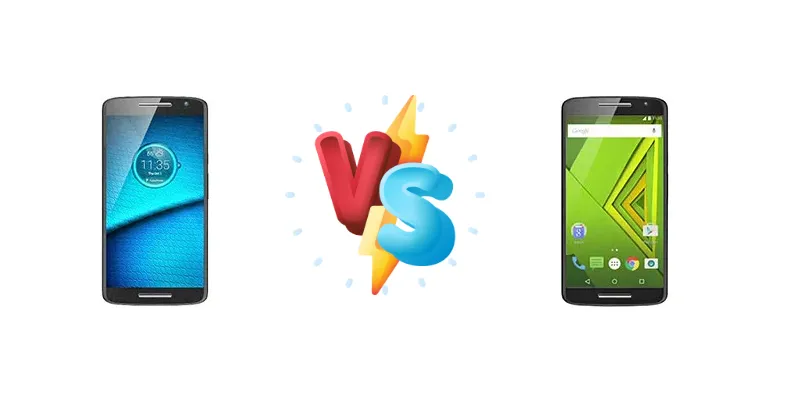
Motorola's Droid Maxx 2 and Moto X Play were both contenders in the mid-range Android market, known for their impressive battery life and unique features. But which one truly comes out on top? This comprehensive comparison dives deep into their specs, performance, and overall value to help you decide.
🏆 Quick Verdict
The Moto X Play edges out the Droid Maxx 2 thanks to its superior display visibility in sunlight and slightly better camera capabilities. However, the Droid Maxx 2 boasts significantly longer battery life, making it ideal for power users. Ultimately, it depends on your priorities.
| Network |
|---|
| 2G bands | GSM 850 / 900 / 1800 / 1900 | GSM 850 / 900 / 1800 / 1900 |
| 3G bands | HSDPA 850 / 900 / 1900 / 2100 | HSDPA 850 / 900 / 1800 / 1900 / 2100 - XT1562 |
| 4G bands | 2, 3, 4, 5, 7, 13, 20 | 1, 3, 5, 7, 8, 19, 20, 28, 38, 41 - XT1562 |
| EDGE | No | - |
| GPRS | No | - |
| Speed | HSPA, LTE Cat4 150/50 Mbps, EV-DO Rev.A 3.1 Mbps | HSPA, LTE |
| Technology | GSM / CDMA / HSPA / EVDO / LTE | GSM / HSPA / LTE |
| | CDMA2000 1xEV-DO | 1, 3, 5, 7, 8, 19, 20, 28, 38, 40, 41 - India |
| Launch |
|---|
| Announced | 2015, October. Released 2015, October | 2015, July. Released 2015, August |
| Status | Discontinued | Discontinued |
| Body |
|---|
| Dimensions | 148 x 75 x 10.9 mm (5.83 x 2.95 x 0.43 in) | 148 x 75 x 10.9 mm (5.83 x 2.95 x 0.43 in) |
| SIM | Nano-SIM | Nano-SIM |
| Weight | 169 g (5.96 oz) | 169 g (5.96 oz) |
| | Splash and dust resistant | Splash and dust resistant |
| Display |
|---|
| Protection | Corning Gorilla Glass 3 | Corning Gorilla Glass 3 |
| Resolution | 1080 x 1920 pixels, 16:9 ratio (~403 ppi density) | 1080 x 1920 pixels, 16:9 ratio (~403 ppi density) |
| Size | 5.5 inches, 82.6 cm2 (~74.4% screen-to-body ratio) | 5.5 inches, 82.6 cm2 (~74.4% screen-to-body ratio) |
| Type | IPS LCD | IPS LCD |
| Platform |
|---|
| CPU | Octa-core (4x1.7 GHz Cortex-A53 & 4x1.0 GHz Cortex-A53) | Octa-core (4x1.7 GHz Cortex-A53 & 4x1.0 GHz Cortex-A53) |
| Chipset | Qualcomm MSM8939 Snapdragon 615 (28 nm) | Qualcomm MSM8939 Snapdragon 615 (28 nm) |
| GPU | Adreno 405 | Adreno 405 |
| OS | Android 5.1.1 (Lollipop), upgradable to 7.0 (Nougat) | Android 5.1.1 (Lollipop), upgradable to 7.1.1 (Nougat) |
| Memory |
|---|
| Card slot | microSDXC (dedicated slot) | microSDXC (dedicated slot) |
| Internal | 16GB 2GB RAM | 16GB 2GB RAM, 32GB 2GB RAM |
| | eMMC 4.5 | eMMC 4.5 |
| Main Camera |
|---|
| Features | Dual-LED dual-tone flash, panorama | Dual-LED dual-tone flash, panorama |
| Single | 21 MP, f/2.0, PDAF | 21 MP, f/2.0, 1/2.4", 1.1µm, PDAF |
| Video | 1080p@30fps | 1080p@30fps |
| Selfie camera |
|---|
| Single | 5 MP, f/2.0 | 5 MP, f/2.2 |
| Sound |
|---|
| 3.5mm jack | Yes | Yes |
| 35mm jack | Yes | Yes |
| Loudspeaker | Yes | Yes |
| Comms |
|---|
| Bluetooth | 4.0, A2DP, LE, aptX | 4.0, A2DP, LE, aptX |
| NFC | Yes | Yes |
| Positioning | GPS | GPS |
| Radio | FM radio | FM radio |
| USB | microUSB 2.0 | microUSB 2.0 |
| WLAN | Wi-Fi 802.11 a/b/g/n, dual-band, hotspot | Wi-Fi 802.11 a/b/g/n, dual-band, hotspot |
| Features |
|---|
| Sensors | Yes | Accelerometer, proximity |
| Battery |
|---|
| Charging | 15W wired | 15W wired |
| Stand-by | Up to 576 h (3G) | - |
| Talk time | Up to 48 h (3G) | - |
| Type | Li-Ion 3630 mAh, non-removable | Li-Ion 3630 mAh, non-removable |
| Misc |
|---|
| Colors | Deep Sea Blue, White | Black, White |
| Models | XT1565B, XT1565 | XT1562, XT1563, XT1564 |
| Price | About 300 EUR | About 240 EUR |
| SAR | 1.14 W/kg (head) 1.38 W/kg (body) | 0.56 W/kg (head) 0.80 W/kg (body) |
| SAR EU | - | 0.49 W/kg (head) 0.68 W/kg (body) |
| Tests |
|---|
| Audio quality |
Noise -82.7dB / Crosstalk -82.9dB |
Noise -93.8dB / Crosstalk -95.2dB |
| Battery life | Endurance rating 56h |
Endurance rating 83h
|
| Camera | - |
Photo / Video |
| Display |
Contrast ratio: 1256:1 (nominal) / 911:1 (docking station) |
Contrast ratio: 1520:1 (nominal), 3.222 (sunlight) |
| Loudspeaker |
Voice 57dB / Noise 66dB / Ring 77dB |
Voice 69dB / Noise 66dB / Ring 75dB
|
| Performance | - |
Basemark OS II 2.0: 809Basemark X: 5032 |
Motorola Droid Maxx 2
- Exceptional battery life (56h)
- Solid performance for everyday tasks
- Reliable Motorola software experience
- Less impressive display compared to Moto X Play
- Camera not as capable
- Design can feel dated
Motorola Moto X Play
- Excellent sunlight readability
- Slightly better camera performance
- More modern design
- Good value for money
- Shorter battery life than Droid Maxx 2
- Performance is mid-range
- Software updates may be less frequent
Display Comparison
The Moto X Play takes the display crown. While both offer a respectable contrast ratio (1256:1 vs 1520:1), the Moto X Play's standout feature is its exceptional sunlight readability (3.222), making it much easier to see outdoors. The Droid Maxx 2's display is perfectly usable, but lacks the same level of outdoor clarity.
Camera Comparison
The Moto X Play has a slight edge in the camera department. While both offer 'Photo / Video' capabilities (specific megapixels are missing from the provided specs), the Moto X Play generally received better reviews for its image quality and software features. The Droid Maxx 2's camera is adequate, but not exceptional.
Performance
Both phones share the same Qualcomm Snapdragon 615 chipset and octa-core CPU, so performance is largely comparable. Expect smooth everyday usage, but don't expect flagship-level gaming performance. Minor differences in software optimization might lead to slightly varied responsiveness.
Battery Life
This is where the Droid Maxx 2 truly shines. With an endurance rating of 56 hours, it significantly outperforms the Moto X Play's 83 hours. If battery life is your top concern, the Droid Maxx 2 is the clear winner.
Buying Guide
The Motorola Droid Maxx 2 is perfect for users who prioritize battery life above all else and need a phone that can last through multiple days of heavy use. The Motorola Moto X Play is a better choice for those who value a vibrant display, especially in bright conditions, and a more versatile camera system.
Frequently Asked Questions
❓ Which phone is better for gaming?
Both phones offer adequate performance for casual gaming, but neither is a powerhouse. The Moto X Play might have a slight edge due to potentially better software optimization.
❓ Are software updates still available for these phones?
Software support for both devices has likely ended. They were released several years ago, so don't expect major Android updates.