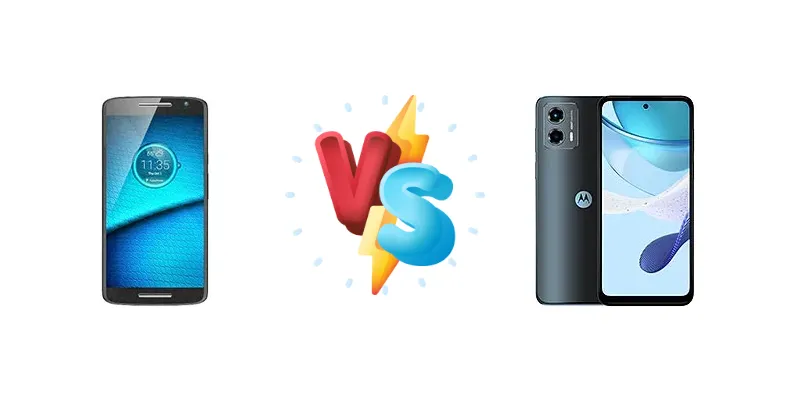
Motorola consistently delivers reliable smartphones, but choosing between models can be tricky. We're pitting the older, battery-focused Droid Maxx 2 against the newer, 5G-enabled Moto G (2023) to see which offers the best overall experience. This comparison will help you decide which phone best suits your needs.
🏆 Quick Verdict
The Moto G (2023) offers a more modern experience with 5G connectivity and a newer chipset. However, the Droid Maxx 2 remains a champion of battery life. If longevity is your top priority, the Maxx 2 wins; otherwise, the Moto G (2023) provides a better balance of features and performance.
| Network |
|---|
| 2G bands | GSM 850 / 900 / 1800 / 1900 | GSM 850 / 900 / 1800 / 1900 |
| 3G bands | HSDPA 850 / 900 / 1900 / 2100 | HSDPA 850 / 900 / 1700(AWS) / 1900 / 2100 |
| 4G bands | 2, 3, 4, 5, 7, 13, 20 | 1, 2, 3, 4, 5, 7, 8, 12, 13, 14, 17, 18, 20, 25, 26, 29, 30, 38, 39, 40, 41, 48, 66, 71 |
| 5G bands | - | 2, 5, 7, 12, 14, 25, 26, 29, 30, 41, 48, 66, 70, 71, 78 SA/NSA |
| EDGE | No | - |
| GPRS | No | - |
| Speed | HSPA, LTE Cat4 150/50 Mbps, EV-DO Rev.A 3.1 Mbps | HSPA, LTE, 5G |
| Technology | GSM / CDMA / HSPA / EVDO / LTE | GSM / HSPA / LTE / 5G |
| | CDMA2000 1xEV-DO | - |
| Launch |
|---|
| Announced | 2015, October. Released 2015, October | 2023, May 02 |
| Status | Discontinued | Available. Released 2023, May 25 |
| Body |
|---|
| Build | - | Glass front, plastic frame, plastic back |
| Dimensions | 148 x 75 x 10.9 mm (5.83 x 2.95 x 0.43 in) | 164 x 75 x 8.4 mm (6.46 x 2.95 x 0.33 in) |
| SIM | Nano-SIM | Nano-SIM |
| Weight | 169 g (5.96 oz) | 189 g (6.67 oz) |
| | Splash and dust resistant | Water-repellent design |
| Display |
|---|
| Protection | Corning Gorilla Glass 3 | - |
| Resolution | 1080 x 1920 pixels, 16:9 ratio (~403 ppi density) | 720 x 1600 pixels, 20:9 ratio (~270 ppi density) |
| Size | 5.5 inches, 82.6 cm2 (~74.4% screen-to-body ratio) | 6.5 inches, 102.0 cm2 (~82.9% screen-to-body ratio) |
| Type | IPS LCD | IPS LCD, 120Hz |
| Platform |
|---|
| CPU | Octa-core (4x1.7 GHz Cortex-A53 & 4x1.0 GHz Cortex-A53) | Octa-core (2x2.2 GHz Kryo 460 & 6x1.8 GHz Kryo 460) |
| Chipset | Qualcomm MSM8939 Snapdragon 615 (28 nm) | Qualcomm SM4350-AC Snapdragon 480+ 5G (8 nm) |
| GPU | Adreno 405 | Adreno 619 |
| OS | Android 5.1.1 (Lollipop), upgradable to 7.0 (Nougat) | Android 13, planned upgrade to Android 14 |
| Memory |
|---|
| Card slot | microSDXC (dedicated slot) | microSDXC (dedicated slot) |
| Internal | 16GB 2GB RAM | 64GB 4GB RAM, 128GB 4GB RAM |
| | eMMC 4.5 | - |
| Main Camera |
|---|
| Dual | - | 48 MP, f/1.7, (wide), 0.8µm, PDAF
2 MP (macro) |
| Features | Dual-LED dual-tone flash, panorama | LED flash, HDR, panorama |
| Single | 21 MP, f/2.0, PDAF | - |
| Video | 1080p@30fps | 1080p@30fps |
| Selfie camera |
|---|
| Features | - | HDR |
| Single | 5 MP, f/2.0 | 8 MP, f/2.0, (wide), 1/4.0", 1.12µm |
| Video | - | 1080p@30fps |
| Sound |
|---|
| 3.5mm jack | Yes | Yes |
| 35mm jack | Yes | Yes |
| Loudspeaker | Yes | Yes, with stereo speakers |
| Comms |
|---|
| Bluetooth | 4.0, A2DP, LE, aptX | 5.1, A2DP, LE |
| NFC | Yes | No |
| Positioning | GPS | GPS, GLONASS, GALILEO, BDS |
| Radio | FM radio | No |
| USB | microUSB 2.0 | USB Type-C 2.0 |
| WLAN | Wi-Fi 802.11 a/b/g/n, dual-band, hotspot | Wi-Fi 802.11 a/b/g/n/ac, dual-band |
| Features |
|---|
| Sensors | Yes | Fingerprint (side-mounted), accelerometer, gyro, proximity, compass |
| Battery |
|---|
| Charging | 15W wired | 15W wired |
| Stand-by | Up to 576 h (3G) | - |
| Talk time | Up to 48 h (3G) | - |
| Type | Li-Ion 3630 mAh, non-removable | Li-Po 5000 mAh |
| Misc |
|---|
| Colors | Deep Sea Blue, White | Ink Blue |
| Models | XT1565B, XT1565 | XT2313 |
| Price | About 300 EUR | $ 56.55 |
| SAR | 1.14 W/kg (head) 1.38 W/kg (body) | - |
| Tests |
|---|
| Audio quality |
Noise -82.7dB / Crosstalk -82.9dB | - |
| Battery life | Endurance rating 56h | - |
| Display |
Contrast ratio: 1256:1 (nominal) / 911:1 (docking station) | - |
| Loudspeaker |
Voice 57dB / Noise 66dB / Ring 77dB | - |
Motorola Droid Maxx 2
- Exceptional battery life
- Durable build quality
- Good contrast ratio display
- Outdated chipset
- Slower performance
- No 5G connectivity
- Older software
Motorola Moto G (2023)
- 5G connectivity
- Modern chipset (Snapdragon 480+)
- Improved performance
- Better camera (likely)
- More modern software
- Battery life not as impressive as Droid Maxx 2
- May lack some premium features
- Price slightly higher than older models
Display Comparison
The Moto G (2023) likely boasts a more vibrant and modern display with better color accuracy and potentially a higher resolution than the Droid Maxx 2. While the Droid Maxx 2 has a respectable contrast ratio, the Moto G (2023)'s display technology is likely superior. Expect better viewing angles and overall clarity on the Moto G.
Camera Comparison
The Moto G (2023) is expected to have a more capable camera system, likely with improved image processing and features. While the Droid Maxx 2's camera is functional, the Moto G (2023) should deliver sharper images, better low-light performance, and more versatile shooting options. Specific megapixel counts are needed for a more precise comparison.
Performance
The Snapdragon 480+ in the Moto G (2023) is significantly more efficient and powerful than the Snapdragon 615 in the Droid Maxx 2. Expect smoother multitasking, faster app loading times, and better gaming performance on the Moto G. The Droid Maxx 2's performance is adequate for basic tasks but will struggle with demanding applications.
Battery Life
This is where the Droid Maxx 2 shines. Its endurance rating of 56 hours is exceptional. The Moto G (2023) offers good battery life, but it won't match the Maxx 2's longevity. If you need a phone that can last for days on a single charge, the Droid Maxx 2 is the clear winner.
Buying Guide
The Motorola Droid Maxx 2 is ideal for users who prioritize extreme battery life above all else and don't need 5G. It's a great choice for travelers or those who spend long periods away from power outlets. The Motorola Moto G (2023) is perfect for those seeking a modern smartphone with 5G, a decent camera, and a smooth user experience at a budget-friendly price.
Frequently Asked Questions
❓ Is the Droid Maxx 2 still worth buying in 2023?
If battery life is your absolute top priority and you don't need 5G, the Droid Maxx 2 can still be a viable option. However, its age means it lacks modern features and performance.
❓ What is the biggest difference between these two phones?
The biggest difference is the chipset and connectivity. The Moto G (2023) has a newer, more efficient chipset and 5G, while the Droid Maxx 2 prioritizes battery life above all else.