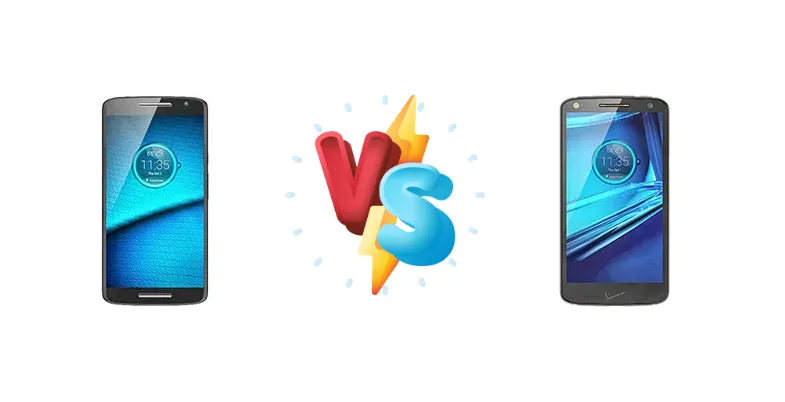
Motorola's Droid line was once synonymous with rugged reliability and long battery life. The Droid Maxx 2 and Droid Turbo 2 both aimed for that title, but with different approaches. Let's dive into a head-to-head comparison to see which phone ultimately delivers the best experience.
🏆 Quick Verdict
The Droid Turbo 2 wins overall thanks to its significantly faster processor, superior build quality (including a shatterproof display), and wireless charging. However, the Maxx 2 offers exceptional battery life, making it a strong contender for users prioritizing endurance above all else.
| Network |
|---|
| 2G bands | GSM 850 / 900 / 1800 / 1900 | GSM 850 / 900 / 1800 / 1900 |
| 3G bands | HSDPA 850 / 900 / 1900 / 2100 | HSDPA 850 / 900 / 1900 / 2100 |
| 4G bands | 2, 3, 4, 5, 7, 13, 20 | 2, 3, 4, 5, 7, 13 |
| EDGE | No | - |
| GPRS | No | - |
| Speed | HSPA, LTE Cat4 150/50 Mbps, EV-DO Rev.A 3.1 Mbps | HSPA, LTE Cat4 150/50 Mbps, EV-DO Rev.A 3.1 Mbps |
| Technology | GSM / CDMA / HSPA / EVDO / LTE | GSM / CDMA / HSPA / EVDO / LTE |
| | CDMA2000 1xEV-DO | CDMA2000 1xEV-DO |
| Launch |
|---|
| Announced | 2015, October. Released 2015, October | 2015, October. Released 2015, October |
| Status | Discontinued | Discontinued |
| Body |
|---|
| Dimensions | 148 x 75 x 10.9 mm (5.83 x 2.95 x 0.43 in) | 149.9 x 78 x 9.2 mm (5.90 x 3.07 x 0.36 in) |
| SIM | Nano-SIM | Nano-SIM |
| Weight | 169 g (5.96 oz) | 170.1 g (6.00 oz) |
| | Splash and dust resistant | - |
| Display |
|---|
| Protection | Corning Gorilla Glass 3 | Shatterproof |
| Resolution | 1080 x 1920 pixels, 16:9 ratio (~403 ppi density) | 1440 x 2560 pixels, 16:9 ratio (~540 ppi density) |
| Size | 5.5 inches, 82.6 cm2 (~74.4% screen-to-body ratio) | 5.4 inches, 81.6 cm2 (~69.8% screen-to-body ratio) |
| Type | IPS LCD | AMOLED |
| Platform |
|---|
| CPU | Octa-core (4x1.7 GHz Cortex-A53 & 4x1.0 GHz Cortex-A53) | Octa-core (4x1.5 GHz Cortex-A53 & 4x2.0 GHz Cortex-A57) |
| Chipset | Qualcomm MSM8939 Snapdragon 615 (28 nm) | Qualcomm MSM8994 Snapdragon 810 (20 nm) |
| GPU | Adreno 405 | Adreno 430 |
| OS | Android 5.1.1 (Lollipop), upgradable to 7.0 (Nougat) | Android 5.1.1 (Lollipop), upgradable to 7.0 (Nougat) |
| Memory |
|---|
| Call records | - | 30 dialed, 30 received, 30 missed calls |
| Card slot | microSDXC (dedicated slot) | microSDXC (dedicated slot) |
| Internal | 16GB 2GB RAM | 32GB 3GB RAM, 64GB 3GB RAM |
| Phonebook | - | 1000 entries |
| | eMMC 4.5 | eMMC 5.0 |
| Main Camera |
|---|
| Features | Dual-LED dual-tone flash, panorama | Dual-LED dual-tone flash, panorama |
| Single | 21 MP, f/2.0, PDAF | 21 MP, f/2.0, PDAF |
| Video | 1080p@30fps | 4K@30fps, 1080p@30fps, HDR |
| Selfie camera |
|---|
| Features | - | LED flash |
| Single | 5 MP, f/2.0 | 5 MP, f/2.0 |
| Sound |
|---|
| 3.5mm jack | Yes | Yes |
| 35mm jack | Yes | Yes |
| Loudspeaker | Yes | Yes |
| Comms |
|---|
| Bluetooth | 4.0, A2DP, LE, aptX | 4.1, A2DP, EDR, LE, aptX |
| Infrared port | - | Yes |
| NFC | Yes | Yes |
| Positioning | GPS | GPS |
| Radio | FM radio | No |
| USB | microUSB 2.0 | microUSB 2.0 |
| WLAN | Wi-Fi 802.11 a/b/g/n, dual-band, hotspot | Wi-Fi 802.11 a/b/g/n/ac, dual-band, hotspot |
| Features |
|---|
| Browser | - | WAP 2.0/xHTML |
| Games | - | Yes |
| Java | - | Yes, MIDP 2.0 |
| Messaging | - | SMS, MMS |
| Sensors | Yes | Accelerometer, gyro, proximity, compass |
| Battery |
|---|
| Charging | 15W wired | 15W wired
Wireless (Qi) |
| Stand-by | Up to 576 h (3G) | Up to 360 h (3G) |
| Talk time | Up to 48 h (3G) | Up to 48 h (3G) |
| Type | Li-Ion 3630 mAh, non-removable | Li-Ion 3760 mAh, non-removable |
| Misc |
|---|
| Colors | Deep Sea Blue, White | Black/Soft-Grip, Black/Pebble Leather, Gray/Ballistic Nylon, Winter White/Soft-Grip |
| Models | XT1565B, XT1565 | XT1585 |
| Price | About 300 EUR | About 330 EUR |
| SAR | 1.14 W/kg (head) 1.38 W/kg (body) | 1.38 W/kg (head) 1.13 W/kg (body) |
| Tests |
|---|
| Audio quality |
Noise -82.7dB / Crosstalk -82.9dB | - |
| Battery life | Endurance rating 56h | - |
| Display |
Contrast ratio: 1256:1 (nominal) / 911:1 (docking station) | - |
| Loudspeaker |
Voice 57dB / Noise 66dB / Ring 77dB | - |
Motorola Droid Maxx 2
- Exceptional battery life
- Affordable price
- Decent display
- Reliable performance for everyday tasks
- Slower processor
- Less premium build quality
- LCD display not as vibrant
- Camera not as good as Turbo 2
Motorola Droid Turbo 2
- Faster processor
- Shatterproof display
- Wireless charging
- Better camera
- Premium build quality
- Higher price
- Battery life not as exceptional as Maxx 2
- Snapdragon 810 could run warm
Display Comparison
Both phones featured 5.5-inch displays, but the Turbo 2’s AMOLED panel offered richer colors and deeper blacks compared to the Maxx 2’s LCD. While the Maxx 2 boasted a high contrast ratio (1256:1), the Turbo 2’s display felt more vibrant and modern. Resolution was similar, around 1080p, providing adequate sharpness for most users.
Camera Comparison
The Droid Turbo 2 generally produced better camera results. While both phones had 13MP rear cameras, the Turbo 2's image processing was superior, resulting in more detailed photos with better dynamic range. Low-light performance was also improved on the Turbo 2. The front-facing cameras were comparable.
Performance
The Snapdragon 810 in the Turbo 2 provided a noticeable performance boost over the Snapdragon 615 in the Maxx 2. Apps launched faster, multitasking was smoother, and demanding games ran with fewer hiccups on the Turbo 2. The Turbo 2's Cortex-A57 cores provided a significant advantage for heavier workloads.
Battery Life
The Maxx 2 truly shined in battery life. Its massive battery consistently delivered exceptional endurance, often exceeding the advertised 56 hours. The Turbo 2, while still offering good battery life, couldn't quite match the Maxx 2's longevity, though wireless charging helped offset this.
Buying Guide
The Motorola Droid Maxx 2 is ideal for users who prioritize battery life above all else and are on a tighter budget. The Motorola Droid Turbo 2 is best suited for power users who demand performance, a premium build, and don't mind paying a bit more.
Frequently Asked Questions
❓ Is the Droid Turbo 2's display really shatterproof?
The Droid Turbo 2 featured a Motorola-developed display coating that significantly reduced the risk of shattering or cracking. While not completely indestructible, it offered exceptional durability.
❓ Which phone is better for gaming?
The Droid Turbo 2 is the clear winner for gaming due to its more powerful Snapdragon 810 processor and superior graphics capabilities.