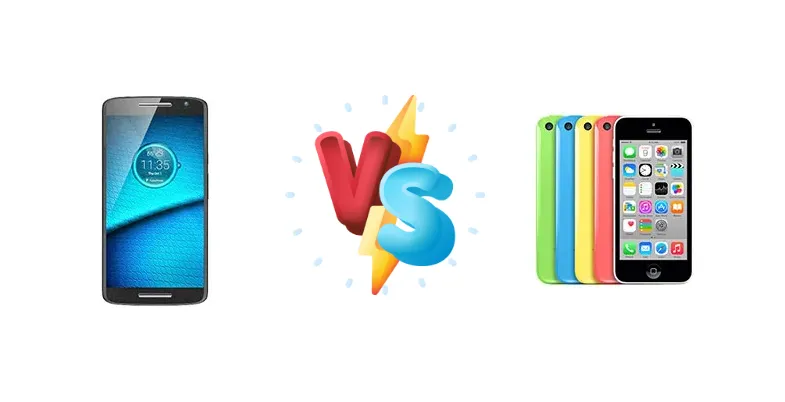
Nostalgia is a powerful force, and sometimes older phones offer surprising value. Today, we're pitting two relics of the past – the Motorola Droid Maxx 2 and the Apple iPhone 5c – against each other. Can these older devices still hold their own in a world of modern smartphones?
🏆 Quick Verdict
The Motorola Droid Maxx 2 takes the crown thanks to its significantly longer battery life and more powerful processor. While the iPhone 5c boasts Apple's ecosystem, the Maxx 2 offers a more robust and enduring experience for budget-conscious users.
| Network |
|---|
| 2G bands | GSM 850 / 900 / 1800 / 1900 | GSM 850 / 900 / 1800 / 1900 - all versions |
| 3G bands | HSDPA 850 / 900 / 1900 / 2100 | HSDPA 850 / 900 / 1700 / 1900 / 2100 - A1532 (GSM), A1532 (CDMA), A1456 |
| 4G bands | 2, 3, 4, 5, 7, 13, 20 | 1, 2, 3, 4, 5, 8, 13, 17, 19, 20, 25 - A1532 GSM, A1532 CDMA |
| EDGE | No | - |
| GPRS | No | - |
| Speed | HSPA, LTE Cat4 150/50 Mbps, EV-DO Rev.A 3.1 Mbps | HSPA 42.2/5.76 Mbps, LTE Cat3 100/50 Mbps, EV-DO Rev.A 3.1 Mbps |
| Technology | GSM / CDMA / HSPA / EVDO / LTE | GSM / CDMA / HSPA / LTE |
| | CDMA2000 1xEV-DO | 1, 2, 3, 5, 7, 8, 20, 38, 39, 40 - A1529 |
| Launch |
|---|
| Announced | 2015, October. Released 2015, October | 2013, September 10. Released 2013, September 20 |
| Status | Discontinued | Discontinued |
| Body |
|---|
| Build | - | Glass front, plastic back, plastic frame |
| Dimensions | 148 x 75 x 10.9 mm (5.83 x 2.95 x 0.43 in) | 124.4 x 59.2 x 9 mm (4.90 x 2.33 x 0.35 in) |
| SIM | Nano-SIM | Nano-SIM |
| Weight | 169 g (5.96 oz) | 132 g (4.66 oz) |
| | Splash and dust resistant | - |
| Display |
|---|
| Protection | Corning Gorilla Glass 3 | - |
| Resolution | 1080 x 1920 pixels, 16:9 ratio (~403 ppi density) | 640 x 1136 pixels, 16:9 ratio (~326 ppi density) |
| Size | 5.5 inches, 82.6 cm2 (~74.4% screen-to-body ratio) | 4.0 inches, 44.1 cm2 (~59.9% screen-to-body ratio) |
| Type | IPS LCD | IPS LCD |
| Platform |
|---|
| CPU | Octa-core (4x1.7 GHz Cortex-A53 & 4x1.0 GHz Cortex-A53) | Dual-core 1.3 GHz Swift (ARM v7-based) |
| Chipset | Qualcomm MSM8939 Snapdragon 615 (28 nm) | Apple A6 (32 nm) |
| GPU | Adreno 405 | PowerVR SGX 543MP3 (triple-core graphics) |
| OS | Android 5.1.1 (Lollipop), upgradable to 7.0 (Nougat) | iOS 7, upgradable to iOS 10.3.3 |
| Memory |
|---|
| Card slot | microSDXC (dedicated slot) | No |
| Internal | 16GB 2GB RAM | 8GB 1GB RAM, 16GB 1GB RAM, 32GB 1GB RAM |
| | eMMC 4.5 | - |
| Main Camera |
|---|
| Features | Dual-LED dual-tone flash, panorama | LED flash, panorama, HDR |
| Single | 21 MP, f/2.0, PDAF | 8 MP, f/2.4, 33mm (standard), 1/3.2", 1.4µm, AF |
| Video | 1080p@30fps | 1080p@30fps |
| Selfie camera |
|---|
| Features | - | face detection, FaceTime over Wi-Fi or Cellular |
| Single | 5 MP, f/2.0 | 1.2 MP |
| Video | - | 720p@30fps |
| Sound |
|---|
| 3.5mm jack | Yes | Yes |
| 35mm jack | Yes | Yes |
| Loudspeaker | Yes | Yes |
| | - | 16-bit/44.1kHz audio
|
| Comms |
|---|
| Bluetooth | 4.0, A2DP, LE, aptX | 4.0, A2DP, LE |
| NFC | Yes | No |
| Positioning | GPS | GPS, GLONASS |
| Radio | FM radio | No |
| USB | microUSB 2.0 | Lightning, USB 2.0 |
| WLAN | Wi-Fi 802.11 a/b/g/n, dual-band, hotspot | Wi-Fi 802.11 a/b/g/n, dual-band |
| Features |
|---|
| Sensors | Yes | Accelerometer, gyro, proximity, compass |
| Battery |
|---|
| Charging | 15W wired | - |
| Stand-by | Up to 576 h (3G) | Up to 250 h (3G) |
| Talk time | Up to 48 h (3G) | Up to 10 h (3G) |
| Type | Li-Ion 3630 mAh, non-removable | Li-Po 1510 mAh, non-removable (5.73 Wh) |
| Misc |
|---|
| Colors | Deep Sea Blue, White | White, Blue, Green, Yellow, Pink |
| Models | XT1565B, XT1565 | A1456, A1507, A1516, A1529, A1532, iPhone5,3, iPhone5,4 |
| Price | About 300 EUR | About 300 EUR |
| SAR | 1.14 W/kg (head) 1.38 W/kg (body) | 1.15 W/kg (head) 1.17 W/kg (body) |
| SAR EU | - | 1.00 W/kg (head) 0.96 W/kg (body) |
| Tests |
|---|
| Audio quality |
Noise -82.7dB / Crosstalk -82.9dB |
Noise -93.9dB / Crosstalk -80.3dB |
| Battery life | Endurance rating 56h |
Endurance rating 52h
|
| Camera | - |
Photo / Video |
| Display |
Contrast ratio: 1256:1 (nominal) / 911:1 (docking station) |
Contrast ratio: 1233:1 (nominal) / 3.512:1 (sunlight) |
| Loudspeaker |
Voice 57dB / Noise 66dB / Ring 77dB |
Voice 66dB / Noise 65dB / Ring 66dB
|
| Performance | - |
Basemark X: 2225 |
Motorola Droid Maxx 2
- Exceptional battery life
- More powerful processor
- Better contrast ratio (docked)
- Generally more affordable
- Older design
- Less polished software experience compared to iOS
- Camera quality is basic
Apple iPhone 5c
- Compact size
- Apple ecosystem integration
- Potentially slightly better image processing
- Classic design
- Significantly weaker performance
- Poor battery life
- Outdated technology
- Limited app support
Display Comparison
Both phones feature displays with a nominal contrast ratio of around 1233:1. However, the Droid Maxx 2 boasts a higher contrast ratio when docked (911:1 vs 3.512:1 in sunlight for the iPhone 5c), suggesting potentially better image quality in certain scenarios. The iPhone 5c's sunlight readability is a notable advantage.
Camera Comparison
Camera specs are listed as 'Photo/Video' for both, indicating basic functionality. Given the age of both devices, image quality will be a significant compromise compared to modern phones. The iPhone 5c likely has slightly better image processing due to Apple's software optimization, but the difference won't be dramatic.
Performance
The Droid Maxx 2's Octa-core Snapdragon 615 processor significantly outperforms the iPhone 5c's Dual-core A6. Expect smoother multitasking, faster app loading, and better overall responsiveness on the Maxx 2. The A6 is showing its age.
Battery Life
This is where the Droid Maxx 2 truly shines. With an endurance rating of 56 hours, it blows the iPhone 5c's 52 hours out of the water. The Maxx 2's larger battery capacity is the key differentiator here.
Buying Guide
The Motorola Droid Maxx 2 is ideal for users prioritizing battery life and performance on a tight budget. The iPhone 5c might appeal to those deeply embedded in the Apple ecosystem or seeking a compact, classic design, but be aware of its limitations.
Frequently Asked Questions
❓ Are these phones still receiving software updates?
Highly unlikely. Both devices are long past their end-of-life and will not receive further software updates. Security vulnerabilities are a significant concern.
❓ Can I use these phones with a modern 4G/5G network?
The Droid Maxx 2 likely supports 4G LTE, but the iPhone 5c's 3G capabilities will severely limit its usability on modern networks. Check carrier compatibility before purchasing.