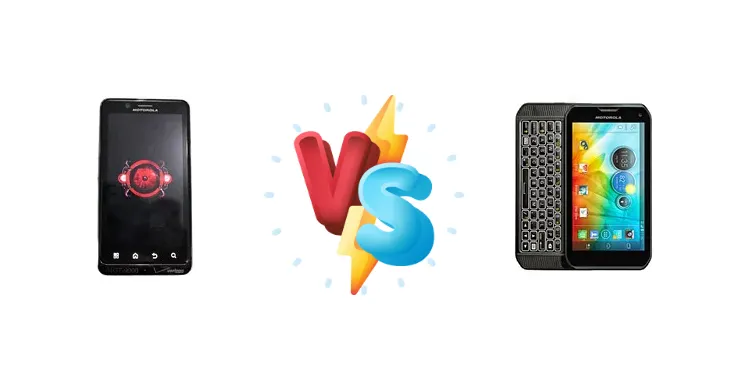
The Motorola Droid Bionic and Photon Q were both contenders in the early Android landscape, offering 4G connectivity and respectable specs. But which one holds up better today? This comparison dives deep into their features, performance, and overall value to help you decide which phone might be right for you (if you're considering a retro revival!).
🏆 Quick Verdict
The Motorola Photon Q 4G LTE edges out the Droid Bionic thanks to its faster 1.5 GHz dual-core processor. While both are dated, the Photon Q's slightly superior speed and potentially better software support (historically) give it a slight advantage. Both are showing their age, however.
| Network |
|---|
| 2G bands | CDMA 800 / 1900 | CDMA 800 / 1900 |
| 3G bands | CDMA2000 1xEV-DO | CDMA2000 1xEV-DO |
| 4G bands | LTE 700 | 25 |
| Speed | EV-DO Rev.A 3.1 Mbps, LTE | HSPA 21.1/5.76 Mbps, LTE, EV-DO Rev.A 3.1 Mbps |
| Technology | CDMA / EVDO / LTE | GSM / CDMA / HSPA / EVDO / LTE |
| | - | HSDPA 850 / 1900 / 2100 |
| Launch |
|---|
| Announced | Not officially announced yet | 2012, July. Released 2012, August |
| Status | Discontinued | Discontinued |
| Body |
|---|
| Dimensions | - | 126.5 x 66 x 13.7 mm (4.98 x 2.60 x 0.54 in) |
| Keyboard | - | QWERTY |
| SIM | Mini-SIM | Non-removable |
| Weight | - | 170.1 g (6.00 oz) |
| Display |
|---|
| Protection | - | Scratch-resistant glass |
| Resolution | 540 x 960 pixels, 16:9 ratio (~245 ppi density) | 540 x 960 pixels, 16:9 ratio (~256 ppi density) |
| Size | 4.5 inches, 55.8 cm2 | 4.3 inches, 51.0 cm2 (~61.1% screen-to-body ratio) |
| Type | IPS LCD | TFT |
| | - | ColorBoost technology |
| Platform |
|---|
| CPU | Dual-core 1.0 GHz | Dual-core 1.5 GHz |
| OS | Android 2.3 (Gingerbread) | Android 4.0.4 (Ice Cream Sandwich) |
| Memory |
|---|
| Card slot | microSDHC (dedicated slot) | microSDHC (dedicated slot) |
| Internal | - | 8GB 1GB RAM |
| Main Camera |
|---|
| Features | Dual-LED flash | LED flash |
| Single | 8 MP, AF | 8 MP, AF |
| Video | Yes | 1080p@30fps |
| Selfie camera |
|---|
| Single | Yes | Yes |
| Sound |
|---|
| 3.5mm jack | Yes | Yes |
| 35mm jack | Yes | Yes |
| Loudspeaker | Yes | Yes |
| Comms |
|---|
| Bluetooth | 2.1, A2DP, EDR | 4.0, A2DP, EDR, LE |
| NFC | - | Yes |
| Positioning | GPS, A-GPS | GPS, A-GPS |
| Radio | - | No |
| USB | microUSB 2.0 | microUSB 2.0 |
| WLAN | Wi-Fi 802.11 b/g/n, DLNA, hotspot | Wi-Fi 802.11 b/g/n, DLNA, hotspot |
| Features |
|---|
| Browser | HTML, Adobe Flash | - |
| Sensors | Accelerometer, proximity, compass | Accelerometer, proximity, compass |
| | HDMI port
MP3/WAV/WMA/AAC+ player
MP4/WMV/H.264 player
Document viewer
Photo viewer/editor
Organizer
Voice memo/dial/commands
Predictive text input (Swype) | HDMI port
MP3/WAV/WMA/AAC+ player
MP4/WMV/H.264 player
Document viewer
Photo viewer/editor
Organizer
Voice memo/dial/commands
Predictive text input (Swype) |
| Battery |
|---|
| Stand-by | - | Up to 220 h (3G) |
| Talk time | - | Up to 7 h 30 min (3G) |
| Type | Removable Li-Po 1750 mAh battery | Non-removable Li-Ion 1785 mAh battery |
| Misc |
|---|
| Colors | Black | Black |
| Models | XT875 | - |
| Price | - | About 220 EUR |
| SAR | - | 0.89 W/kg (head) 0.77 W/kg (body) |
Motorola Droid Bionic Targa
- Verizon Compatibility
- Potentially slightly better camera in good light
- Larger battery (marginally)
- Slower processor
- Outdated software
- Lower overall performance
- Limited app compatibility
Motorola Photon Q 4G LTE XT897
- Faster processor
- Potentially better display
- More responsive performance
- Historically better software support (though both are outdated)
- Smaller battery
- Lower megapixel camera
- Outdated software
- Limited app compatibility
Display Comparison
Both phones feature 4.3-inch displays, but the Photon Q's display is generally considered to have slightly better color accuracy and viewing angles. The Droid Bionic's display is adequate, but not exceptional. Resolution is similar, around 960 x 540 pixels on both.
Camera Comparison
The Droid Bionic boasts an 8MP rear camera, while the Photon Q has a 5MP camera. However, image quality is heavily impacted by the aging sensors and processing. Low-light performance is poor on both. The Droid Bionic *might* produce slightly better images in good lighting conditions due to the higher megapixel count, but the difference is minimal.
Performance
The Photon Q's 1.5 GHz dual-core processor provides a noticeable performance boost over the Droid Bionic's 1.0 GHz dual-core. Expect smoother multitasking and faster app loading times on the Photon Q. Both phones will struggle with modern, demanding apps.
Battery Life
The Droid Bionic typically had a slightly larger battery capacity (1900 mAh vs. 1850 mAh on the Photon Q). However, battery life on both phones is severely impacted by their age and the demands of running older Android versions. Expect a day's use at best with light usage.
Buying Guide
The Droid Bionic might appeal to die-hard Verizon fans seeking a nostalgic experience. The Photon Q, with its slightly better specs, could be a choice for those wanting a bit more performance from a vintage Android device. However, both are best suited for very specific use cases – perhaps as a secondary device or for offline tasks.
Frequently Asked Questions
❓ Are these phones still receiving software updates?
No, both the Droid Bionic and Photon Q are long past their software update cycles. They are running outdated versions of Android and will not receive further updates.
❓ Can I use these phones with a modern 4G LTE network?
While they were designed for 4G LTE, compatibility with modern networks is unlikely. Carrier support has likely been discontinued, and the phones may only connect to older 3G networks (if available).