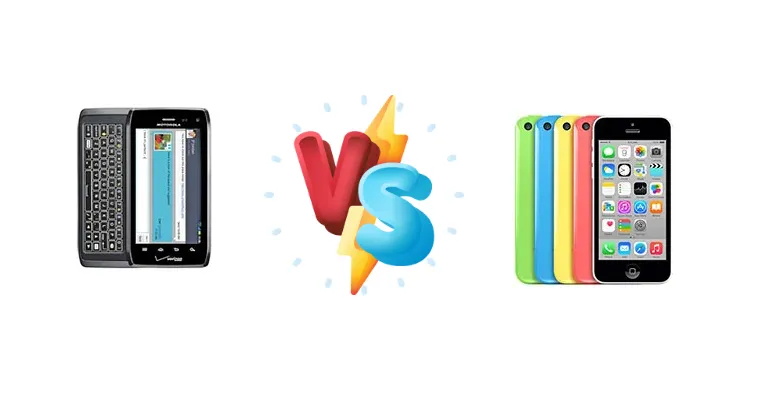
Remember a time before foldable phones and 120Hz displays? The Motorola DROID 4 and Apple iPhone 5c represent that era. Both devices, released in 2012 and 2013 respectively, offer a glimpse into the past of mobile technology. Let's see how these relics stack up against each other.
🏆 Quick Verdict
The iPhone 5c edges out the DROID 4 due to its generally smoother iOS experience, slightly better performance thanks to the A6 chip, and a more polished overall design. However, the DROID 4's physical keyboard and Android OS might appeal to specific users.
| Network |
|---|
| 2G bands | CDMA 800 / 1900 | GSM 850 / 900 / 1800 / 1900 - all versions |
| 3G bands | CDMA2000 1xEV-DO | HSDPA 850 / 900 / 1700 / 1900 / 2100 - A1532 (GSM), A1532 (CDMA), A1456 |
| 4G bands | 13 | 1, 2, 3, 4, 5, 8, 13, 17, 19, 20, 25 - A1532 GSM, A1532 CDMA |
| Speed | EV-DO Rev.A 3.1 Mbps, LTE, HSPA | HSPA 42.2/5.76 Mbps, LTE Cat3 100/50 Mbps, EV-DO Rev.A 3.1 Mbps |
| Technology | GSM / CDMA / HSPA / EVDO / LTE | GSM / CDMA / HSPA / LTE |
| | HSDPA 850 / 900 / 1900 / 2100 | 1, 2, 3, 5, 7, 8, 20, 38, 39, 40 - A1529 |
| Launch |
|---|
| Announced | 2012, January. Released 2012, February | 2013, September 10. Released 2013, September 20 |
| Status | Discontinued | Discontinued |
| Body |
|---|
| Build | - | Glass front, plastic back, plastic frame |
| Dimensions | 127 x 67.3 x 12.7 mm (5.0 x 2.65 x 0.5 in) | 124.4 x 59.2 x 9 mm (4.90 x 2.33 x 0.35 in) |
| Keyboard | QWERTY | - |
| SIM | Micro-SIM | Nano-SIM |
| Weight | 178.9 g (6.28 oz) | 132 g (4.66 oz) |
| Display |
|---|
| Protection | Corning Gorilla Glass | - |
| Resolution | 540 x 960 pixels, 16:9 ratio (~275 ppi density) | 640 x 1136 pixels, 16:9 ratio (~326 ppi density) |
| Size | 4.0 inches, 44.1 cm2 (~51.6% screen-to-body ratio) | 4.0 inches, 44.1 cm2 (~59.9% screen-to-body ratio) |
| Type | TFT | IPS LCD |
| Platform |
|---|
| CPU | Dual-core 1.2 GHz Cortex-A9 | Dual-core 1.3 GHz Swift (ARM v7-based) |
| Chipset | TI OMAP 4430 | Apple A6 (32 nm) |
| GPU | PowerVR SGX540 | PowerVR SGX 543MP3 (triple-core graphics) |
| OS | Android 2.3 (Gingerbread), upgradable to 4.0 (Ice Cream Sandwich) | iOS 7, upgradable to iOS 10.3.3 |
| Memory |
|---|
| Card slot | microSDHC (dedicated slot) | No |
| Internal | 16GB 1GB RAM | 8GB 1GB RAM, 16GB 1GB RAM, 32GB 1GB RAM |
| Main Camera |
|---|
| Features | LED flash | LED flash, panorama, HDR |
| Single | 8 MP, AF | 8 MP, f/2.4, 33mm (standard), 1/3.2", 1.4µm, AF |
| Video | 1080p@30fps | 1080p@30fps |
| Selfie camera |
|---|
| Features | - | face detection, FaceTime over Wi-Fi or Cellular |
| Single | 1.3 MP | 1.2 MP |
| Video | 720p | 720p@30fps |
| Sound |
|---|
| 3.5mm jack | Yes | Yes |
| 35mm jack | Yes | Yes |
| Loudspeaker | Yes | Yes |
| | - | 16-bit/44.1kHz audio
|
| Comms |
|---|
| Bluetooth | 4.0, A2DP, LE, EDR | 4.0, A2DP, LE |
| NFC | - | No |
| Positioning | GPS, A-GPS | GPS, GLONASS |
| Radio | No | No |
| USB | microUSB 2.0, OTG | Lightning, USB 2.0 |
| WLAN | Wi-Fi 802.11 b/g/n, hotspot | Wi-Fi 802.11 a/b/g/n, dual-band |
| Features |
|---|
| Sensors | Accelerometer, proximity, compass | Accelerometer, gyro, proximity, compass |
| | HDMI port
MP3/WAV/WMA/eAAC+ player
MP4/H.264/WMV player
Document viewer
Photo viewer/editor
Organizer
Voice memo/dial
Predictive text input | - |
| Battery |
|---|
| Stand-by | Up to 204 h | Up to 250 h (3G) |
| Talk time | Up to 12 h 30 min | Up to 10 h (3G) |
| Type | Non-removable Li-Ion 1785 mAh battery | Li-Po 1510 mAh, non-removable (5.73 Wh) |
| Misc |
|---|
| Colors | Black | White, Blue, Green, Yellow, Pink |
| Models | - | A1456, A1507, A1516, A1529, A1532, iPhone5,3, iPhone5,4 |
| Price | About 260 EUR | About 300 EUR |
| SAR | 0.70 W/kg (head) 0.58 W/kg (body) | 1.15 W/kg (head) 1.17 W/kg (body) |
| SAR EU | - | 1.00 W/kg (head) 0.96 W/kg (body) |
| Tests |
|---|
| Audio quality | - |
Noise -93.9dB / Crosstalk -80.3dB |
| Battery life | - |
Endurance rating 52h
|
| Camera | - |
Photo / Video |
| Display | - |
Contrast ratio: 1233:1 (nominal) / 3.512:1 (sunlight) |
| Loudspeaker | - |
Voice 66dB / Noise 65dB / Ring 66dB
|
| Performance | - |
Basemark X: 2225 |
Motorola DROID 4 XT894
- Physical keyboard for enhanced typing
- Android OS (customization options)
- Expandable storage via microSD
- Relatively compact size
- Outdated processor and performance
- Lower screen quality
- Less polished software experience
- Limited app support compared to newer devices
Apple iPhone 5c
- Smoother iOS experience
- Better performance (A6 chip)
- More polished design
- Stronger brand recognition
- Generally better camera quality
- Limited storage (no expandable storage)
- Outdated design
- Older iOS version (limited updates)
- Smaller screen compared to modern phones
Display Comparison
Both phones feature 4-inch displays with a resolution of 960 x 640. The iPhone 5c's display is generally considered slightly better due to Apple's color calibration and overall screen technology, though the contrast ratios are similar (1233:1 nominal, 3.512:1 sunlight). The DROID 4's screen can appear a bit washed out in comparison.
Camera Comparison
Both phones have basic camera setups. The iPhone 5c's camera, while limited by today's standards, generally produces slightly better image quality with more accurate colors and better dynamic range. The DROID 4's camera is adequate for basic snapshots but struggles in low-light conditions.
Performance
The iPhone 5c's Apple A6 chip (1.3 GHz dual-core) provides a noticeable performance advantage over the DROID 4's TI OMAP 4430 (1.2 GHz dual-core). iOS is also generally more optimized for the hardware, resulting in a smoother and more responsive user experience. App loading times and multitasking are faster on the iPhone 5c.
Battery Life
Both devices boast an endurance rating of 52 hours, suggesting comparable battery life. However, real-world usage will vary depending on usage patterns. The iPhone 5c's power efficiency is slightly better due to iOS optimization.
Buying Guide
The Motorola DROID 4 is for those who crave a physical keyboard and a taste of older Android. The iPhone 5c is for users wanting a simple, reliable iOS experience and a more recognizable brand, even with its age. Both are budget options for those seeking a basic smartphone.
Frequently Asked Questions
❓ Are these phones still usable in 2024?
Yes, but with limitations. Network compatibility and app support may be issues. Both phones are likely running outdated operating systems, posing security risks. Use with caution and only for basic tasks.
❓ Can I update the software on either of these phones?
The DROID 4 will not receive further Android updates. The iPhone 5c is also past its update cycle and will not receive new iOS versions. You're stuck with the original software.