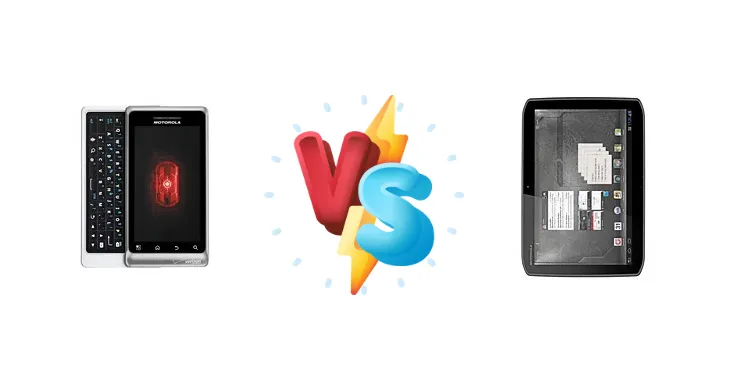
Released roughly a year apart, the Motorola DROID 2 Global and the DROID XYBOARD 10.1 MZ617 represent distinct phases in Motorola’s Android strategy. The DROID 2 Global, a smartphone, aimed for a balance of features and portability, while the XYBOARD 10.1 was a full-fledged tablet designed to compete with the emerging iPad. This comparison dissects the core differences between these devices, focusing on the architectural improvements and their impact on user experience.
🏆 Quick Verdict
For the average user seeking a modern tablet experience, the Motorola DROID XYBOARD 10.1 MZ617 is the clear winner. Its dual-core Cortex-A9 processor provides a substantial performance uplift over the DROID 2 Global’s single-core Cortex-A8, making it better suited for multitasking and demanding applications. However, the DROID 2 Global remains a viable option for those prioritizing smartphone-level portability.
| Network |
|---|
| 2G bands | CDMA 800 / 1900 | GSM 850 / 900 / 1800 / 1900 |
| 3G bands | CDMA2000 1xEV-DO | HSDPA 850 / 900 / 1900 / 2100 |
| 4G bands | - | 13 - Verizon |
| Speed | HSPA 10.2/5.76 Mbps, EV-DO Rev.A 3.1 Mbps | HSPA, LTE, EV-DO Rev.B |
| Technology | GSM / CDMA / HSPA / EVDO | GSM / CDMA / HSPA / EVDO / LTE |
| | HSDPA 850 / 1900 / 2100 | CDMA2000 1xEV-DO |
| Launch |
|---|
| Announced | 2010, November. Released 2010, November | 2011, December. Released 2011, December |
| Status | Discontinued | Discontinued |
| Body |
|---|
| Dimensions | 116.3 x 60.5 x 13.7 mm (4.58 x 2.38 x 0.54 in) | 259.9 x 173.6 x 8.8 mm (10.23 x 6.83 x 0.35 in) |
| Keyboard | QWERTY | - |
| SIM | Mini-SIM | Mini-SIM |
| Weight | 173 g (6.10 oz) | 599 g (1.32 lb) |
| | - | Splash resistant |
| Display |
|---|
| Protection | Corning Gorilla Glass | Corning Gorilla Glass |
| Resolution | 480 x 854 pixels, 16:9 ratio (~265 ppi density) | 800 x 1280 pixels, 16:10 ratio (~149 ppi density) |
| Size | 3.7 inches, 37.7 cm2 (~53.6% screen-to-body ratio) | 10.1 inches, 295.8 cm2 (~65.6% screen-to-body ratio) |
| Type | TFT | HD-IPS LCD |
| Platform |
|---|
| CPU | 1.2 GHz Cortex-A8 | Dual-core 1.2 GHz Cortex-A9 |
| Chipset | TI OMAP 3640 | TI OMAP 4430 |
| GPU | PowerVR SGX530 | PowerVR SGX540 |
| OS | Android 2.2 (Froyo), upgradable to 2.3 (Gingerbread) | Android 3.2 (Honeycomb), upgradable to 4.0 (Ice Cream Sandwich) |
| Memory |
|---|
| Card slot | microSDHC (dedicated slot), 8 GB included | No |
| Internal | 8GB 512MB RAM | 16GB 1GB RAM, 32GB 1GB RAM, 64GB 1GB RAM |
| Main Camera |
|---|
| Features | - | LED flash |
| Single | 5 MP, AF | 5 MP, AF |
| Video | 480p@30fps | 720p@30fps |
| Selfie camera |
|---|
| Single | - | 1.3 MP |
| | No | - |
| Sound |
|---|
| 3.5mm jack | Yes | Yes |
| 35mm jack | Yes | Yes |
| Loudspeaker | Yes | Yes, with stereo speakers |
| | - | 3D virtual surround sound |
| Comms |
|---|
| Bluetooth | 2.1, A2DP | 2.1, A2DP, EDR |
| Infrared port | - | Yes |
| Positioning | GPS, A-GPS | GPS, A-GPS |
| Radio | No | No |
| USB | microUSB 2.0 | microUSB 2.0 |
| WLAN | Wi-Fi 802.11 b/g/n, DLNA, hotspot | Wi-Fi 802.11 a/b/g/n, dual-band, hotspot |
| Features |
|---|
| Browser | HTML, Adobe Flash | - |
| Sensors | Accelerometer, proximity, compass | Accelerometer, gyro, compass, barometer |
| | MP3/WAV/WMA/AAC+ player
MP4/WMV/H.264 player
Document viewer
Photo viewer/editor
Organizer
Voice memo/dial/commands
Predictive text input (Swype) | HDMI port
MP3/WAV/WMA/AAC+ player
MP4/WMV/H.264 player
Document viewer
Photo viewer/editor
Organizer
Voice memo
Predictive text input |
| Battery |
|---|
| Stand-by | Up to 230 h | - |
| Talk time | Up to 8 h 20 min | Up to 10 h |
| Type | Removable Li-Po 1420 mAh battery | Non-removable Li-Ion 7000 mAh battery |
| Misc |
|---|
| Colors | White, Black | Black |
| Price | About 200 EUR | About 260 EUR |
| SAR | 1.58 W/kg (head) 0.89 W/kg (body) | - |
Motorola DROID 2 Global
- Compact and portable smartphone form factor
- Familiar smartphone operating system
- Voice communication capabilities
- Limited processing power compared to the XYBOARD 10.1
- Smaller screen size restricts media consumption
- Less suitable for productivity tasks
Motorola DROID XYBOARD 10.1 MZ617
- Significantly faster dual-core Cortex-A9 processor
- Large 10.1-inch display for immersive viewing
- Better suited for multitasking and demanding applications
- Less portable than the DROID 2 Global
- Larger battery requires longer charging times
- Primarily a tablet, lacking dedicated voice communication features
Display Comparison
The DROID 2 Global, being a smartphone, features a smaller display, likely around 3.7 inches, with a resolution appropriate for its size. The XYBOARD 10.1, however, boasts a 10.1-inch display, offering a vastly superior viewing experience for videos and web browsing. While specific display technologies aren't provided, the larger screen size of the XYBOARD 10.1 inherently allows for greater pixel density and a more immersive visual experience. The DROID 2 Global's display is constrained by its form factor, while the XYBOARD 10.1 benefits from the larger canvas.
Camera Comparison
Given the context data, a detailed camera comparison is limited. Both devices likely featured rear-facing cameras typical of their era, but the XYBOARD 10.1, as a tablet, may have included a higher-resolution front-facing camera for video conferencing. The DROID 2 Global’s camera was likely optimized for quick snapshots, while the XYBOARD’s camera was likely secondary to its core tablet functions. Without specific sensor details, it’s difficult to assess image quality, but the XYBOARD’s larger form factor could potentially accommodate a slightly larger sensor.
Performance
The core difference lies in the chipsets. The DROID 2 Global utilizes the TI OMAP 3640 with a single-core 1.2 GHz Cortex-A8 processor. This architecture, while capable for its time, is significantly less powerful than the XYBOARD 10.1’s TI OMAP 4430, featuring a dual-core 1.2 GHz Cortex-A9 processor. The Cortex-A9 represents a substantial architectural improvement over the A8, offering increased instruction throughput and better performance per clock cycle. This translates to faster app loading times, smoother multitasking, and improved responsiveness on the XYBOARD 10.1. The dual-core configuration further amplifies this advantage, allowing the XYBOARD to handle more demanding tasks concurrently.
Battery Life
Battery capacity is not specified, but the XYBOARD 10.1, with its larger screen and more powerful processor, would have required a significantly larger battery than the DROID 2 Global to achieve comparable battery life. The XYBOARD 10.1 likely supported faster charging technologies available at the time, but the larger battery capacity would still result in longer overall charge times. The DROID 2 Global, benefiting from its smaller screen and less demanding processor, would likely offer shorter charging times but also a smaller overall battery capacity.
Buying Guide
Buy the Motorola DROID 2 Global if you need a compact, smartphone-sized device with basic Android functionality and a focus on voice communication. Buy the Motorola DROID XYBOARD 10.1 MZ617 if you prioritize a larger screen for media consumption, productivity tasks, and a significantly faster processor for a smoother, more responsive user experience. The XYBOARD is for those who want a tablet first, and portability second.
Frequently Asked Questions
❓ Will the DROID XYBOARD 10.1 MZ617 run modern Android apps smoothly?
Given its age and the limitations of the OMAP 4430 processor, the XYBOARD 10.1 will struggle with many modern Android apps. While it can likely handle basic tasks, demanding games and resource-intensive applications may experience significant lag or instability. It's best suited for older Android versions and less demanding apps.
❓ Is the single-core processor in the DROID 2 Global sufficient for basic tasks like email and web browsing?
Yes, the DROID 2 Global’s OMAP 3640 and Cortex-A8 processor are adequate for basic tasks like email, web browsing, and light social media use. However, multitasking and running multiple apps simultaneously will likely result in noticeable slowdowns. It's important to manage expectations and avoid pushing the device too hard.
❓ Can either device be upgraded to a newer version of Android?
Officially, neither device received significant Android updates beyond its initial release version. While custom ROMs may be available from the developer community, installing them carries risks and may void any remaining warranty. Expect limited support for modern Android features and security patches.