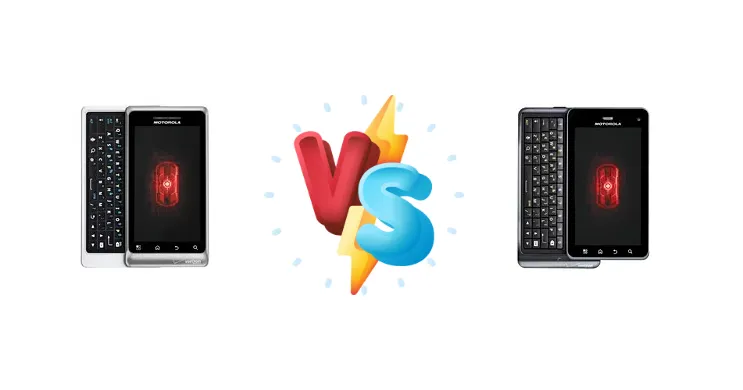
Remember the days of physical keyboards and Android 2.x? The Motorola DROID 2 Global and DROID 3 were iconic devices. But which one holds up better today? We're diving deep into a comparison of these classic smartphones to help you decide which one might be worth a nostalgic revisit.
🏆 Quick Verdict
The DROID 3 wins due to its significantly faster dual-core processor and improved chipset. While both offer a physical keyboard, the DROID 3's performance advantage makes it the better choice for anyone looking for a usable experience beyond basic tasks. The DROID 2 is a charming relic, but noticeably slower.
| Network |
|---|
| 2G bands | CDMA 800 / 1900 | GSM 850 / 900 / 1800 / 1900 |
| 3G bands | CDMA2000 1xEV-DO | HSDPA 850 / 1900 / 2100 |
| Speed | HSPA 10.2/5.76 Mbps, EV-DO Rev.A 3.1 Mbps | EV-DO Rev.A 3.1 Mbps, HSPA |
| Technology | GSM / CDMA / HSPA / EVDO | GSM / CDMA / HSPA / EVDO |
| | HSDPA 850 / 1900 / 2100 | - |
| Launch |
|---|
| Announced | 2010, November. Released 2010, November | 2011, July. Released 2011, July |
| Status | Discontinued | Discontinued |
| Body |
|---|
| Dimensions | 116.3 x 60.5 x 13.7 mm (4.58 x 2.38 x 0.54 in) | 124 x 64 x 13 mm (4.88 x 2.52 x 0.51 in) |
| Keyboard | QWERTY | QWERTY |
| SIM | Mini-SIM | Mini-SIM |
| Weight | 173 g (6.10 oz) | 167 g (5.89 oz) |
| Display |
|---|
| Protection | Corning Gorilla Glass | - |
| Resolution | 480 x 854 pixels, 16:9 ratio (~265 ppi density) | 540 x 960 pixels, 16:9 ratio (~275 ppi density) |
| Size | 3.7 inches, 37.7 cm2 (~53.6% screen-to-body ratio) | 4.0 inches, 44.1 cm2 (~55.6% screen-to-body ratio) |
| Type | TFT | TFT |
| Platform |
|---|
| CPU | 1.2 GHz Cortex-A8 | Dual-core 1GHz Cortex-A9 |
| Chipset | TI OMAP 3640 | TI OMAP 4430 |
| GPU | PowerVR SGX530 | PowerVR SGX540 |
| OS | Android 2.2 (Froyo), upgradable to 2.3 (Gingerbread) | Android 2.3 (Gingerbread), not upgradable to 4.1 (Jelly Bean) |
| Memory |
|---|
| Card slot | microSDHC (dedicated slot), 8 GB included | microSDHC (dedicated slot) |
| Internal | 8GB 512MB RAM | 16GB 512MB RAM |
| Main Camera |
|---|
| Features | - | LED flash |
| Single | 5 MP, AF | 8 MP, AF |
| Video | 480p@30fps | 1080p@30fps |
| Selfie camera |
|---|
| Single | - | VGA |
| | No | - |
| Sound |
|---|
| 3.5mm jack | Yes | Yes |
| 35mm jack | Yes | Yes |
| Loudspeaker | Yes | Yes |
| Comms |
|---|
| Bluetooth | 2.1, A2DP | 2.1, A2DP, EDR |
| Positioning | GPS, A-GPS | GPS, A-GPS |
| Radio | No | No |
| USB | microUSB 2.0 | microUSB 2.0 |
| WLAN | Wi-Fi 802.11 b/g/n, DLNA, hotspot | Wi-Fi 802.11 b/g/n, DLNA, hotspot |
| Features |
|---|
| Browser | HTML, Adobe Flash | - |
| Sensors | Accelerometer, proximity, compass | Accelerometer, proximity, compass |
| | MP3/WAV/WMA/AAC+ player
MP4/WMV/H.264 player
Document viewer
Photo viewer/editor
Organizer
Voice memo/dial/commands
Predictive text input (Swype) | - |
| Battery |
|---|
| Stand-by | Up to 230 h | Up to 300 h |
| Talk time | Up to 8 h 20 min | Up to 9 h 16 min |
| Type | Removable Li-Po 1420 mAh battery | Removable Li-Ion 1540 mAh battery |
| Misc |
|---|
| Colors | White, Black | Black |
| Models | - | XT862, XT860 |
| Price | About 200 EUR | About 200 EUR |
| SAR | 1.58 W/kg (head) 0.89 W/kg (body) | 0.77 W/kg (head) 1.46 W/kg (body) |
Motorola DROID 2 Global
- Physical keyboard
- Compact size
- Relatively durable
- Slow performance
- Outdated software
- Low-resolution display
- Limited app compatibility
Motorola DROID 3
- Physical keyboard
- Faster processor than DROID 2
- Slightly better display
- More responsive user experience
- Outdated software
- Low-resolution display
- Limited app compatibility
- Battery life could be better
Display Comparison
Both phones feature a 3.7-inch display, but the DROID 3's screen is slightly brighter and offers marginally better viewing angles. Resolution is similar (854 x 480), so visual differences are subtle. The DROID 3's display technology is slightly more advanced, though both are showing their age.
Camera Comparison
Both phones feature 5MP cameras. Image quality is comparable, with both struggling in low-light conditions. Don't expect stunning photos from either device; they're adequate for basic snapshots. Video recording capabilities are also limited to 720p on both.
Performance
This is where the DROID 3 truly shines. Its dual-core 1GHz Cortex-A9 processor and OMAP 4430 chipset provide a noticeable performance boost over the DROID 2's single-core 1.2GHz Cortex-A8 and OMAP 3640. Apps load faster, multitasking is smoother, and the overall user experience is more responsive on the DROID 3.
Battery Life
The DROID 3 generally offers slightly better battery life due to its more efficient chipset, though both phones have a similar battery capacity (around 1500mAh). Expect a full day of light use from either device, but heavy usage will require frequent charging.
Buying Guide
The Motorola DROID 2 Global is best suited for collectors or those seeking a very basic, keyboard-centric phone for minimal tasks. The DROID 3 is a slightly better option for those wanting a more responsive experience, though still limited by its age. Neither is recommended for modern app usage.
Frequently Asked Questions
❓ Are these phones still receiving software updates?
No, both the DROID 2 Global and DROID 3 are long past their software update cycles. They are running outdated versions of Android and are not compatible with newer apps.
❓ Can I use these phones as secondary devices?
They could be used as basic secondary devices for calls and texts, but their limited capabilities and outdated software make them less practical than modern smartphones.