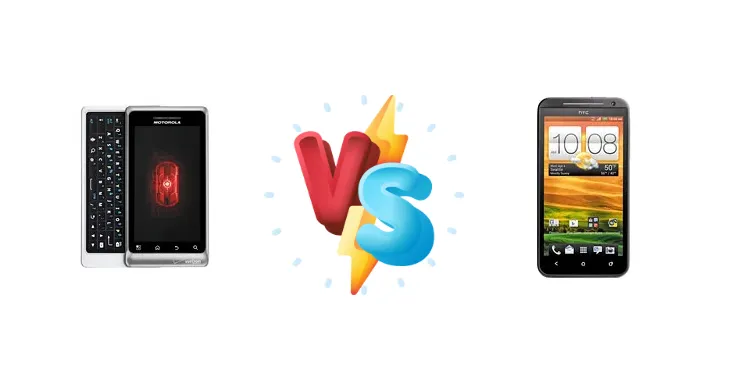
Released in the early days of 4G LTE, both the Motorola DROID 2 Global and the HTC Evo 4G LTE represented attempts to deliver cutting-edge mobile experiences. While both aimed for the enthusiast market, they took drastically different approaches to achieving that goal, primarily centered around their core processing power and chipset choices. This comparison dissects those differences to determine which device holds up better under scrutiny.
🏆 Quick Verdict
For the average user seeking a more responsive and future-proof experience, the HTC Evo 4G LTE is the clear winner. Its Qualcomm Snapdragon S4 Plus chipset, with its dual-core 1.5 GHz Krait architecture, provides a substantial performance advantage over the Motorola DROID 2 Global’s 1.2 GHz Cortex-A8-based OMAP 3640, making it better suited for multitasking and demanding applications.
| Network |
|---|
| 2G bands | CDMA 800 / 1900 | CDMA 800 / 1900 |
| 3G bands | CDMA2000 1xEV-DO | CDMA2000 1xEV-DO |
| 4G bands | - | 25 |
| Speed | HSPA 10.2/5.76 Mbps, EV-DO Rev.A 3.1 Mbps | LTE Cat3 100/50 Mbps, EV-DO Rev.A 3.1 Mbps |
| Technology | GSM / CDMA / HSPA / EVDO | CDMA / EVDO / LTE |
| | HSDPA 850 / 1900 / 2100 | - |
| Launch |
|---|
| Announced | 2010, November. Released 2010, November | 2012, April. Released 2012, May |
| Status | Discontinued | Discontinued |
| Body |
|---|
| Dimensions | 116.3 x 60.5 x 13.7 mm (4.58 x 2.38 x 0.54 in) | 134.8 x 68.9 x 8.9 mm (5.31 x 2.71 x 0.35 in) |
| Keyboard | QWERTY | - |
| SIM | Mini-SIM | Mini-SIM |
| Weight | 173 g (6.10 oz) | 134 g (4.73 oz) |
| | - | Built-in kickstand |
| Display |
|---|
| Protection | Corning Gorilla Glass | Corning Gorilla Glass |
| Resolution | 480 x 854 pixels, 16:9 ratio (~265 ppi density) | 720 x 1280 pixels, 16:9 ratio (~312 ppi density) |
| Size | 3.7 inches, 37.7 cm2 (~53.6% screen-to-body ratio) | 4.7 inches, 60.9 cm2 (~65.6% screen-to-body ratio) |
| Type | TFT | Super IPS LCD2 |
| Platform |
|---|
| CPU | 1.2 GHz Cortex-A8 | Dual-core 1.5 GHz Krait |
| Chipset | TI OMAP 3640 | Qualcomm MSM8960 Snapdragon S4 Plus |
| GPU | PowerVR SGX530 | Adreno 225 |
| OS | Android 2.2 (Froyo), upgradable to 2.3 (Gingerbread) | Android 4.0.3 (Ice Cream Sandwich), Sense UI 4 |
| Memory |
|---|
| Card slot | microSDHC (dedicated slot), 8 GB included | microSDHC (dedicated slot) |
| Internal | 8GB 512MB RAM | 16GB 1GB RAM |
| Main Camera |
|---|
| Features | - | LED flash |
| Single | 5 MP, AF | 8 MP, AF |
| Video | 480p@30fps | 1080p@30fps, stereo sound rec. |
| Selfie camera |
|---|
| Single | - | 1.3 MP |
| Video | - | 720p |
| | No | - |
| Sound |
|---|
| 3.5mm jack | Yes | Yes |
| 35mm jack | Yes | Yes |
| Loudspeaker | Yes | Yes |
| Comms |
|---|
| Bluetooth | 2.1, A2DP | 4.0, A2DP |
| NFC | - | Yes |
| Positioning | GPS, A-GPS | GPS, A-GPS |
| Radio | No | Stereo FM radio, RDS |
| USB | microUSB 2.0 | microUSB 2.0 (MHL TV-out) |
| WLAN | Wi-Fi 802.11 b/g/n, DLNA, hotspot | Wi-Fi 802.11 a/b/g/n, Wi-Fi Direct, DLNA, hotspot |
| Features |
|---|
| Browser | HTML, Adobe Flash | - |
| Sensors | Accelerometer, proximity, compass | Accelerometer, gyro, proximity, compass |
| | MP3/WAV/WMA/AAC+ player
MP4/WMV/H.264 player
Document viewer
Photo viewer/editor
Organizer
Voice memo/dial/commands
Predictive text input (Swype) | MP4/DivX/Xvid/H.264/WMV player
MP3/eAAC+/WMA/WAV player
Document editor
Voice memo/dial/commands
Predictive text input |
| Battery |
|---|
| Stand-by | Up to 230 h | - |
| Talk time | Up to 8 h 20 min | Up to 7 h 30 min |
| Type | Removable Li-Po 1420 mAh battery | Non-removable Li-Ion 2000 mAh battery |
| Misc |
|---|
| Colors | White, Black | Gray, White |
| Price | About 200 EUR | About 180 EUR |
| SAR | 1.58 W/kg (head) 0.89 W/kg (body) | 0.72 W/kg (head) 1.29 W/kg (body) |
Motorola DROID 2 Global
- Potentially more conservative power consumption in basic tasks.
- Familiar Motorola user interface (for existing users).
- May have been more readily available in certain markets.
- Significantly slower processor compared to the Evo 4G LTE.
- Less responsive user interface and slower app loading times.
- Limited multitasking capabilities.
HTC Evo 4G LTE
- Faster dual-core Snapdragon S4 Plus processor.
- More responsive user interface and smoother animations.
- Improved multitasking and gaming performance.
- More efficient 28nm manufacturing process for better battery life.
- Potentially higher price point at launch.
- HTC Sense UI may not appeal to all users.
- May have experienced more software updates issues compared to Motorola.
Display Comparison
Detailed display specifications are unavailable, but both devices likely featured similar 4-inch displays common for the era. However, the impact of the chipset on display responsiveness is notable. The Evo 4G LTE’s more powerful GPU, integrated within the Snapdragon S4 Plus, would have allowed for smoother animations and faster rendering of UI elements, resulting in a more fluid visual experience. The DROID 2 Global, constrained by the OMAP 3640, would likely exhibit more noticeable lag during transitions.
Camera Comparison
Without specific camera sensor details, a direct comparison is difficult. However, the Evo 4G LTE’s more powerful image signal processor (ISP) within the Snapdragon S4 Plus would likely provide superior image processing capabilities. This includes faster autofocus, better noise reduction, and improved dynamic range. While both phones likely featured similar megapixel counts, the Evo 4G LTE’s ISP would have a greater ability to extract detail and produce higher-quality images, especially in challenging lighting conditions. The OMAP 3640’s ISP would be comparatively limited.
Performance
The core difference lies in the chipsets. The Motorola DROID 2 Global’s TI OMAP 3640, based on the Cortex-A8 architecture, is a single-core processor clocked at 1.2 GHz. In contrast, the HTC Evo 4G LTE boasts the Qualcomm MSM8960 Snapdragon S4 Plus, a dual-core 1.5 GHz Krait processor. The Krait architecture, designed by Qualcomm, offered significantly improved Instructions Per Clock (IPC) compared to the Cortex-A8. This translates to faster processing speeds even at a similar clock rate. Furthermore, the Snapdragon S4 Plus benefits from a more advanced 28nm manufacturing process, improving thermal efficiency and allowing for sustained performance under load. The DROID 2 Global’s OMAP 3640, likely built on a larger process node, would be more prone to thermal throttling.
Battery Life
Battery capacity details are missing. However, the Snapdragon S4 Plus’s 28nm process node offers a significant advantage in power efficiency. This means the Evo 4G LTE could potentially achieve longer battery life despite similar or even lower battery capacity compared to the DROID 2 Global. The OMAP 3640, built on a less efficient process, would consume more power for the same tasks, leading to shorter battery runtimes. The Evo 4G LTE’s faster processing also allows for quicker completion of tasks, reducing overall power consumption.
Buying Guide
Buy the Motorola DROID 2 Global if you prioritize a potentially more conservative power profile and are comfortable with a less demanding user experience. Its OMAP 3640 chipset, while older, might offer slightly better efficiency in very basic tasks. Buy the HTC Evo 4G LTE if you value performance, responsiveness, and a smoother experience with modern applications. The Snapdragon S4 Plus delivers a significant leap in processing power, making it the better choice for users who multitask, game, or use resource-intensive apps.
Frequently Asked Questions
❓ Will the DROID 2 Global struggle with modern Android apps, even after custom ROM installation?
Yes, the DROID 2 Global’s OMAP 3640 processor is significantly underpowered for modern Android applications. While a custom ROM might improve performance slightly, the core hardware limitations will still be a major bottleneck, resulting in lag and crashes with many apps.
❓ Does the Snapdragon S4 Plus in the Evo 4G LTE support features like Bluetooth 4.0 or NFC?
Yes, the Qualcomm MSM8960 Snapdragon S4 Plus does support Bluetooth 4.0, offering improved power efficiency and faster data transfer speeds. It also includes NFC capabilities, enabling features like mobile payments and quick pairing with compatible devices.
❓ Is the difference in performance between these two phones noticeable in everyday tasks like browsing and email?
Absolutely. The Evo 4G LTE’s Snapdragon S4 Plus will provide a noticeably smoother and more responsive experience when browsing the web, checking email, and navigating the user interface. The DROID 2 Global’s OMAP 3640 will exhibit more lag and slower loading times.